Best Side-Imaging Fish Finders for Kentucky Lake
Finding fish in a vast body of water like Kentucky Lake can feel like searching for a needle in a haystack, especially when you're looking for subtle structure or scattered schools of baitfish that traditional sonar might miss. This guide is designed to help Tennessee anglers understand the power of side-imaging fish finders and how to leverage this incredible technology to uncover hidden gems and boost your success on large, complex reservoirs like Kentucky Lake.
The Revolutionary Power of Side-Imaging Sonar
For years, anglers relied on traditional 2D sonar, which gave us a cone-shaped view directly beneath the boat. It was a massive leap forward, no doubt, but imagine trying to find a specific brush pile or a rock outcropping in a huge, submerged forest by only looking straight down. It’s tough, right? Then came side-imaging, and suddenly, it was like someone turned on the lights underwater, giving us a panoramic view that changed everything for fishing big waters like Kentucky Lake.
How Side-Imaging Works Its Magic
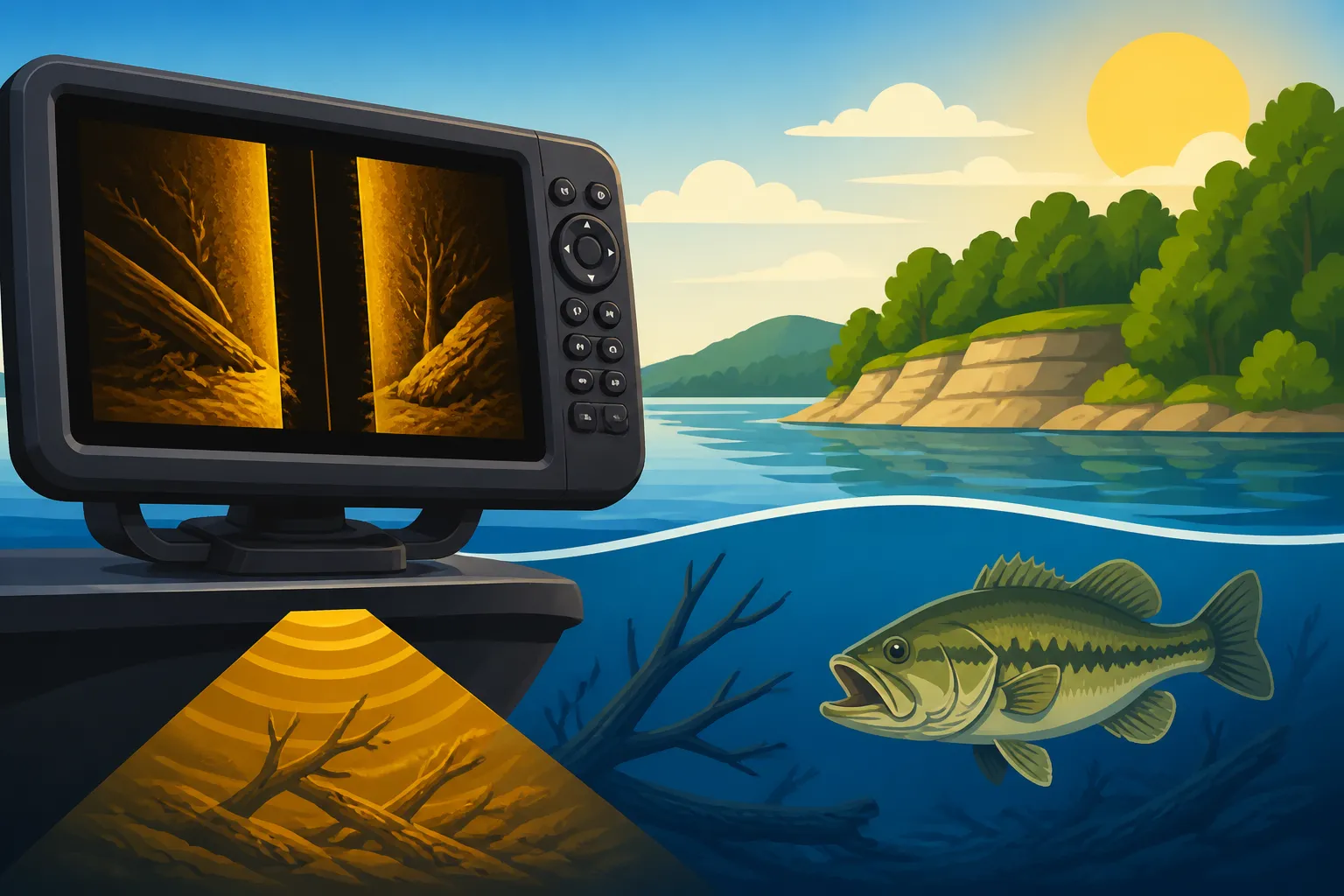
Side-imaging sonar uses high-frequency sound waves, but instead of sending them out in a cone directly below, it projects them in thin, fan-shaped beams to the sides of your boat. These beams sweep out over a wide area, often hundreds of feet on either side, mapping the bottom and any objects present. The sonar unit then processes these returns and displays them as a photographic-like image on your screen. What you get is an incredibly detailed picture of the bottom contour, submerged timber, rock piles, baitfish schools, and even individual fish, all laid out laterally from your boat's path.
Think of it like this: traditional 2D sonar is a flashlight pointing straight down. Down imaging is like a slightly more focused, thinner beam pointing straight down, giving better detail directly below. Side-imaging, however, is like having two powerful spotlights shining out from either side of your boat, illuminating everything for a considerable distance. You can literally see a tree lying on the bottom, the shadow it casts, and often, the fish holding right next to it. This ability to see the "shadow" of an object is incredibly important because it gives you a sense of height and perspective, helping you differentiate between a flat piece of debris and a significant piece of structure that fish might relate to.
Why Side-Imaging is a Game Changer for Big Water
On massive lakes such as Kentucky Lake, with its sprawling flats, countless creek channels, and acres of submerged cover, covering water efficiently is paramount. Side-imaging allows you to do just that. Instead of making pass after pass over a suspected area with traditional sonar, you can cruise at a moderate speed, scanning huge swaths of the lake bottom. This greatly reduces search time and increases your chances of finding productive spots. Imagine trying to locate a small school of crappie tucked into a brush pile on a vast flat. With side-imaging, you can spot that brush pile, and often the fish holding to it, from a safe distance without spooking them. This capability is particularly useful when targeting species that relate heavily to structure, such as bass, crappie, or even catfish. You can learn a lot about Kentucky Lake's Best Catfish Waters in Tennessee and how side-imaging might help you explore them.
This technology helps anglers find hidden creek beds, old roadbeds, submerged rock veins, and timber lines that would be nearly impossible to pinpoint with older sonar units. It also helps you understand the context of what you're seeing. Instead of just a blob on 2D sonar, side-imaging shows you the precise shape and orientation of structure, allowing you to approach it from the most advantageous angle. For anyone wanting to truly unlock the potential of a large reservoir like Kentucky Lake, a good side-imaging unit is not just a luxury; it's a vital tool. You'll quickly discover how it enhances your ability to find Best Bass Fishing Spot on Kentucky Lake or other prime locations.
Key Features to Look for in a Kentucky Lake Side-Imaging Unit
When you're investing in a side-imaging unit, especially for the demanding environment of Kentucky Lake, there are several crucial features you'll want to prioritize. Not all units are created equal, and getting the right combination of capabilities can make a world of difference in your fishing success. You'll find many of these units and accessories at major outdoor retailers like Bass Pro Shops or online platforms like Amazon. For more general advice, consider reading about Best Fish Finders for Tennessee Reservoir Fishing.
Screen Size and Resolution
This might seem obvious, but for side-imaging, a larger screen with high resolution is absolutely non-negotiable. The beauty of side-imaging lies in its detailed, photographic view, and trying to interpret that on a small, low-resolution screen is like looking at a masterpiece through a keyhole. You'll miss the subtle nuances that often make the difference between finding fish and just seeing structure. A 9-inch screen is often considered the minimum for serious side-imaging, with 10 to 12 inches being even better if your budget allows. High-definition resolution ensures that the images are crisp, allowing you to clearly distinguish between a submerged stump and a schooling fish, or even pick out individual fish from a bait ball. On a big lake, where you might be scanning vast areas, having that clarity is invaluable.
Transducer Quality and Frequencies
The transducer is the heart of your fish finder, and for side-imaging, its quality directly impacts the clarity and range of your side-scan images. Look for transducers that offer multiple frequencies. Higher frequencies (like 800 kHz to 1.2 MHz) provide incredibly sharp, detailed images, especially in shallower water or for identifying small objects. However, they don't penetrate as far or as deep. Lower frequencies (like 455 kHz) will give you a wider and deeper scan range, which is excellent for covering expansive areas on Kentucky Lake, but with slightly less detail. The best units will allow you to switch between frequencies or even run them simultaneously, giving you the flexibility to adapt to different depths and conditions. The placement of your transducer is also critical; it needs to be mounted in a location that provides a clear, unobstructed view to the sides.
GPS and Chartplotter Integration
For a lake the size of Kentucky Lake, a standalone fish finder without GPS and chartplotter capabilities would be a huge disservice. Integrated GPS allows you to mark waypoints directly on the screen where you spot interesting structure or fish. This is essential for navigating back to productive areas, creating routes, and understanding your position relative to the underwater features you're seeing. A good chartplotter will come with detailed mapping, often showing contours, navigation aids, and even some marked submerged features. When you combine the real-time, photographic view of side-imaging with precise GPS location and detailed maps, you gain an unparalleled understanding of the underwater landscape. This integration helps immensely in managing your boat and fishing strategy, especially when fishing Kentucky Lake Fishing on the Tennessee Side.
User-Friendliness and Mount Options
While side-imaging technology is advanced, the best units are designed with user-friendliness in mind. Look for intuitive menus, easily accessible controls, and customizability so you can tailor the display and settings to your preferences. You don't want to spend precious fishing time fumbling with complicated settings. Additionally, consider the mounting options. Kentucky Lake can get choppy, so you need a sturdy mount that can withstand vibrations and impact. Ram mounts are a popular choice for their adjustability and strength, ensuring your valuable electronics stay put and visible even in rough conditions. Think about how easy it is to update the software, too; manufacturers frequently release updates that improve performance and add new features.
Top Considerations for Kentucky Lake Anglers
Kentucky Lake presents unique challenges and rewards for anglers. Its immense size, varied depths, and diverse habitat mean that having the right tools, especially a capable side-imaging fish finder, can dramatically improve your success. Understanding how side-imaging specifically helps navigate these conditions is key to unlocking the lake's full potential.
Navigating Shallow Flats and Submerged Timber
Kentucky Lake is famous for its vast shallow flats, often dotted with stumps, laydowns, and old roadbeds—perfect hiding spots for bass and crappie. However, these areas can be tricky to navigate and fish effectively. This is where side-imaging truly shines. You can idle or slowly motor across these flats, scanning hundreds of feet to either side, quickly identifying submerged timber, brush piles, or subtle depth changes that hold fish. Traditional 2D sonar might only show you a blurry return directly beneath your boat, but side-imaging will paint a clear picture of an entire tree lying on its side, the shadows it casts, and even show you fish suspended within or around it.
Imagine approaching a large flat known for its crappie. Instead of randomly drifting, you can use side-imaging to pinpoint specific brush piles or submerged logs, then make a precise cast without ever driving directly over the fish. This stealthy approach is critical for pressured fish. Side-imaging helps you identify the "edges" of cover, which are often prime ambush points for predatory fish. It's not just about finding the cover, but understanding its relationship to the surrounding bottom, currents, and other features. This knowledge is crucial for productive fishing on Watts Bar Lake Bass and Catfish Species as well.
Finding Schools of Baitfish and Predatory Species
Another significant advantage of side-imaging on a lake like Kentucky Lake is its ability to locate and identify schools of baitfish, which are often the key to finding game fish. Baitfish often congregate in specific areas, such as creek channels, points, or over submerged humps. Side-imaging can display these schools as large, dense clouds or individual specks, sometimes so clearly that you can tell the size of the bait. And where there's bait, there are usually predators.
When you see a large school of shad on your side-imaging screen, you can then scrutinize the area for larger returns – the tell-tale signs of bass, crappie, or striped bass actively feeding or staging nearby. You can follow these baitfish schools, understanding their movement patterns and anticipating where game fish might intercept them. This is particularly effective for open-water species like striped bass, where finding the bait is often half the battle. If you're chasing these powerful fish, understanding your gear is key, check out Best Boats for Kentucky Lake Striped Bass in Tennessee to get an idea of other essential equipment.
| Side-Imaging Advantage | Traditional Sonar | Side-Imaging Sonar |
|---|---|---|
| Area Coverage | Narrow cone directly below | Wide, panoramic view to sides |
| Object Identification | Limited detail, often blurred | Clear, photographic-like images of structure |
| Shadow Detail | None | Shows shadows, indicating height and shape |
| Finding Fish | Primarily directly below | Scans wide area, identifies fish near structure |
| Efficiency on Large Lakes | Requires many passes, slower | Covers vast areas quickly, reduces search time |
| Structure Mapping | Difficult to visualize overall structure | Creates detailed map of submerged features |
Recommended Brands for Side-Imaging Units
While I can't endorse specific models or give you current pricing, there are several reputable brands known for their side-imaging technology that you'll commonly find at retailers like Bass Pro Shops and on online platforms like Amazon. These brands have invested heavily in sonar development and offer excellent options for anglers on Kentucky Lake.
- Humminbird: Often credited with pioneering side-imaging technology (branded as Side Imaging®), Humminbird units are renowned for their incredibly clear and detailed images. Their MEGA Side Imaging offers some of the highest frequencies available, providing exceptional clarity. Many Kentucky Lake anglers swear by Humminbird for mapping structure and finding fish.
- Lowrance: Lowrance offers excellent side-imaging (branded as StructureScan®) capabilities, often praised for their user-friendly interfaces and robust mapping features. Their units provide strong performance for both shallow and deeper water applications, making them a versatile choice for a diverse lake like Kentucky.
- Garmin: Garmin has quickly become a major player in the marine electronics market, with their own impressive side-imaging technology (branded as SideVü™). Garmin units are often lauded for their quick-refreshing GPS maps and seamless integration of various sonar technologies, providing a comprehensive view of the underwater world.
When considering any of these brands, pay attention to the specific generation of their side-imaging technology, as performance has continually improved with each iteration. Reading user reviews and watching demonstration videos can also provide valuable insights into real-world performance on different types of water.
Getting the Most Out of Your Side-Imaging on Kentucky Lake
Having a powerful side-imaging unit is one thing; knowing how to use it effectively on a body of water like Kentucky Lake is another. There's a learning curve, but with a bit of practice and understanding, you can quickly become proficient at interpreting what your screen is telling you.
Optimal Boat Speed and Settings
The ideal boat speed for side-imaging can vary depending on the unit, water depth, and what you're trying to find. Generally, a slow, controlled speed of 3-5 mph (or even slower in very shallow water) will give you the most detailed and clear images. Going too fast will compress the images, making them harder to interpret, and you might miss subtle details. Some units have a "scroll speed" setting that you can adjust to match your boat speed, ensuring a more natural-looking display.
Experiment with your sensitivity and contrast settings. Higher sensitivity can pick up more detail, but it can also introduce clutter. Conversely, too low a sensitivity might cause you to miss faint returns from scattered fish or subtle structure. The key is to find a balance that gives you a clear, detailed picture without excessive noise. Many units also have color palettes; try different ones to see which provides the best visual contrast for your eyes and the current conditions. If you're fishing after a cold front, for instance, fish might be tighter to cover, requiring fine-tuned settings to pick them out. Consider adjusting your technique after reading How to Adjust Your Technique After a Cold Front.
Learning to Interpret the Screen
Interpreting side-imaging displays is a skill that improves with practice. The key is to understand shadows. Every object on the bottom, whether it's a rock, a stump, or a brush pile, will cast a "shadow" away from the transducer. The longer the shadow, the taller the object. A fish suspended off the bottom will show up as a bright return with a distinct shadow, indicating its height in the water column.
Start by identifying known structures, like a boat ramp or a prominent point, and observe how they appear on your screen. Look for consistent patterns:
- Hard bottom: Appears brighter and wider.
- Soft bottom: Appears darker and narrower.
- Trees/Brush Piles: Show distinct branches and cast long, irregular shadows.
- Rock Piles: Appear as distinct bumps with varying shadow lengths.
- Fish: Can appear as bright dots or streaks, often with a shadow indicating their position relative to the bottom.
Pay attention to both sides of your screen. Some anglers prefer to keep the boat running parallel to a contour or shoreline, effectively mapping one side of the boat clearly. Others prefer to zig-zag slightly to get overlapping images and a more comprehensive view. Remember, the information displayed is relative to your boat's position, so always keep an eye on your GPS to understand exactly where that promising structure or school of fish is located. For help understanding the larger lake system, refer to Tennessee River Fishing Access Points.
Combining Side-Imaging with Other Technologies
While side-imaging is powerful, it's even more effective when used in conjunction with other sonar technologies. Most modern fish finders are multi-functional, offering 2D sonar and down-imaging alongside side-imaging.
- 2D Sonar: Still valuable for showing what's directly beneath your boat in real-time. Use it to confirm fish activity under the boat once side-imaging has led you to an area. It's excellent for understanding fish depth directly below.
- Down-Imaging: Provides a more detailed, photo-like view directly beneath the boat, often superior to 2D for discerning structure details immediately below. Use it for a closer look at a structure you've identified with side-imaging.
- Mapping/Chartplotter: As mentioned earlier, integrate your side-imaging discoveries with your GPS maps. Mark waypoints for every significant piece of structure or fish concentration. Over time, you'll build a personalized map of productive spots on Kentucky Lake.
- Live Sonar (e.g., Garmin LiveScope, Humminbird Mega Live, Lowrance ActiveTarget): These forward- and down-looking technologies are the next evolution, allowing you to see fish and structure in real-time around your boat. While side-imaging helps you find the spots efficiently, live sonar helps you fish them effectively, showing you how fish react to your bait.
By combining these tools, you create a comprehensive picture of the underwater world, allowing you to not only find fish more efficiently but also to understand their behavior and how they relate to the vast and diverse structure of Kentucky Lake. It’s an exciting time to be an angler, with so many technological advancements at our fingertips. Remember, the goal is always to maximize your time on the water, and these tools are designed to do just that, whether you're a seasoned pro or just getting started with Boat Fishing Tips for Beginners.
Disclaimer
This article is for general informational purposes only and does not constitute professional advice. Laws, prices and regulations vary by location and change over time. Consult a qualified professional for guidance on your specific situation.