Best Kayak Anchors for River Fishing
If you've ever tried to fish from a kayak in a river, you know the struggle: one minute you're in the perfect spot, the next the current has swept you downstream, far from where the fish are biting. It's frustrating to constantly paddle against the flow or feel out of control. This guide is all about helping you conquer those river currents by choosing, using, and managing the best kayak anchors for river fishing, ensuring you can hold your position and enjoy your time on the water.
Why a Kayak Anchor is Essential for River Fishing in Tennessee
River fishing from a kayak offers an incredible sense of intimacy with nature, letting you access hidden pockets that bigger boats can't reach. But it also comes with a unique set of challenges, primarily the ever-present current. Having the right anchor isn't just a convenience; it's a game-changer for safety, control, and ultimately, your fishing success.
Battling Currents and Staying Put
Imagine this: you've been working your way upstream on the Clinch River, paddling hard, and you finally spot that perfect eddy where you know the smallmouth bass are hiding. You cast, get a bite, but before you can even set the hook properly, the current tugs you out of position. Sound familiar? Without an anchor, you're constantly fighting the river, expending energy that could be spent fishing. A well-chosen kayak anchor allows you to "stop and shop," planting yourself exactly where you want to be, even in a decent flow. This stability means you can focus on your presentation, feel subtle bites, and manage your line without being distracted by your drifting kayak. It turns a chaotic drift into a precise attack on your target species, whether it's trout in a cold-water stream or bass in a larger river.
Enhancing Safety and Control
Beyond just fishing effectiveness, anchors play a huge role in safety, especially on rivers where conditions can change quickly. Picture a scenario where you hook into a really strong fish that pulls your kayak towards an unexpected submerged obstacle or into a fast, rocky section of the Cumberland River. With a reliable anchor and a proper quick-release system, you have the ability to either hold your ground or, more importantly, immediately disengage and regain control if danger arises. This is crucial for avoiding snags, collisions, or being pulled into rapids or dangerous hydraulic features. An anchor also provides a much-needed sense of stability when you need to reach for gear, tend to a fish, or simply stretch your legs. Without one, even a momentary lapse in paddling can send you downstream faster than you'd like, potentially into unfamiliar or hazardous territory.
Improving Your Fishing Success
Let's be honest, we're all out there to catch fish, and a good anchor directly contributes to that goal. Think about delicate fly fishing for trout in the Caney Fork River or precision casting for crappie around submerged timber in a slow-moving backwater. These techniques demand a stable platform. An anchor allows you to thoroughly work a piece of structure, make repeated casts to the same productive spot, or even sit patiently waiting for a bite without constantly correcting your position. It also enables you to use heavier tackle or specific baits that might require you to be stationary. Without the right anchor, you might find yourself rushing through prime water, missing opportunities because you're constantly battling the current rather than the fish. The ability to anchor and dissect a stretch of river is a fundamental shift from simply drifting through it, often leading to significantly more successful and enjoyable fishing trips. If you're looking to elevate your game, this piece of gear is absolutely non-negotiable. For other helpful items, check out our Kayak Fishing Gear Checklist for Tennessee Rivers.
Types of Kayak Anchors for River Environments
When it comes to anchoring a kayak in a river, not all anchors are created equal. The ideal choice often depends on the type of river you're fishing, the bottom composition, and the strength of the current. Understanding the different types available will help you make an informed decision for your Tennessee river adventures.
Grapple Anchors: The Versatile Choice
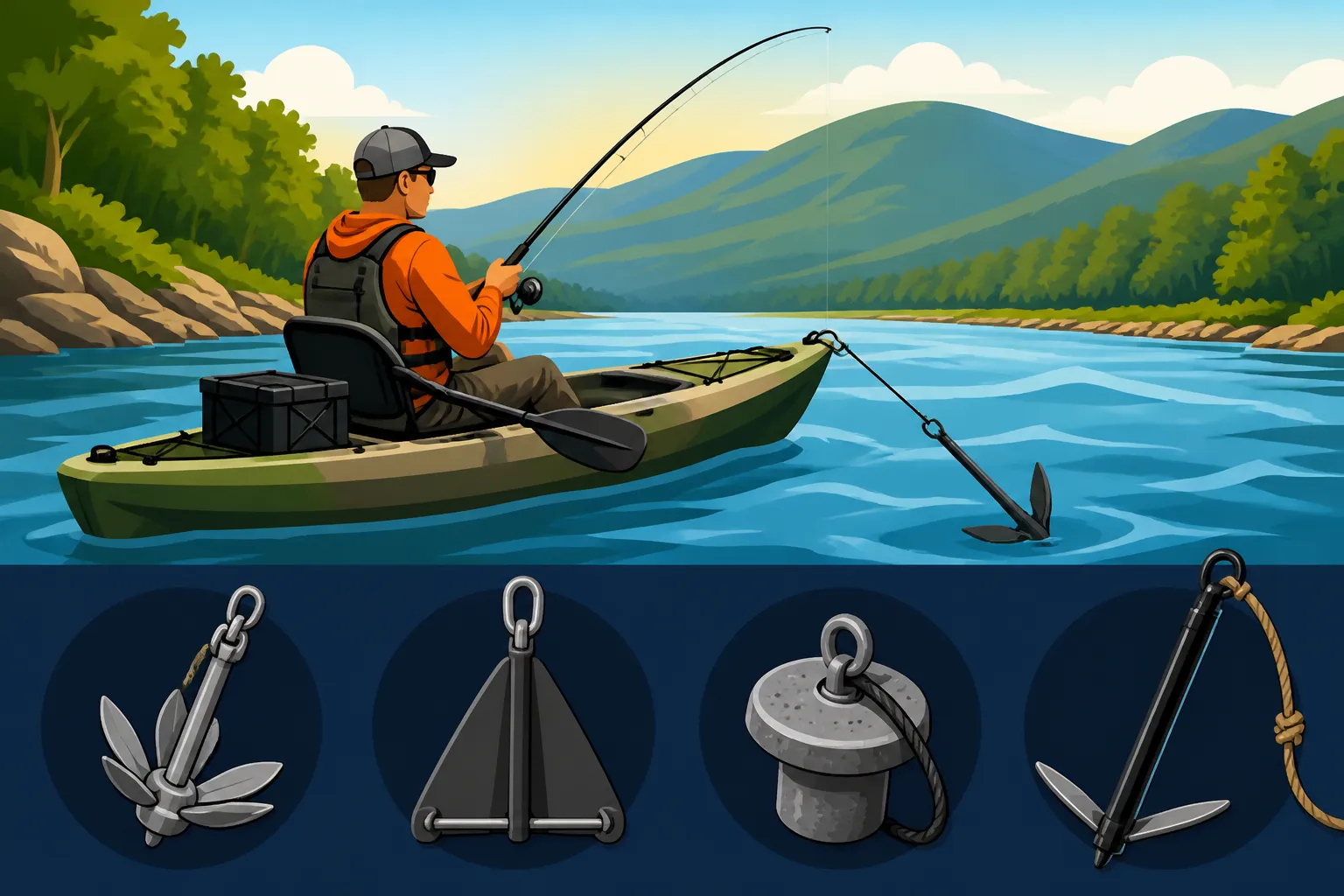
Grapple anchors, sometimes called folding anchors or claw anchors, are probably the most common type you'll see on kayaks, and for good reason. They typically feature four "flukes" or arms that fold out, allowing them to grab onto various bottom structures like rocks, logs, or even thick vegetation. Their design makes them incredibly versatile for many river conditions. When fishing a river with a mixed bottom – say, sandy stretches alternating with rocky areas and submerged wood – a grapple anchor often performs admirably. They're usually compact when folded, making them easy to store in a kayak hatch or bungee to the deck.
The key to their effectiveness lies in those flukes digging in. If you're on a fast-moving section of the Tennessee River with a rocky bottom, a 1.5 to 3-pound grapple anchor can provide enough bite to hold a smaller kayak. However, their very design that allows them to snag structure also means they can, well, snag permanently. Losing an anchor to a submerged log or rock crevice is a rite of passage for many river anglers. To mitigate this, many experienced kayakers rig their grapple anchors with a zip-tie or a weaker cord at the bottom, so if it gets truly stuck, a hard tug will break the weak link, allowing the anchor to be pulled out from the opposite end, flukes first. You can find a good selection of these at retailers like Bass Pro Shops.
Drag Chains/Stake-Out Poles: For Shallower Waters
When you're exploring the shallower, slower stretches of a river, or even wading, drag chains and stake-out poles offer fantastic, snag-resistant alternatives to traditional anchors.
A drag chain is essentially just a length of heavy chain, often 3-6 feet long, weighing a few pounds. It works by dragging along the bottom, creating friction and resistance. Since it has no flukes or sharp edges, it's far less likely to snag on rocks or logs, making it perfect for muddy, silty, or even lightly vegetated bottoms. You simply toss it over and let it do its work. While it won't hold you perfectly stationary in a strong current, it's excellent for slowing your drift significantly, allowing you to thoroughly fish a particular seam or bank. For quieter, smaller rivers, or if you prefer a subtle approach that doesn't disturb the fish, a drag chain is a fantastic, minimalist option.
Stake-out poles are exactly what they sound like: long, rigid poles, typically 6-10 feet, made of fiberglass, aluminum, or carbon fiber, with a pointed end. These are primarily for very shallow water, where you can simply plunge the pole into a soft bottom, like mud or sand, to secure your kayak. They are incredibly silent, offer instant deployment and retrieval, and keep your boat completely stationary. Many anglers who fish tidal rivers or shallow backwaters swear by them. They're perfect for stalking redfish or targeting panfish in extremely skinny water, where even a slight disturbance from a dropped anchor could spook your quarry. However, their utility is limited to depths where you can actually plant the pole securely, usually no more than 6-7 feet. Both drag chains and stake-out poles offer a lighter, less intrusive way to manage your position in the right conditions.
Folding Anchors and Box Anchors: Portable Power
While grapple anchors are often called "folding anchors," there are other designs that also fold for portability, offering different holding characteristics. The term "folding anchor" generally refers to the multi-fluke design, but let's briefly touch on another heavy-duty option that sometimes folds: the box anchor.
Box anchors are less common for kayaks due to their size and weight, but they are a powerhouse for larger kayaks or situations with extremely strong currents and varied bottoms. They are typically square or rectangular, with sides that dig into the substrate. What makes them unique is their ability to set quickly and hold a boat with immense force due to their design creating a "digging" action as the boat pulls on the anchor line. Some smaller versions exist that fold flat for storage, but they still tend to be much heavier than grapple anchors, often in the 5-10 pound range. If you're consistently battling swift flows on a major Tennessee river system like the Tennessee River itself and need maximum holding power for a larger, heavily loaded fishing kayak, a dedicated box anchor might be worth the extra bulk, assuming you have the space to store it. They are less prone to snagging than grapple anchors in some circumstances, as their design allows them to pull free more easily by changing the angle of retrieval.
Drift Socks: Not Exactly an Anchor, but a Control Tool
While not technically an anchor that holds you in place, a drift sock (sometimes called a drift anchor or sea anchor) is an indispensable tool for river kayakers who want to control their drift rather than stop it entirely. A drift sock is a large, parachute-like cone made of durable fabric. When deployed, it fills with water and creates significant drag, slowing your kayak's movement through the water. This is incredibly useful when you want to cover a long stretch of river slowly and meticulously, presenting your lure or bait naturally with the current.
For instance, if you're targeting striped bass on Norris Lake near a river channel where the current is just a bit too fast for a perfect drift, deploying a drift sock can reduce your speed to an ideal crawl. It allows you to maintain boat control while still covering water, especially effective for covering broad flats or long runs where you don't necessarily want to stay in one exact spot. Many anglers combine a drift sock with a light grapple anchor or drag chain: use the drift sock to slow the overall pace, then deploy the small anchor for quick, temporary stops to work a specific feature. It’s an excellent tool for maximizing your time fishing, rather than just paddling or being swept away.
Here’s a quick comparison of popular kayak anchor types for river fishing:
| Anchor Type | Best For | Pros | Cons | Ideal River Condition |
|---|---|---|---|---|
| Grapple Anchor | General river fishing, varied bottoms | Folds for storage, good grip on rocks/wood | Can get snagged easily | Moderate current, rocky/sandy bottoms |
| Drag Chain | Slow currents, shallow areas | Won't snag hard, easy to retrieve | Less holding power in strong current | Slow moving, muddy/sandy bottom |
| Stake-Out Pole | Very shallow water, soft bottoms | Silent, no rope to manage, very direct | Limited to very shallow water | Calm, very shallow, soft bottom |
| Box Anchor | Strong currents, larger kayaks | Excellent holding power, quick set/release | Bulky, heavier, more expensive | Strong current, varied bottoms |
| Drift Sock | Controlling drift speed | Slows kayak, natural presentation | Doesn't stop kayak, requires retrieval | Moderate to fast current, open water |
Key Considerations When Choosing a River Kayak Anchor
Selecting the perfect kayak anchor isn't just about picking one off the shelf. It involves thinking about the conditions you'll face, how you'll manage it on your kayak, and how durable it needs to be to withstand the rigors of river fishing. Getting these details right can make all the difference between a frustrating day and a fantastic one.
Anchor Weight and Holding Power
The weight of your anchor is a critical factor, directly impacting its holding power. For most single-person fishing kayaks in moderate river currents, an anchor in the 1.5 to 3-pound range is a good starting point. However, this isn't a one-size-fits-all rule. If you're fishing a wider, faster-flowing river, like certain sections of the Tennessee River, or if you have a larger, heavier kayak (especially loaded with gear), you might need to bump up to a 5-pound anchor to reliably hold your position. Conversely, if you're primarily fishing very small, slow-moving streams or relying on a drag chain to simply slow your drift, less weight might be perfectly adequate.
It's a delicate balance: too light, and you'll drag constantly; too heavy, and it becomes a cumbersome chore to deploy and retrieve, not to mention the added bulk. Consider the specific rivers you frequent most often. If you typically fish smaller, calmer waters, a lighter grapple anchor will suffice. If you're venturing into the stronger currents of larger reservoirs or river sections, don't be afraid to go a bit heavier. It's often better to have a slightly heavier anchor that holds than a lighter one that slips, forcing you to re-anchor repeatedly.
Rope Management and Quick Release Systems
An anchor is only as good as the system that connects it to your kayak, and proper rope management is paramount for both effectiveness and safety. You'll need high-quality anchor rope, typically braided nylon, which is strong and resists abrasion. A good rule of thumb for anchor rope length is at least 3-5 times the maximum depth you plan to anchor in, allowing for scope (the angle of the rope to the bottom) for better holding. For river fishing, where depths can vary and currents are present, having 50 to 75 feet of rope is usually a safe bet.
Beyond the rope, a proper anchor trolley system is almost non-negotiable for river kayakers. This system consists of a ring that runs along a line installed on each side of your kayak, allowing you to position your anchor point anywhere from the bow to the stern. This means you can anchor from the bow to face upstream into the current, or from the stern to face downstream, or even from the side, depending on your fishing situation. Being able to shift your anchor point helps manage your boat's angle to the current and wind, preventing unwanted swinging or "weather vaning." Crucially, a quick-release system for your anchor rope is a life-saving feature. This is often a simple cleat or cam device that allows you to instantly detach your anchor rope from your kayak if you get snagged, are pulled into danger, or need to make an emergency escape. Imagine getting a grapple anchor stuck in a fierce current and being unable to release it; it's a recipe for disaster. Always practice your quick release before you hit the water. Amazon offers many options for anchor trolleys and cleats.
Durability and River-Specific Features
River environments are tough on gear. Unlike calm lake fishing, river bottoms are often rocky, abrasive, and full of hidden snags like submerged trees and concrete debris. Your anchor and its associated hardware need to be built to last. Look for anchors made of galvanized steel or stainless steel for corrosion resistance. The rope should be abrasion-resistant, and any pulleys, carabiners, or cleats in your anchor trolley system should be marine-grade.
Some river-specific features to consider include a "breakaway" or "retrieve-friendly" design for grapple anchors, as mentioned earlier. This modification involves attaching the anchor line to the bottom of the anchor rather than the top, with a weak link (like a zip tie) connecting the top of the anchor to the main line. If the anchor gets truly stuck, a sharp tug will break the weak link, allowing you to pull the anchor out backward, freeing the flukes. This greatly reduces anchor loss. Additionally, consider how easily your anchor can be cleaned of mud and debris, as river bottoms can be messy. For anglers targeting trout, sometimes you want a very subtle anchor that doesn't churn up the bottom and spook fish. For bass anglers, getting into thick cover might require a more aggressive, heavy-duty grapple. Durability here isn't a luxury; it's a necessity for continued use season after season on Tennessee's diverse waterways.
Setting Up and Using Your Kayak Anchor Safely
Having the right anchor is only half the battle; knowing how to set it up and use it safely and effectively is just as important. River fishing presents unique challenges, and a well-thought-out anchoring strategy can make your day far more productive and worry-free.
Anchor Trolley Systems: Your Best Friend on the River
If you're serious about river fishing from your kayak, an anchor trolley system isn't just a convenience – it's practically essential. This ingenious setup allows you to control the exact point from which your anchor line deploys on your kayak, shifting it from bow to stern, or anywhere in between. Why is this so crucial on a river?
Imagine you're trying to fish a specific eddy. If your anchor is fixed to the front of your boat, the current might swing your stern downstream, putting you in an awkward position to cast. With an anchor trolley, you can run your anchor line to the bow to face upstream into the current, stabilizing your kayak and allowing you to cast effectively into the eddy. Or, if you want to drift backward while precisely working a bank, you can shift the anchor point to the stern. This flexibility prevents your kayak from becoming a "weather vane" in the current and wind, constantly spinning and making accurate casting impossible. Installation involves mounting a small line with rings along the gunwales of your kayak, connecting your anchor line to one of the rings. It might seem like a small detail, but the control and versatility it offers for managing your position in a river's flow are immense. You can pick up a quality anchor trolley kit at Bass Pro Shops or explore options online on Amazon. Remember, pairing this with a reliable Life Jacket Rules for Kayaks and Canoes in Tennessee is always the best practice.
Deploying and Retrieving Your Anchor Effectively
Proper deployment and retrieval techniques are key to successful and safe anchoring. When you find your desired spot, it's generally best to drift slightly past it, then gently deploy your anchor upstream from your target. This allows the anchor to set properly as your kayak drifts back over the spot, and the rope to gain the necessary scope. Don't just chuck your anchor out; lower it smoothly to avoid spooking fish and tangling the line. Once the anchor touches the bottom, let out enough scope (typically 3-5 times the depth, plus extra for current) to ensure a good hold. You'll feel the anchor "bite" and your kayak slow and stabilize.
Retrieving your anchor on a river can be tricky. If your anchor is firmly stuck, pulling straight up might not work and could lead to anchor loss. Instead, try to retrieve it directly from above the anchor, or if you have a breakaway system, give a sharp tug to break the weak link. If using an anchor trolley, you can often paddle forward a bit to change the angle of pull, which can help free a snagged anchor. Always make sure your anchor line is coiled neatly before stowing to prevent tangles on your next deployment. Nothing ruins a fishing rhythm faster than a bird's nest of anchor rope. Remember to always bring all your gear in safely, as detailed in our Best Kayak Crates and Storage for Fishing Trips guide.
Safety Precautions and Emergency Releases
Safety always comes first, especially when dealing with moving water. Rivers, with their currents, submerged obstacles, and potential for sudden changes, demand vigilance. The most crucial safety feature for any river kayak anchor system is a quick-release mechanism. This is typically a cleat or specialized cam device that allows you to instantly detach your anchor rope from your kayak with a single, swift motion.
Why is this so important? Imagine your anchor gets snagged on a submerged log in a fast current, and your kayak starts to pin against the obstacle, or you're being pulled towards rapids. Without a quick release, you could be in a dangerous situation, potentially capsizing or being pulled under. With a quick release, you can immediately free your kayak and paddle to safety. Always rig your quick release within easy arm's reach. Practice using it regularly so it becomes second nature in an emergency. It’s also wise to attach a float to the end of your anchor rope after the quick release, so if you have to ditch your anchor, you can retrieve it later. Never tie your anchor rope directly to a fixed point on your kayak without a quick-release. This could turn your anchor into a dangerous tether in an emergency. For tips on navigating rivers, reading the water can be helpful, as explored in How to Read Water When Trout Fishing. Additionally, having a Kayak Fishing Gear Checklist for Tennessee Rivers ensures you don't forget any other crucial safety items.
Disclaimer
This article is for general informational purposes only and does not constitute professional advice. Laws, prices and regulations vary by location and change over time. Consult a qualified professional for guidance on your specific situation.