How to Identify a Largemouth Bass in Tennessee
There’s nothing quite like the thrill of a hard strike and the fight of a powerful bass, but sometimes, especially for us passionate anglers here in Tennessee, knowing exactly what kind of bass you’ve just reeled in can be a bit of a head-scratcher. With several bass species swimming our waters, it's easy to confuse them. This comprehensive guide will walk you through the distinct features that make the largemouth bass stand out, helping you identify your catch with confidence and ensure you're always adhering to local regulations.
The Iconic Largemouth Bass: A Tennessee Staple
The largemouth bass, or Micropterus salmoides, isn't just a fish; it's practically a legend in the angling world, especially here in the Volunteer State. Found in almost every significant body of water across Tennessee, from the sprawling reservoirs like Kentucky Lake and Chickamauga to smaller farm ponds, this species is a favorite target for its aggressive strikes and impressive fighting spirit. Its widespread presence and sporting appeal make it a cornerstone of Tennessee's freshwater fishing scene. Understanding how to correctly identify a largemouth isn't just for showing off your knowledge; it's crucial for several practical reasons that impact your fishing experience and the health of our fisheries.
Why Identification Matters Beyond Bragging Rights
You might think, "A bass is a bass, right?" Not exactly. While all bass are fun to catch, knowing the difference between a largemouth, smallmouth, or spotted bass is more important than just identifying your next trophy photo. First and foremost, fishing regulations in Tennessee often vary by species. Catch limits, size restrictions, and even specific seasons can differ significantly. Imagine getting a hefty fine because you mistakenly kept an undersized spotted bass when you thought it was a legal largemouth. It happens, and it's a frustrating situation that’s entirely avoidable with a little know-how.
Beyond regulations, accurate identification helps you become a more effective angler. Different bass species prefer different habitats, respond to different lures, and exhibit distinct feeding behaviors. If you're consistently targeting largemouth but keep catching smallmouth, your approach might need adjustment. Learning to tell them apart means you can fine-tune your techniques, choose the right Best Lures for Largemouth Bass in Spring for the species you're after, and ultimately have more success on the water. It’s about understanding the nuances of the ecosystem you're fishing in and playing your part in responsible angling.
Setting the Scene: Where You'll Find Them
Largemouth bass are habitat opportunists, but they definitely have preferences. They thrive in warmer, stiller waters with plenty of cover. Think shallow coves, weed beds, submerged timber, lily pads, and brush piles in our major reservoirs. Lakes with abundant vegetation, like Reelfoot Lake or Chickamauga Lake, are prime largemouth territory because these areas provide ambush points for hunting prey and protection from predators. You'll often find them lurking in the shadows, waiting for an unsuspecting baitfish or crawfish to swim by. While you might hook one occasionally in slightly deeper, clearer water, their bread and butter spots are typically in the shallower, structurally complex areas of lakes and slow-moving rivers. Knowing their preferred haunts is often the first clue to what kind of bass you're likely to encounter.
Key Physical Features of a Largemouth Bass
Alright, let's get down to brass tacks. When you pull a bass out of the water, there are a few tell-tale signs that scream "Largemouth!" Pay close attention to these features, and you'll be identifying them like a seasoned pro in no time.
The Mouth: The Most Obvious Clue
This is where the largemouth gets its name, and it's often the quickest way to identify the species. When you look at the fish, gently close its mouth. Now, observe where the corner of its jaw (the maxilla) extends. For a largemouth bass, this jawline will typically extend past the back edge of its eye. Seriously, take a mental note or even gently trace it with your finger. It's usually quite pronounced. This is a very reliable indicator, and it sets them apart from their smaller-mouthed cousins. Imagine you're trying to fit a golf ball in its mouth – it looks like it could manage it with ease. This wide gape allows them to swallow surprisingly large prey, which is part of what makes them such effective predators and exciting targets for anglers.
Dorsal Fin Separation: A Clear Divider
Another crucial identification mark is found on the top of the fish's back: the dorsal fin. Unlike some other bass species that have continuous or barely separated dorsal fins, the largemouth bass has two distinctly separate dorsal fins. The first dorsal fin, which is spiny, will have a noticeable and deep notch or separation from the second, softer-rayed dorsal fin. It's almost like two distinct fins are placed one after the other, rather than a single continuous ridge. Think of it as a clear dip in the silhouette of their back. You can usually slide your finger quite easily into this gap. This characteristic is consistent across all largemouth bass and provides another solid checkpoint when you're trying to make a positive identification.
Lateral Line and Body Coloration
Now, let's talk about their wardrobe. The largemouth bass typically sports a prominent, dark, horizontal stripe or series of blotches running along its sides, from the gill plate all the way to the tail. This is known as the lateral line, and while all fish have one (it's a sensory organ), the pattern and darkness of it on a largemouth are quite distinctive. This stripe can sometimes appear broken or as a series of darker splotches, especially on older fish or those in specific habitats, but it’s always there.
The overall body coloration can vary quite a bit depending on the water clarity, depth, and bottom composition of where the fish lives. Fish caught from clear, rocky lakes might be lighter green with more defined markings, while those from murky, vegetated waters could be very dark, almost olive green, making the lateral line appear less distinct but still present. Their belly is usually white or cream-colored, contrasting sharply with their darker back and sides. Sometimes, you might even notice a faint iridescent sheen on their scales, especially when they first come out of the water. If you're looking for gear to help you spot them or their habitat, Amazon has a wide selection of polarized sunglasses that can cut glare on the water, making it easier to see structure where these bass might be hiding.
Body Shape and Overall Profile
When you hold a largemouth bass, you'll generally notice a robust, somewhat elongated body that's laterally compressed (flatter from side to side). They have a deep body profile, meaning they're taller than they are wide. While their shape can vary slightly with age, diet, and region, they tend to have a powerful, muscular appearance, especially around the tail, which is built for explosive bursts of speed when ambushing prey. Their head is relatively large in proportion to their body, again emphasizing that namesake mouth. They often look like streamlined torpedoes, perfectly adapted for darting through cover and ambushing prey.
Distinguishing Largemouth from Common Lookalikes in Tennessee
Tennessee waters are home to a fantastic array of bass species, which is great for fishing, but it also means you'll regularly encounter fish that can be confused with largemouth. The most common culprits are spotted bass and smallmouth bass. Knowing the specific differences between these three is key to accurate identification.
Largemouth vs. Spotted Bass
The spotted bass, or "spot" as many anglers call them, can be a tricky one, especially younger ones. They often share similar habitat preferences with largemouth in some lakes, leading to frequent encounters.
Here’s how to tell them apart:
- The Mouth: This is still your primary go-to. While a largemouth's jaw extends past the eye, a spotted bass's jaw typically extends only to the middle of the eye, or just slightly beyond it, but rarely past the back edge. It's subtly smaller, hence why anglers sometimes call them "Kentucky spots" or "Alabama spots."
- Lateral Line: Both have a lateral line, but the spotted bass often has rows of distinct dark spots below its lateral line, giving it a "spotted" appearance on its belly. The largemouth, in contrast, usually has a cleaner, whitish belly.
- Tongue Patch: This is a definitive, but sometimes overlooked, clue. Gently open the fish's mouth and feel its tongue. A spotted bass will usually have a small, rough patch of teeth on its tongue. A largemouth bass will have a smooth tongue. This feature is a reliable discriminator, but be careful not to get hooked!
- Dorsal Fins: While both have separated dorsal fins, the separation on a spotted bass is usually less pronounced than on a largemouth. It's more of a deep notch than a clear gap.
For a deeper dive, check out our guide on Largemouth Bass vs Spotted Bass: How to Tell Them Apart.
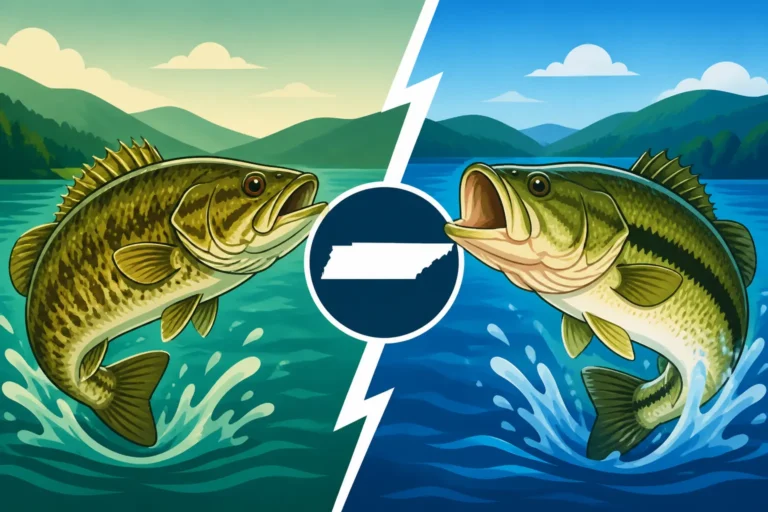
Largemouth vs. Smallmouth Bass
Smallmouth bass, Micropterus dolomieu, are another highly prized game fish in Tennessee, particularly in cooler, clearer waters and rivers like the Cumberland or the headwaters of the Tennessee River system. They are absolute fighters, often referred to as "bronze backs" due to their coloration.
Here are the critical distinctions:
- The Mouth: Again, the mouth is key. The smallmouth bass has a noticeably smaller mouth than the largemouth. Its jaw will typically not extend beyond the middle of its eye. If you compare them side-by-side, the difference is striking.
- Coloration and Markings: Smallmouth bass usually have a more uniform bronze, brown, or olive-green coloration, often with vertical bars or blotches on their sides, rather than a distinct horizontal stripe like the largemouth. Their eyes can also appear more reddish. This gives them a distinctly different aesthetic, especially when pulled from clear water.
- Habitat: This is a big one. Smallmouth bass prefer cooler, clearer, rocky waters with good current. You'll find them in rivers, deeper parts of large reservoirs, and around rocky points and ledges. Largemouth prefer warmer, shallower, weedy areas. If you're fishing a fast-flowing, clear river, you're more likely to catch smallmouth. If you're in a stagnant, lily-pad-filled pond, it's almost certainly a largemouth.
- Dorsal Fins: Like the spotted bass, the smallmouth has a less distinct separation between its two dorsal fins compared to the largemouth. It's more of a deep notch.
You can learn even more about these differences in Smallmouth Bass vs Largemouth Bass: What's the Difference?.
Here's a quick comparison table to help you keep these distinctions straight:
| Feature | Largemouth Bass | Smallmouth Bass | Spotted Bass |
|---|---|---|---|
| Mouth Extension | Extends past the back edge of the eye | Rarely extends beyond the middle of the eye | Extends to middle of the eye, rarely past it |
| Dorsal Fins | Deep, distinct separation between two fins | Shallow notch, less distinct separation | Deep notch, less distinct separation |
| Lateral Line | Prominent, dark horizontal stripe or blotches | Vertical bars or splotches, less defined stripe | Dark spots below the lateral line |
| Tongue | Smooth | Smooth | Usually has a rough tooth patch |
| Coloration | Green to olive, white belly | Bronze to brown, often with vertical bars | Greenish-gold, often with spots below lateral line |
| Preferred Habitat | Warm, shallow, vegetated, still water | Cool, clear, rocky, flowing water | Mix of both, often in reservoirs |
Beyond the Basics: Other Identification Cues and Considerations
While the physical features are your best bet, sometimes other factors can provide helpful clues or add a layer of complexity to identification.
Habitat as an Indicator
As we touched on earlier, the environment where you catch a bass can be a strong hint about its species. If you're fishing a shallow, murky cove full of lily pads on Watts Bar Lake, almost every bass you hook is likely to be a largemouth. Conversely, if you're working a deep, rocky point with clear water on Dale Hollow Lake, there's a good chance you'll be tangling with smallmouth. Best Fishing Lakes in Tennessee details some of these specific environments.
Of course, fish move, and their habitats can overlap, especially in large reservoirs with diverse structures. You might occasionally catch a smallmouth in an area you expected to find largemouth, or vice-versa. However, understanding the general preferences of each species will increase your identification accuracy significantly. Consider your surroundings; it's like a geological fingerprint for the fish.
Size and Growth Patterns
While size isn't a definitive identification factor, it can offer a general clue, especially when considering trophy potential. Largemouth bass generally grow larger and heavier than spotted bass. While smallmouth can reach impressive sizes, true trophy-class fish in Tennessee, particularly those over 10 pounds, are almost always largemouth. If you've just landed a behemoth, say a 12-pounder, it's virtually certain to be a largemouth. Remember, Tennessee's Largemouth Bass Limit Is 5 Per Day, Only 1 Over 18 Inches, which focuses on larger fish, indicating their potential for significant growth. You can often find specialty scales and measuring tapes on Amazon designed for handling and recording large fish safely.
However, never rely solely on size. A small largemouth can easily be confused with a larger spotted bass, and a trophy smallmouth could be mistaken for a smaller largemouth if you're not paying attention to the definitive features. Always use the mouth, dorsal fins, and lateral line markings as your primary identification tools.
Local Variations and Hybridization
One more thing to keep in mind is that fish can sometimes exhibit slight regional variations in appearance due to diet, water conditions, and genetic factors. What looks like a "classic" largemouth in West Tennessee's muddy lakes might have slightly different coloration than one from a clearer, rockier reservoir in East Tennessee. These are minor differences, however, and the core identifying features (mouth, dorsal fin separation) remain consistent.
Also, it's important to be aware that bass species can sometimes hybridize, particularly spotted bass with largemouth bass. While less common, a hybrid can display a mix of features, making identification extremely challenging, even for experienced anglers. In these rare cases, it's best to consult local wildlife agencies or release the fish if you're unsure about regulations. For most of your catches, however, the distinct features discussed above will guide you well.
Ultimately, becoming proficient at identifying a largemouth bass in Tennessee comes down to practice and observation. The more bass you catch and carefully examine, the more intuitive the process will become. Remember these key features—especially that signature large mouth and distinct dorsal fin separation—and you'll be well on your way to confidently identifying your catches and fishing responsibly within Tennessee's regulations.
Disclaimer
This article is for general informational purposes only and does not constitute professional advice. Laws, prices and regulations vary by location and change over time. Consult a qualified professional for guidance on your specific situation.