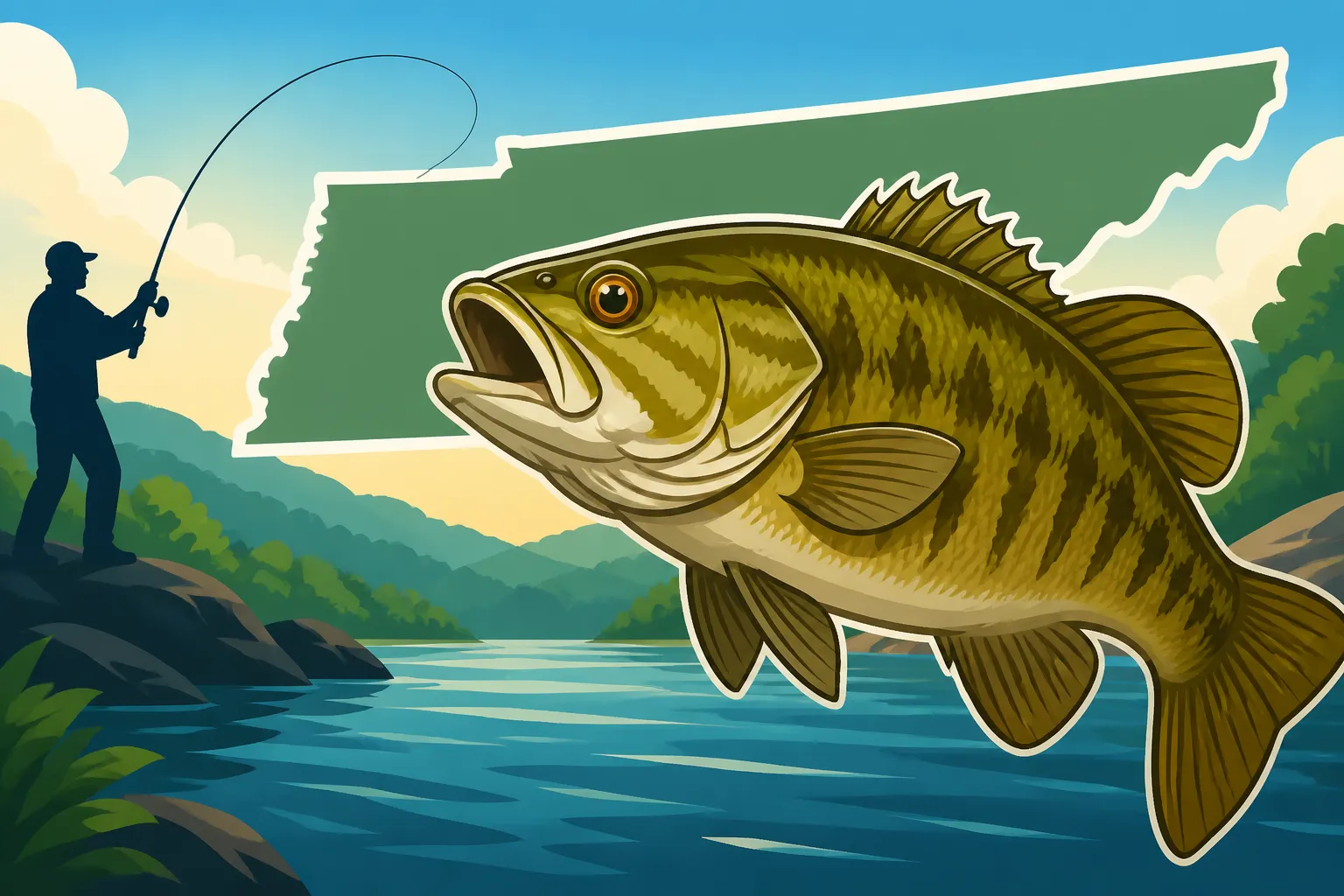
How to Identify Tennessee’s State Fish, the Smallmouth Bass
It's incredibly frustrating when you're out on the water, you've just landed a beautiful bass, and then you're left scratching your head, wondering exactly which species it is. With regulations often differing by species and size, knowing how to properly identify your catch is more than just curiosity—it's essential for staying compliant and ensuring you're protecting our precious Tennessee fisheries. This guide is going to walk you through everything you need to know to confidently identify the magnificent smallmouth bass, one of our state's most beloved and feisty game fish.
Understanding the Smallmouth Bass: Tennessee's Prized Catch
The smallmouth bass, Micropterus dolomieu, holds a special place in the hearts of many Tennessee anglers. It's not just a challenging fish to catch; it's also one of Tennessee's two official state fish, a testament to its popularity and sporting value. Often found in the clearer, cooler waters of our rivers and larger reservoirs, the smallmouth offers a fight that few other freshwater fish can match, known for its acrobatic jumps and powerful runs. But before you can appreciate the fight, you've got to be sure you've got a smallmouth on the line. Distinguishing it from its close relatives, like the largemouth and spotted bass, can be tricky, especially for newer anglers or when you're in a hurry on the water. That's why having a solid grasp of its unique characteristics is so important.
Why Smallmouth Are So Highly Regarded
There's a reason so many anglers specifically target smallmouth bass across Tennessee. Their aggressive nature and powerful fighting style make every catch an exhilarating experience. Unlike the largemouth, which might stay deep and try to bulldog its way to freedom, a smallmouth often prefers to leap and thrash, testing your tackle and your angling skills to their limits. They thrive in different environments, too, often preferring rocky, cooler, and clearer waters, which means targeting them can take you to some of the most scenic spots in our beautiful state. It's truly a unique angling adventure when you're after "brown bass," as they're affectionately known.
The Importance of Correct Identification for Regulations
Beyond the thrill of the catch, accurate identification is crucial for adhering to Tennessee Fishing Regulations Explained. Each bass species in Tennessee, including the smallmouth, often has specific size and creel limits. For instance, the smallmouth bass has a daily limit in many areas, and there might be slot limits where you can only keep fish within or outside a certain size range. Misidentifying your catch could lead to unintentional violations, which no angler wants. Carrying a waterproof fish identification chart, perhaps one you ordered from Amazon, can be a great resource to keep right on your boat or in your tackle box for quick reference when you're unsure. Taking the time to properly identify your fish ensures you're a responsible steward of our fisheries.
The Definitive Guide to Smallmouth Bass Identification
When you've got a fish in hand, there are several key physical traits that shout "smallmouth bass!" once you know what to look for. It’s all about focusing on a few distinct features that set them apart from their bass brethren. Paying close attention to these details will make you an expert identifier in no time.
Body Shape and Coloration
One of the first things you'll notice about a smallmouth bass is its overall body shape. They tend to be more compact and football-shaped compared to the largemouth. They're muscular, giving them that powerful fighting ability. Their coloration can vary quite a bit depending on the water clarity and bottom composition of where they live, but generally, smallmouth bass have a brownish-bronze hue on their backs, fading to a lighter, often yellowish-white belly. What truly sets them apart from a largemouth in terms of color is the vertical barring or tiger stripes along their flanks. These dark, broken vertical bars are usually quite pronounced, especially in clear water fish. While largemouth have a more solid, horizontal dark band, smallmouth sport those distinctive vertical patterns. These markings aren't always perfectly symmetrical, but they are a consistent characteristic.
Mouth and Jaw Structure
This is perhaps the most defining characteristic, and it's even in their name! The mouth of a smallmouth bass is, well, smaller than that of a largemouth. If you hold the fish horizontally and look at its mouth, the upper jaw (or maxillary) typically extends only to about the middle of the eye, or just slightly beyond it. This is a critical point of identification. In contrast, a largemouth bass's jaw extends well past the back of its eye. While it might sound like a subtle difference, once you've seen a few of each, it becomes incredibly obvious. Run your thumb across the roof of the mouth; smallmouth often have a small patch of teeth on the tongue, though this can be harder to feel accurately.
Dorsal Fin and Eye Placement
Let's talk about the dorsal fin. Both largemouth and smallmouth bass have two dorsal fins, but the connection between them is a key differentiator. On a smallmouth, the two dorsal fins (the spiny front one and the soft-rayed back one) are usually clearly connected, though there might be a slight dip or notch between them. The connection is quite noticeable. In contrast, the largemouth bass has a much deeper, almost complete separation between its two dorsal fins. It almost looks like two distinct fins.
As for the eyes, smallmouth bass tend to have reddish or orangish eyes, especially noticeable in clear water. Their eyes also appear relatively larger in proportion to their head compared to a largemouth. Combine this with the jawline extending only to the middle of the eye, and you have another strong identifier. This is one of those features that becomes much clearer with practice. If you're really into learning more about our diverse fish, you might enjoy reading Tennessee's 291 Native Fish Species and 52 Sport Fish Explained.
Smallmouth vs. Its Cousins: Avoiding Misidentification
This is where many anglers get tripped up! Smallmouth bass share the waters with other common species, and a quick glance can be deceiving. Let's break down the key differences between the smallmouth and its most common lookalikes in Tennessee.
Smallmouth vs. Largemouth Bass
The largemouth bass (Micropterus salmoides) is arguably the most recognized bass in Tennessee, but it's often confused with the smallmouth. Here’s a quick comparison:
| Feature | Smallmouth Bass | Largemouth Bass |
|---|---|---|
| Jaw Extension | Upper jaw ends at or slightly past the middle of the eye | Upper jaw extends significantly beyond the back of the eye |
| Body Shape | More compact, football-shaped, muscular | Elongated, generally deeper body |
| Coloration | Brownish-bronze, often with distinct vertical bars/tiger stripes | Greenish back, whitish belly, prominent horizontal dark stripe |
| Dorsal Fins | Connected, often with a slight dip | Deep, almost complete separation between the two fins |
| Habitat | Cooler, clearer, rockier waters (rivers, deep reservoirs) | Warmer, often murkier waters, heavy vegetation, stumps |
You can see that the jaw is the biggest giveaway. If that jaw extends far past the back of the eye, you've got a largemouth. If it only goes to the middle, it's a smallmouth. Understanding Largemouth vs Smallmouth Bass: Tennessee Angler's Guide can help solidify these distinctions even further.
Smallmouth vs. Spotted Bass
Now, this is where it gets really interesting, and frankly, tougher. The spotted bass (Micropterus punctulatus) looks a lot like a smallmouth, especially in certain waters. They often share similar habitats, too. However, there are still reliable ways to tell them apart:
- Jaw Line: Similar to the smallmouth, the spotted bass's jaw usually doesn't extend past the back of its eye. So, the jaw test doesn't help much here.
- Tongue Patch: This is the best identifier for spotted bass. If you gently open its mouth and feel the tongue, a spotted bass will almost always have a rough patch of teeth on its tongue. Smallmouth bass can have a patch, but it's often much smaller and less pronounced or entirely absent. This rough patch is a key feature for identifying Spotted Bass Identification in Tennessee Reservoirs.
- Body Markings: Spotted bass have rows of distinct dark spots along their lower flanks, below the lateral line, which often form a diamond pattern. Smallmouth have those vertical bars, but not these distinct, separated spots.
- Pyloric Caeca: This is a more scientific method not practical on the water, but spotted bass have 9-14 pyloric caeca (finger-like projections from the stomach), while smallmouth have 5-9. Don't worry, you don't need to dissect your fish! The tongue patch and flank spots are your go-to.
The key really comes down to the spots on the lower flank and the tongue patch. If you see those distinct spots below the lateral line, it's almost certainly a spotted bass.
Habitat and Behavior: Clues to Spotting Smallmouth
Knowing where smallmouth bass like to live and what they tend to do can also give you a huge leg up in identification, sometimes even before you get the fish to the boat. It's like knowing your neighbor's preferred hangout spot – you're more likely to run into them there!
Preferred Waters and Structure
Smallmouth bass are particular about their living arrangements. They thrive in cooler, clearer water than their largemouth cousins. You'll often find them in rivers with current, clear creeks, and the deep, rocky areas of large reservoirs like Dale Hollow Lake, Norris Lake, and Watts Bar Lake. They absolutely love structure, but it's often a different kind of structure than a largemouth prefers. Think rock piles, gravel beds, ledges, submerged timber, boulders, and steep banks. They use these areas for ambush points and for protection from current. If you're fishing a clear, rocky point on Norris Lake Fishing Guide, Tennessee's Clearest Water, you're far more likely to hook a smallmouth than a largemouth. Conversely, if you're in a shallow, weed-choked cove, it's probably a largemouth paradise. Understanding Best Rivers for Fishing in Tennessee will often lead you to prime smallmouth territory.
When the water gets colder, smallmouth will often retreat to deeper rock piles or channel swings, where they can still find cover and ambush prey. They're not typically found hunkering down in thick mats of lily pads or shallow flooded timber like largemouth might be. Knowing this can help you predict what species you might encounter when you cast your line.
Feeding Habits and Aggression
Smallmouth bass are incredibly aggressive predators. They have a reputation for hitting lures hard and fast, often leading to heart-stopping strikes. Their diet consists primarily of crayfish, minnows, insects, and smaller fish. You'll notice that many popular smallmouth lures imitate crayfish or baitfish, like tubes, jigs, crankbaits, and spinnerbaits. They're opportunistic feeders and aren't shy about chasing down a meal. This aggressive nature also contributes to their thrilling fight once hooked.
This behavior can sometimes be a clue to their identity. If you're retrieving a lure over a rocky bottom and something absolutely smashes it with a violent, head-shaking strike, there's a good chance you've just tangled with a smallmouth. While other bass species are aggressive, the smallmouth's ferocity, especially in current, is often distinct. They are less likely to shy away from open water or current, embracing it as a hunting ground, which also sets them apart behaviorally from their often more cover-oriented cousins.
Practical Tips for On-the-Water Identification
Even with all this knowledge, identifying a fish quickly on the boat can still be a challenge. Here are a few practical tips to help you seal the deal on that smallmouth identification.
Bring a Reference Guide
Don't rely solely on memory! There are many excellent, compact, waterproof fish identification guides available. A quick search on Amazon for "Tennessee fish identification chart waterproof" will yield several results. Keep one of these handy in your tackle box or boat's storage. It's a small investment that can prevent confusion and ensure you're always making the right call regarding Tennessee Fishing Season and Catch Limits.
Take a Photo (Safely)
If you're still unsure, especially if you're practicing catch and release, snap a quick, clear photo of the fish. Try to get a shot that clearly shows the jawline, dorsal fin connection, and body markings. You can then release the fish quickly and safely, and consult your reference guide or even an online resource later. This is particularly helpful when you're dealing with a borderline catch, or you're simply trying to learn. Remember to handle the fish minimally and gently if you plan to release it.
Observe Multiple Features
Don't just rely on one feature, like coloration, which can be highly variable. Look at the whole picture: the jaw extension, the dorsal fin connection, the body shape, the presence or absence of a tongue patch (for spotted bass), and the vertical barring or horizontal stripe. The more features you can confirm, the more confident you can be in your identification. With practice, you'll find that you can identify a smallmouth bass almost instantly, which means more time fishing and less time guessing! You'll become proficient enough to know if you've got a smallmouth that needs to meet Tennessee's Smallmouth Bass Limit Explained or if it's a largemouth under different rules.
Disclaimer
This article is for general informational purposes only and does not constitute professional advice. Laws, prices and regulations vary by location and change over time. Consult a qualified professional for guidance on your specific situation.