Best Downriggers for Tennessee Striped Bass Trolling
There's nothing quite like the thrill of a big striped bass hitting your line, especially when you know you've had to work for it. But let's be honest, those powerful fish often hang out in the deeper parts of our vast Tennessee reservoirs, making them incredibly challenging to reach with conventional trolling methods. This guide is all about demystifying one of the most effective tools for consistently getting your lures down to where those trophy stripers lurk: the downrigger.
Understanding Downriggers: Why They're Essential for Tennessee Stripers
When you're chasing striped bass in Tennessee's massive lakes like Norris, Cherokee, or Watts Bar, you quickly realize they don't always hang out near the surface. Often, especially in warmer months or during specific feeding patterns, these powerful fish retreat to cooler, deeper water, sometimes 30, 50, or even 100 feet down. Trying to get a lure to those depths with just lead weights and long lines can be a frustrating exercise in guesswork and inefficiency. That's where downriggers become absolutely indispensable.
The Challenge of Deepwater Trolling in Tennessee Reservoirs
Imagine trying to present a lure at a precise depth of 60 feet while your boat is moving at two or three miles per hour. Without a downrigger, you'd be spooling out hundreds of feet of line, relying on heavy weights that cause significant drag and make your lure's action unnatural. Your line would form a massive belly in the water, making it almost impossible to know exactly how deep your bait actually is. This isn't just inefficient; it’s a recipe for missed opportunities and tangled lines. Striped bass are often suspended over deep water, not necessarily glued to the bottom, and hitting that specific depth zone is critical for success. Trying to hit those precise depths using standard trolling setups often results in either too shallow or too deep presentations, completely missing the fish that are holding at that specific thermal break or baitfish school.
How Downriggers Precisely Control Depth
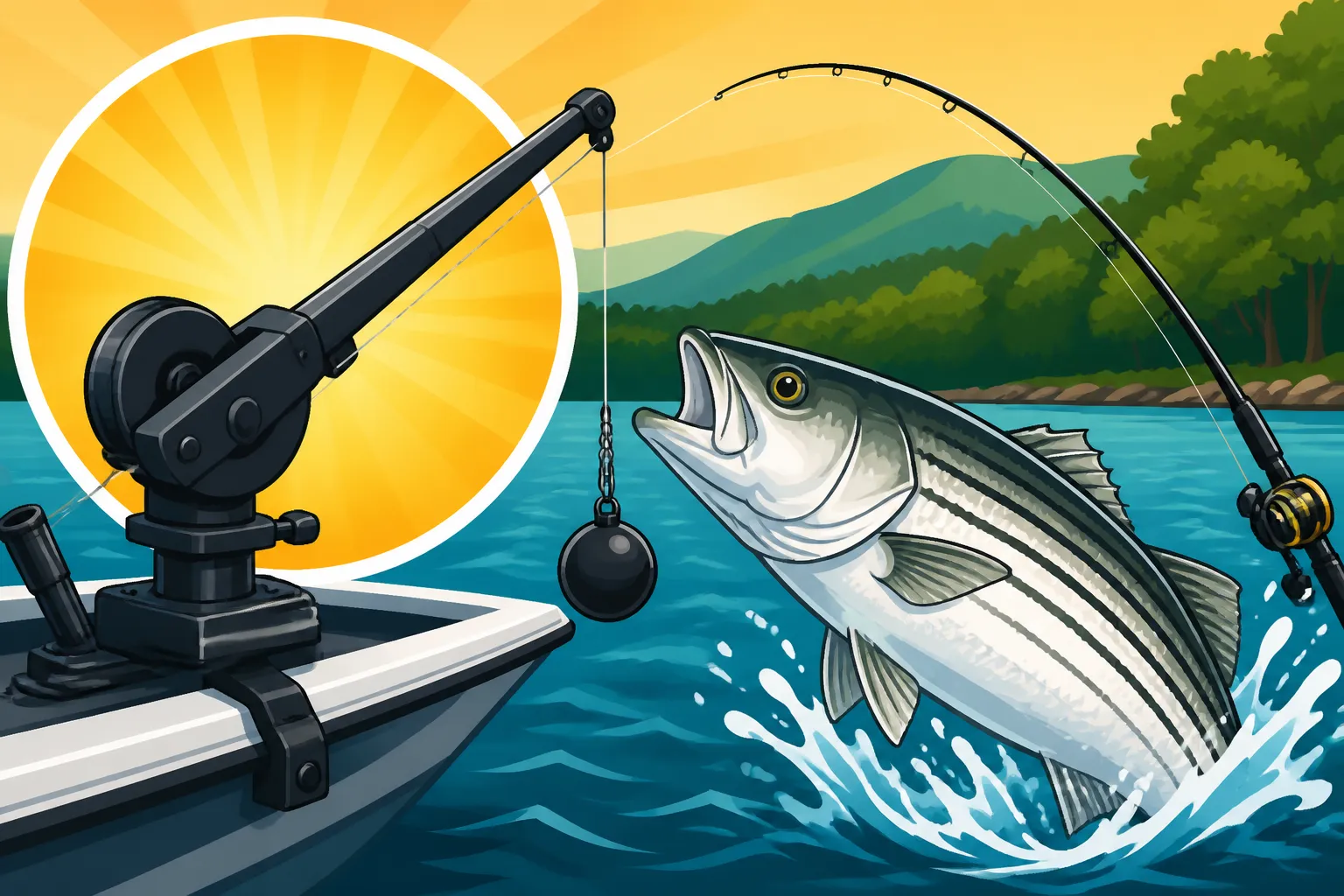
A downrigger is essentially a miniature crane for your fishing line, designed to carry a heavy "cannonball" weight straight down, pulling your fishing line with it. Your fishing line is clipped into a release mechanism on the downrigger cable, which holds your lure at the exact desired depth. When a fish strikes, the clip releases, and you're fighting the fish directly on your main fishing line, free of the heavy downrigger weight. This allows your lure to swim freely and naturally at a set depth, without the drag of heavy weights on your main line. The precision is phenomenal – you can target fish holding at 45 feet, 60 feet, or even 100 feet down with incredible accuracy. This ability to target specific depth ranges is a game-changer when you're trying to figure out where the stripers are feeding on a given day. You'll often hear experienced anglers talk about Deep Water Techniques for Striped Bass, and downriggers are at the heart of those strategies.
The Advantage of Spreading Your Spread
One of the biggest benefits of downriggers is the ability to create a multi-level trolling spread. Instead of running all your lines at a similar, shallow depth, you can deploy multiple downriggers, each set to a different depth. For instance, you might run one downrigger at 50 feet, another at 65 feet, and perhaps a third at 80 feet. This allows you to effectively "sample" different parts of the water column until you locate the depth where the stripers are most active. You can also combine downriggers with traditional planer boards or flat lines to cover a huge area both vertically and horizontally, mimicking a school of baitfish. This diverse presentation increases your chances of encountering fish and helps you quickly dial in on their preferred depth. When considering Trolling for Striped Bass in Tennessee, having this kind of control over your spread is invaluable for maximizing your efforts on the water.
Key Features to Look for in a Downrigger for Tennessee Waters
Choosing the right downrigger isn't just about grabbing the first one you see. Tennessee's big reservoirs and powerful striped bass demand certain features to ensure durability, ease of use, and effective fishing. Thinking about how you fish, your boat's setup, and your budget will guide your decision.
Manual vs. Electric Downriggers
This is often the first big decision. Both have their place, but for serious striper fishing, electric typically wins out for efficiency and sheer muscle.
Manual Downriggers
Manual downriggers are operated by hand crank, much like a traditional fishing reel. They are generally more affordable and simpler in design, making them a great entry point for anglers who are new to downriggers or only fish deep occasionally. They're also less prone to electronic failures since there aren't any complex circuits or motors. If you have a smaller boat, limited battery space, or prefer a minimalist setup, a manual downrigger can be a good choice. However, retrieving a heavy downrigger ball from 80+ feet, especially when resetting lines after a fish or checking your bait, can be a real workout, especially when you're trying to manage multiple lines. For the dedicated striper angler who plans to make many drops and retrieves throughout the day, the effort can quickly become exhausting.
Electric Downriggers
Electric downriggers, as the name suggests, are powered by your boat's 12V system, allowing for effortless retrieval of the downrigger ball at the touch of a button. Many models also feature an auto-stop function that automatically halts the retrieval when the weight reaches the surface, preventing damage. High-end electric models can integrate with your boat's electronics, offering precise depth tracking, jigging functions, and even bottom-tracking capabilities that automatically adjust the weight's depth to follow the contours of the lakebed. For anyone regularly targeting deep-water striped bass, especially in tournaments or on multi-day trips, electric downriggers are a huge advantage. Brands like Scotty and Cannon (available at places like Bass Pro Shops and Amazon) offer a wide range of electric models, from robust entry-level units to advanced, networkable systems. While they represent a larger initial investment and require a reliable power source, the convenience and efficiency they provide are often well worth it for serious anglers. They truly take the grunt work out of deep trolling, allowing you to focus on boat control and fish detection.
Boom Length and Retrieval Speed
These features directly impact how effectively you can spread your lines and respond to strikes.
Boom Length
The boom is the arm of the downrigger that extends out from the base. A longer boom allows you to spread your lines further away from the boat, reducing the chance of tangles, especially when running multiple downriggers or combining them with planer boards. For larger boats or when targeting fish that spook easily from the boat's shadow or propeller wash, a longer boom (24-inch to 60-inch range) is often preferred. Shorter booms are more suitable for smaller boats or when space is limited, but you'll need to be more mindful of your line spread. Adjustable booms are a fantastic feature, allowing you to customize the length based on your current fishing situation or boat size. When you're trying to run a sophisticated spread like for Trolling for Striped Bass, boom length really makes a difference.
Retrieval Speed
This is primarily a concern for electric downriggers. A faster retrieval speed means you can get your downrigger ball back to the surface more quickly after a strike or when moving to a new spot. This might seem like a minor detail, but when you're busy with a hooked striper and need to get other lines out of the way, or if you're frequently checking baits, a slow retrieval can be incredibly frustrating. Look for models with decent retrieval rates, often measured in feet per minute. Some premium models even offer variable speed control, giving you maximum flexibility.
Line Capacity and Weight Capability
The type of downrigger cable and the weight of your cannonball are critical for efficient deepwater fishing.
Downrigger Line (Cable) Capacity
The downrigger drum needs to hold enough cable to reach the depths you plan to fish, with some extra for safety. Most serious striper anglers will want at least 200 feet of cable, often more, especially if you're exploring the deeper thermoclines of lakes like Cherokee or Norris. While stainless steel cable is traditional and durable, many anglers are now opting for braided synthetic downrigger line, such as spectra or Kevlar. These synthetic lines are thinner, stronger, and don't hum in the water like steel cable, which some believe can spook fish. They also tend to "blow back" less in the water current, allowing your weight to run more vertically. Ensure the downrigger you choose is compatible with the line type you prefer.
Weight Capability
Downriggers are rated for a maximum downrigger ball weight. For striped bass trolling, especially when fishing deep or in current, you'll typically use cannonballs weighing between 8 and 12 pounds, sometimes even 15 pounds for extreme depths or faster trolling speeds. Ensure your chosen downrigger is robust enough to handle these heavier weights without excessive strain on the motor or gearing (for electric models) or causing too much instability (for manual models). Trying to use an underpowered downrigger with a too-heavy ball is a recipe for premature wear and tear. You'll want a reliable setup when you're pursuing Tennessee Striped Bass Fishing Techniques in these big bodies of water.
Top Downrigger Options for Tennessee Striped Bass Anglers
With a myriad of downriggers on the market, it can be overwhelming to pick the right one. Let's break down some general categories and popular choices that are well-suited for chasing those hard-fighting Tennessee stripers. While specific prices fluctuate, understanding the types and their features will help you budget and decide.
Entry-Level Manual Downriggers
For those just getting into deep-water trolling or who only occasionally venture after stripers, a solid manual downrigger can be a great starting point. They're typically more budget-friendly and less complicated to install.
One common example you might find from brands like Cannon or Scotty (often available through retailers like Bass Pro Shops or on Amazon) would be a compact, clamp-on manual downrigger. These usually feature a shorter boom, perhaps 24 inches, and can handle an 8-pound cannonball with ease. They're perfect for smaller aluminum boats or kayaks where space and power are at a premium. While retrieving a weight from 50+ feet will build your arm muscles, they offer excellent depth control without the fuss of wiring. They're also very portable, making it easy to move them between boats or store them when not in use. If you're looking for an affordable way to test the waters of Deep Water Techniques for Striped Bass, this is a sensible route to go. They’ll get your lure down to the fish, even if it takes a bit more elbow grease.
Mid-Range Electric Downriggers
This category offers the best blend of features, convenience, and value for most dedicated Tennessee striper anglers. These units provide the ease of electric retrieval without the top-tier price tag of fully integrated systems.
Many anglers find themselves drawn to models like the Cannon Uni-Troll or the Scotty Depthpower series. These are workhorses that offer reliable electric retrieval, often with a decent boom length (30-48 inches), and the capability to handle 10- to 12-pound weights comfortably. Features commonly include an auto-stop function that prevents the weight from crashing into the boom, a swivel base for easy repositioning, and often a clutch system for smooth deployment. Some might even offer a positive ion control feature, which some anglers believe can attract fish. The ability to retrieve your weight quickly and effortlessly frees you up to focus on navigation, sonar, and fighting fish. This is particularly valuable when you're trying to maintain specific boat speeds or adjust your Trolling for Striped Bass patterns on the fly. These models can usually be found at major outdoor retailers and online, providing a significant upgrade in fishing experience.
High-End Advanced Systems
For the serious, tournament-level angler or anyone who demands the ultimate in precision, integration, and convenience, high-end electric downriggers are the way to go. These systems come with a higher investment but offer unparalleled control and advanced features.
Consider models like the Cannon Optimum or the Scotty Strongarm series. These downriggers boast advanced features such as full digital control, precise depth readout, wireless remote control, and the ability to network with your boat's other marine electronics (like chartplotters and fish finders). This integration means you can control your downriggers directly from your MFD (Multi-Function Display) at the helm, programming specific depth contours, bottom tracking, or even controlled jigging motions. They often have very strong motors, long, heavy-duty booms (up to 60 inches or more), and can easily handle 15- to 20-pound weights for extreme deepwater applications. Some even feature adjustable retrieval speeds and advanced line counter systems. For anglers who spend countless hours chasing Best Lures for Striped Bass in Open Water in the deep clear waters of Tennessee, these systems offer a distinct advantage, allowing for maximum efficiency and fish-catching capability. While these advanced systems might feel like overkill for casual fishing, for those who truly obsess over every detail, they are an invaluable asset.
Here's a quick comparison of downrigger types:
| Feature | Manual Downrigger | Mid-Range Electric Downrigger | High-End Electric Downrigger |
|---|---|---|---|
| Cost | Lower | Moderate | Higher |
| Ease of Retrieval | Manual crank (laborious) | Push-button (effortless) | Push-button (effortless) |
| Depth Control | Good (but requires attention) | Very Good | Excellent (digital precision) |
| Boom Length Options | Shorter to Medium | Medium to Long | Long (often extendable) |
| Weight Capability | 8-10 lbs | 10-15 lbs | 15-20+ lbs |
| Advanced Features | Minimal | Auto-stop, swivel base | Digital integration, GPS sync, bottom tracking, remote control |
| Power Requirement | None | 12V DC | 12V DC, sometimes higher current |
| Best For | Beginners, occasional use, small boats | Dedicated anglers, frequent use | Tournament anglers, ultimate control |
Setting Up and Using Your Downrigger for Optimal Striper Success
Getting a downrigger isn't the end of the story; knowing how to properly set it up and use it effectively is what will truly lead to more striped bass in your boat. There's a learning curve, but once you get the hang of it, you'll wonder how you ever fished without one.
Mounting and Rigging Your Downrigger
Proper mounting is paramount for safety and performance. Downriggers, especially when loaded with heavy cannonballs, exert significant force. Most downriggers come with a base plate that needs to be securely bolted to a sturdy part of your boat, typically the transom or gunwale. If you have a track system on your boat, many downriggers offer track-compatible mounts for easy installation and repositioning. Always ensure the mounting location can handle the stress, and use backing plates if necessary to distribute the load. Remember, you're not just supporting the downrigger itself, but the constant pull of the weight through the water.
Once mounted, spool your downrigger with your chosen line – either stainless steel cable or braided synthetic. Securely attach your downrigger ball release clip to the end of the cable. These clips are designed to hold your fishing line under tension, then release it when a fish strikes. Pay attention to the manufacturer's instructions for winding the cable, ensuring it's spooled tightly and evenly to prevent kinks or tangles. If you have an electric model, ensure it's correctly wired to your boat's 12V power supply with appropriate fusing. Thinking about Boat Fishing Rules and License Requirements in Tennessee also means making sure your entire setup is secure and safe for operation.
Selecting the Right Downrigger Ball and Release Clip
The downrigger ball is your "elevator" to the depths. They come in various weights and shapes. For general striped bass trolling in Tennessee, 8- to 12-pound cannonballs are most common. If you're fishing very deep (100+ feet) or trolling at higher speeds (which might be the case when chasing active stripers), a 15-pound ball might be necessary to keep your line running vertically and minimize "blowback" (where the water resistance pushes the ball shallower than your set depth). Pancake-shaped or finned balls are designed to track straighter and reduce blowback compared to traditional round balls.
The release clip is arguably one of the most crucial, yet often overlooked, components. It needs to hold your fishing line securely enough to keep your lure at depth while also releasing consistently when a fish bites. Different clips offer varying degrees of tension. For larger, harder-hitting stripers, you'll want a clip with adjustable tension that you can set tight enough to prevent premature releases from lure drag or boat bounce, but loose enough to pop off when a fish strikes. Many anglers use a rubber band or small loop of monofilament to attach their fishing line to the clip, providing an extra cushion and ensuring a clean release. Experiment with different clips and tension settings to find what works best for your specific lures and target fish.
Trolling Patterns and Depth Adjustments
This is where the art of downrigger fishing truly comes into play. Once your downrigger is set, deploy your fishing line with your chosen lure, making sure it's running a good distance behind the boat (e.g., 50-100 feet). Then, clip your fishing line into the downrigger release, and slowly lower the downrigger ball to your desired depth. Watch your sonar for baitfish schools and fish arches; stripers are almost always found near bait. If you're not seeing fish at one depth, don't be afraid to adjust your downrigger by 5 or 10 feet. This flexibility to quickly change depths is a major advantage.
Varying your boat speed, making S-turns, and even briefly stopping the boat can impart a different action to your lure, sometimes triggering a strike. Pay attention to your fish finder for thermoclines – these are temperature breaks in the water column where baitfish and predators often congregate. Setting your downriggers just above, in, or just below these breaks can be incredibly effective. Remember that How Water Temperature Affects Fish Activity is a huge factor, and downriggers allow you to precisely target the ideal temperature zone. If you're using multiple downriggers, stagger your depths and lure colors to find the winning combination. Always be mindful of Tennessee's Fishing Season and Catch Limits for striped bass and other species, ensuring you're compliant with regulations.
Disclaimer
This article is for general informational purposes only and does not constitute professional advice. Laws, prices and regulations vary by location and change over time. Consult a qualified professional for guidance on your specific situation.