Best Trolling Gear for Tennessee Striped Bass
There's nothing quite like the powerful strike of a Tennessee striped bass, but finding these often-elusive giants in our vast lakes and reservoirs can feel like a monumental task. They roam open water, chasing massive schools of baitfish, which makes traditional casting methods hit-or-miss at best. This guide is all about equipping you with the knowledge and the right gear to confidently troll for striped bass across Tennessee, helping you cover more water, present your baits effectively, and ultimately, bring more of these incredible fish to the boat.
Understanding Striped Bass and Their Habits in Tennessee
Before we dive into the gear, it's crucial to understand why trolling is such a game-changer for striped bass fishing in Tennessee. Stripers are apex predators that are constantly on the move, following their food sources. They can be found in a wide range of water depths and areas, from the main lake channels to creek arms, and trying to locate them by casting to visible structure simply isn't efficient enough.
Why Trolling is Effective for Tennessee Stripers
Trolling allows you to present multiple baits at various depths and speeds simultaneously, covering a much larger area than any other technique. This means you're actively searching for fish rather than waiting for them to come to you. Imagine pulling a spread of lures or live baits through a vast open water basin on a lake like Norris or Watts Bar, systematically investigating different depths where stripers might be holding. This sustained presentation is incredibly appealing to schooling fish like striped bass, which often hit out of aggression or competitive instinct when they see a "school" of baits moving through their territory.
Furthermore, trolling helps you maintain a consistent lure presentation, which is key when you finally locate a productive depth or area. Once you get a bite, you can immediately replicate that successful setup – speed, depth, lure choice – to target more fish in the same school. It's a method of methodical exploration that significantly increases your odds of encountering these hard-fighting fish, especially when they're suspended in the water column and not relating to bottom structure. This is a fundamental concept in Tennessee Striped Bass Fishing Techniques.
Key Tennessee Striped Bass Habitats and Behaviors
Tennessee's large reservoirs, like Cherokee, Percy Priest, and Kentucky Lake, are prime striped bass territory. These fish thrive in the deep, clear waters that offer abundant forage like gizzard shad, alewives, and threadfin shad. You'll often find stripers congregating around main lake points, submerged islands, humps, and the mouths of major creeks, especially where there's a good current or thermocline.
Their behavior is heavily influenced by water temperature and the availability of baitfish. In warmer months, stripers tend to go deep during the day, seeking cooler, oxygen-rich water, only coming shallower to feed at dawn, dusk, or under low-light conditions. During cooler seasons, they might be more scattered or even move into shallower areas, though they still prefer open water and will chase baitfish aggressively. Understanding these seasonal and daily patterns is vital for knowing where to start your trolling pass and at what depth to present your gear.
Observing your surroundings is also crucial. Keep an eye out for active bird feeding, which often signals baitfish being driven to the surface by predatory fish like stripers. Your electronics, which we'll discuss later, will be your best friend in locating these bait balls and the stripers lurking beneath them. Learning about these specific habitats is key for improving your success rate on the water.
Essential Trolling Rods and Reels for Striped Bass
When you're dealing with a fish that can peel line off your reel like a freight train, having the right rods and reels isn't just a preference; it's a necessity. Weak, flimsy gear will quickly lead to broken lines, pulled hooks, and a whole lot of frustration. Striped bass fishing demands strength and durability.
Choosing the Right Rod Action and Length
For trolling, you'll want rods that are stout enough to handle heavy lures, multiple fish on umbrella rigs, and the sheer power of a surging striper, but also have enough give to absorb shocks and prevent hooks from tearing out. A medium-heavy to heavy power rod with a moderate or moderate-fast action is generally ideal. This combination allows for backbone when fighting a big fish but still offers a softer tip for detecting subtle bites and for the rod to load up properly under the strain of heavy weights or multiple baits.
Length is also important. For trolling from a boat, rods typically range from 7 to 8.5 feet. Shorter rods (7 feet) can be easier to manage in a crowded boat and for fighting fish directly over the transom, while longer rods (8 to 8.5 feet) help spread out your lines more effectively when using multiple rods, reducing tangles, especially when you're running planer boards. Materials like fiberglass or composite blanks are often favored for their durability and parabolic bend, which acts like a shock absorber when a big striper hits.
Selecting Durable Reels with Ample Line Capacity
Your reel is arguably the most critical component of your trolling setup. For striped bass, you'll primarily be looking at conventional (baitcasting) reels rather than spinning reels, due to their superior drag systems, line capacity, and winching power. A good trolling reel needs a smooth, powerful drag that can be finely adjusted to handle long, blistering runs from a large striper without faltering. The last thing you want is a jerky drag that causes line breakage or pulled hooks when that trophy fish decides to make a break for it.
Line capacity is equally vital. Striped bass can make incredibly long runs, especially in open water, so you need a reel that can hold a significant amount of heavy monofilament or braided line. Reels designed for saltwater or heavy freshwater applications are generally a good starting point. Many anglers prefer reels with a line counter feature, which is an absolute game-changer for trolling. This allows you to precisely know how much line you have out, making it easy to replicate successful depths and communicate with fellow anglers on the boat. Brands like Shimano and Penn offer excellent options that you can often find at a local Bass Pro Shops or through online retailers like Amazon.
Lines, Leaders, and Terminal Tackle for Trolling Success
It's often said that a chain is only as strong as its weakest link, and nowhere is that more true than in fishing. The line, leaders, and terminal tackle are the direct connection between you and the fish, and any compromise here can spell disaster when a large striped bass decides to test your gear. Investing in quality components and tying strong knots are non-negotiable for successful trolling.
Mainline and Leader Considerations
For your mainline, you have a few good choices, each with its own advantages. Monofilament line is a popular option due to its stretch, which acts as an additional shock absorber against powerful strikes and head shakes. It's also more forgiving when a fish surges, helping to prevent hooks from tearing out. For trolling stripers, 20 to 30 lb test monofilament is a common choice. However, its stretch can make bite detection a bit less sensitive and setting the hook in deep water requires more effort.
Braided line, on the other hand, offers incredible strength-to-diameter ratio and virtually no stretch, providing excellent sensitivity and solid hooksets, even at great depths. You can use a lighter test braid (e.g., 30-50 lb test) that has the breaking strength of much heavier mono, allowing for more line on your reel. The lack of stretch can be a double-edged sword, however; it offers no give, so a strong hookset or sudden head shake from a striper can sometimes result in pulled hooks or even snapped rods if your drag isn't set perfectly. Many anglers opt for a braided mainline with a monofilament or fluorocarbon leader to combine the benefits of both.
Regardless of your mainline choice, a leader is almost always a good idea. Fluorocarbon leaders are nearly invisible underwater, which can be critical for wary stripers, and they offer good abrasion resistance. Monofilament leaders are more economical and also provide some shock absorption. Leader material typically ranges from 30 to 50 lb test, depending on the size of the stripers you're targeting and the amount of structure in the area. The length of your leader can vary, but a 3-6 foot leader is a common starting point, connecting your mainline to your terminal tackle with a strong knot or a high-quality swivel. Best Line Weight for Tennessee Striped Bass Trolling has more on this.
Hooks, Swivels, and Snaps: The Little Things that Matter
While they might seem small, your terminal tackle plays a huge role in your success. Weak or improperly chosen hooks, swivels, or snaps can be the reason you lose that fish of a lifetime. For striped bass, strong, sharp hooks are paramount. Whether you're using treble hooks on a crankbait or J-hooks for live bait, ensure they are forged, sharp, and appropriately sized for your bait and target species. Many anglers choose to upgrade factory hooks on lures to stronger, sharper versions.
Swivels are essential for preventing line twist, especially when trolling spinning lures or when a fish fights by twisting and rolling. High-quality ball-bearing swivels are generally preferred for their smooth rotation and durability. Use a swivel that is rated for a higher breaking strength than your main line. Snaps are used for quickly changing lures. Again, invest in strong, heavy-duty snaps that won't bend or fail under pressure. Fasteners, such as those you'd find in a well-stocked tackle department at Bass Pro Shops or ordered online, should be selected with a strength rating that matches or exceeds your line and leader.
When putting everything together, pay close attention to your knots. Learn to tie reliable knots like the Palomar knot, improved Clinch knot, or Uni knot for connecting line to swivels and lures. For joining your mainline to a leader, a double Uni knot or an FG knot are excellent, low-profile choices that maintain high breaking strength. Practice these knots at home until they become second nature, because a poorly tied knot is just an accident waiting to happen.
Lures and Baits: What Stripers Can't Resist
Striped bass are opportunistic predators, and they're not particularly picky when they're in a feeding mood. However, presenting the right lure or bait effectively at the right depth can make all the difference. Trolling allows you to cover a lot of ground with a variety of offerings, increasing your chances of finding what the stripers are keying in on that day.
Top Trolling Lures for Tennessee Striped Bass
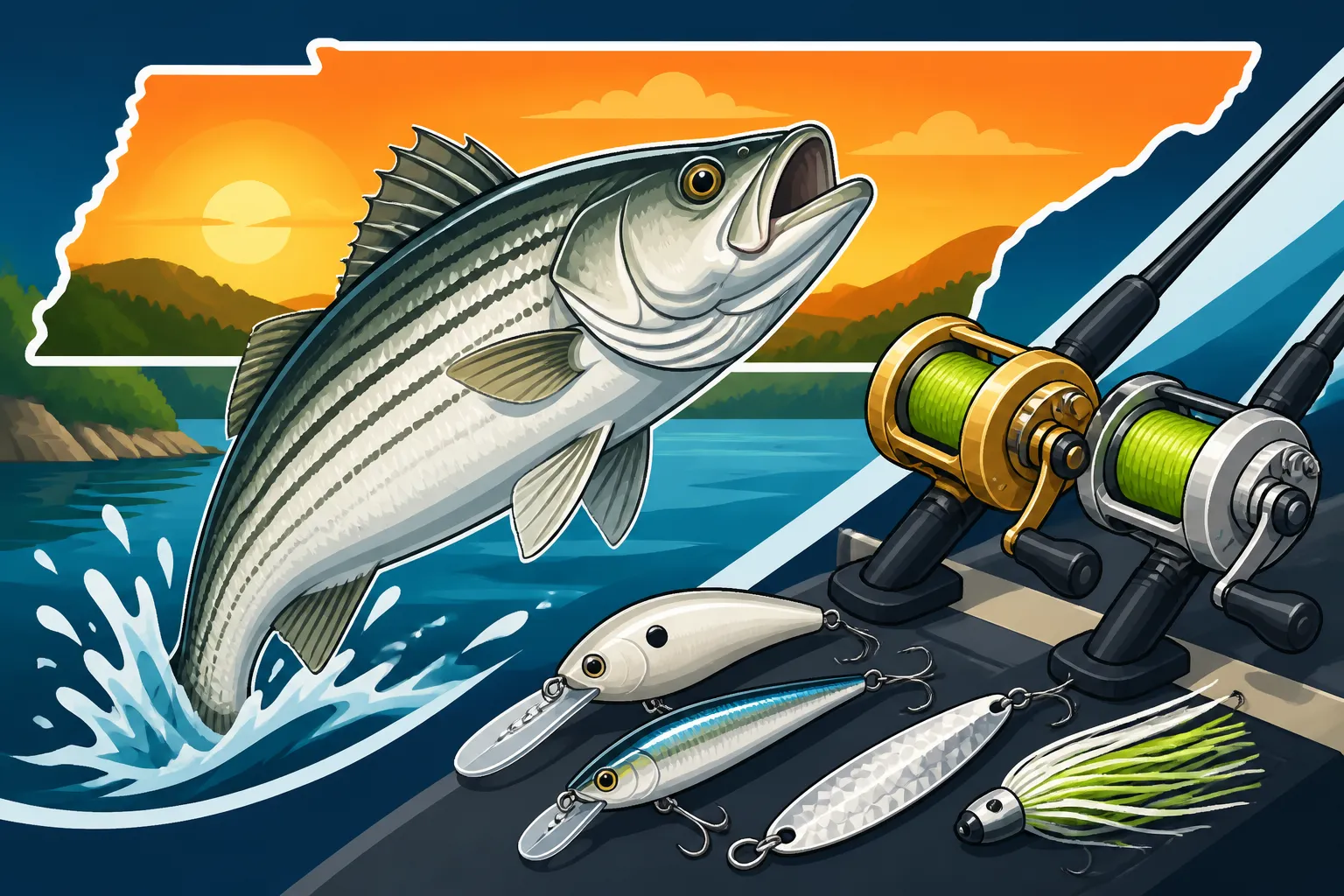
When it comes to artificial lures for trolling stripers, you've got a fantastic arsenal to choose from. One of the most classic and consistently effective options is the bucktail jig. These jigs, often tipped with a soft plastic trailer or a strip of pork rind, can be trolled directly behind the boat or as part of an umbrella rig. Their pulsating action in the water mimics baitfish perfectly, and their weight helps them get down to deeper depths.
Crankbaits are another powerhouse, especially those deep-diving models that can reach significant depths on their own or with the help of a downrigger. Look for crankbaits that have a tight wobble and come in natural baitfish colors like shad, blueback herring, or chrome with a blue back. Sizes can vary, but those in the 6-8 inch range are often productive. The key is to select a crankbait that dives to the depth where you're seeing bait and fish on your electronics. You can learn more about specific types in Best Lures for Striped Bass in Deep Water.
Perhaps the most iconic trolling lure for big stripers is the umbrella rig (or A-rig). This setup uses a central wire frame with multiple arms, each tipped with a swimbait, grub, or small bucktail jig. The result is a convincing school of baitfish presentation that can draw ferocious strikes from large stripers. Umbrella rigs can be heavy, so they require stout rods and reels. You can troll them bare or attach them to a downrigger for depth control.
Swimbaits, both soft plastic and hard-bodied, are also highly effective. Large, realistic swimbaits can be trolled individually or as part of a multi-lure spread. They offer a lifelike swimming action that is incredibly enticing to stripers. Experiment with different colors and sizes to match the local forage in the particular Tennessee lake you're fishing.
Live Bait Trolling Strategies
While artificial lures are incredibly effective, nothing quite beats live bait for finicky stripers or when you're targeting truly giant fish. Live bait trolling, often called "pulling live bait," is a technique that has accounted for countless trophy striped bass in Tennessee. The most common and effective live baits are gizzard shad and alewives, which are natural forage for stripers in many of our reservoirs.
The key to successful live bait trolling is to keep your bait healthy and lively. This means having a good livewell with plenty of aeration and fresh water on your boat. Baits should be hooked in a way that allows them to swim naturally and stay alive for as long as possible. Common hooking methods include nose-hooking (through both nostrils or just above the eyes) or bridle-hooking (using a rigging needle and floss to attach the hook without piercing the bait's body, preserving its vitality).
You'll troll live baits at slower speeds than artificial lures, typically just fast enough to make the bait swim naturally without spinning. Depth control is still paramount, and you can achieve this by using egg sinkers on your main line (often called a "Carolina rig" when applied to trolling), three-way swivels with a dropper weight, or by attaching your live bait rig to a downrigger. The natural scent and erratic swimming action of a live bait can often tempt a striper when artificials fail, making it an indispensable technique for serious striper anglers.
Mastering Depth Control: Downriggers, Planer Boards, and Lead Core
Trolling for striped bass isn't just about dragging lures behind your boat; it's about presenting those lures at precise depths in the water column where the fish are holding. Since stripers often suspend in open water, sometimes far below the surface, having reliable depth control methods is absolutely critical. Without these tools, you're essentially just guessing, and that's not a recipe for consistent success.
The Power of Downriggers for Precise Depth
Downriggers are the gold standard for precise depth control in trolling, especially when targeting suspended fish like striped bass in deep Tennessee lakes. They allow you to get your baits down to an exact depth and keep them there, regardless of your trolling speed. A downrigger uses a heavy ball (typically 8-12 pounds) attached to a cable, which is lowered to your desired depth. Your fishing line is then attached to this cable using a release clip.
When a fish strikes, the tension from the bite pulls the line free from the release clip, allowing you to fight the fish directly on your rod and reel without the resistance of the heavy downrigger ball. This system is incredibly efficient because it lets you run multiple lines at different depths off a single boat, essentially creating a vertical spread of baits. For example, you might run one downrigger ball at 40 feet, another at 60 feet, and so on, until you find the productive depth. This precision is invaluable when stripers are holding in a tight band in the water column, often associated with a thermocline or a specific baitfish school. You can learn more about this by checking out Best Downriggers for Tennessee Striped Bass Trolling.
Spreading Your Spread with Planer Boards
While downriggers manage vertical depth, planer boards are designed to spread your lures horizontally away from the boat. This allows you to cover a much wider swath of water and present more baits simultaneously without tangling lines, even with multiple rods out. They're especially effective when fish are shallower or when you want to keep your lines out of the boat's wake.
There are two main types: in-line planer boards, which clip directly onto your fishing line and run out to the side, and mast-style planer boards, which run off a central mast mounted to your boat, with multiple lines clipped to a single, larger board. When a fish hits, the in-line board typically trips or releases, allowing you to reel in the fish directly. Mast-style boards require you to retrieve the board first, then fight the fish. Using planer boards effectively means you can present baits in undisturbed water away from the boat, which can be crucial for wary stripers that might be spooked by boat traffic. They are an integral part of Rod Holder and Planer Board Setup for Reservoir Striper Trolling.
The Versatility of Lead Core Line
Lead core line offers a simpler, more affordable method of depth control compared to downriggers, though it's not as precise. This line is constructed with a lead core surrounded by a braided or woven sheath, making it heavy and causing it to sink. The amount of line you let out, combined with your trolling speed, dictates the depth your lure will reach.
Lead core line is typically color-coded, with each color representing 10 yards of line. This makes it easy to know how much line you have out. For example, if you're getting bites at 5 colors, you can easily replicate that setup. It's often used with crankbaits or swimbaits that have some diving ability of their own. While less precise than downriggers, lead core is excellent for covering a range of depths, especially if the stripers are scattered or you're just starting to explore a new area. It's also a great option for boats without downriggers, providing effective depth control with minimal equipment.
Here's a quick comparison of these depth control methods:
| Method | Precision | Spread | Ease of Use | Cost | Ideal Scenarios |
|---|---|---|---|---|---|
| Downriggers | High | Low | Moderate | High | Precise depth targeting, deep suspended fish |
| Planer Boards | Low (depth) | High | Moderate | Medium | Wide coverage, spreading lines, wary fish near surface |
| Lead Core Line | Medium | Low | Easy | Low | Exploring depths, smaller boats, scattered fish |
Electronics and Accessories to Enhance Your Trolling Game
In today's world, fishing without modern electronics is like trying to navigate a dark room blindfolded. When you're trolling for striped bass across massive bodies of water like Tennessee's reservoirs, these tools become your eyes and ears, revealing the underwater world and dramatically increasing your efficiency and success.
Fish Finders and GPS: Your Eyes Underwater
A high-quality fish finder is arguably the most critical piece of electronic gear for striped bass trolling. It allows you to "see" what's beneath your boat, showing you bottom structure, baitfish schools, and most importantly, the stripers themselves. Look for units that offer traditional 2D sonar, side imaging, and down imaging. 2D sonar is excellent for seeing fish directly under your boat and understanding the water column. Down imaging gives you a photo-like view of what's directly below, making it easier to distinguish bait balls from larger fish.
Side imaging, however, is a game-changer for trolling. It allows you to scan wide areas to the left and right of your boat, revealing baitfish schools, submerged timber, humps, and suspended stripers that you might otherwise troll right past. This capability lets you adjust your trolling path to intercept fish or productive structure long before you're directly over it. Coupling your fish finder with a reliable GPS system is equally important. GPS allows you to mark waypoints for productive areas, track your trolling paths, and navigate back to specific spots where you've caught fish or found concentrations of bait. This helps you repeat successful patterns and avoid unproductive water, saving you valuable time and fuel. Check out Best Fish Finders for Tennessee Reservoir Fishing for more details.
Essential Boating and Safety Accessories for Trolling
Beyond your fishing-specific electronics, there are several boating and safety accessories that are crucial for a successful and safe trolling trip, especially when you're spending hours on large, open waters. A reliable marine radio (VHF) is indispensable for communication, especially if you're fishing far from shore or in areas with limited cell service. It allows you to monitor weather updates, communicate with other boats, and call for assistance in an emergency.
Rod holders are absolutely essential for trolling. You'll likely be running multiple lines, and sturdy, adjustable rod holders will keep your rods securely in place while allowing for easy deployment and retrieval. Look for models that can withstand the violent strike of a striped bass and are robust enough to handle the constant pressure of trolling. A good set of nets, including a large landing net with a long handle, is also crucial for safely landing big stripers, especially when you're trying to quickly unhook and release fish or bring them into the boat.
Finally, never neglect safety gear. This includes properly fitting life jackets for everyone on board (and ensuring kids under 12 are wearing them while underway, as per Tennessee regulations), a first aid kit, signal devices like flares or a whistle, and a functioning fire extinguisher. Spending long hours on the water, often far from immediate help, demands that you prioritize safety. Being well-prepared means you can focus on the fishing, knowing you're ready for whatever the lake throws at you.
Disclaimer
This article is for general informational purposes only and does not constitute professional advice. Laws, prices and regulations vary by location and change over time. Consult a qualified professional for guidance on your specific situation.