Is a Boating Safety Certificate Required for Kayaks in Tennessee?
It's completely understandable to feel a bit lost when it comes to boating regulations, especially with all the different types of watercraft out there. You've got your traditional bass boats, pontoon boats, and then there are kayaks and canoes, which seem to live in their own little world. Many paddlers wonder if all those rules, like needing a boating safety certificate, apply to them when they're simply enjoying the quiet waters of a Tennessee lake or river. This guide aims to clear up that confusion, specifically addressing whether you, as a kayak angler or recreational paddler, need a boating safety certificate to legally and safely navigate Tennessee's beautiful waterways.
Understanding Tennessee's Boating Safety Certificate Requirements
Navigating the waters of Tennessee means understanding the rules, and one of the big ones for many boaters is the requirement for a boating safety certificate. This isn't just a piece of paper; it's a way to ensure that operators have a foundational understanding of safe boating practices, navigation rules, and emergency procedures. But where do kayaks fit into this picture? That's where things can get a little murky for many folks, and it’s a valid question to ask!
Who Needs the Certificate: Age and Propulsion
In Tennessee, the core requirement for a boating safety certificate generally revolves around two key factors: the operator's age and the type of propulsion their vessel uses. If you were born after January 1, 1989, and you operate any "mechanically propelled vessel" on Tennessee public waters, you are legally required to have successfully completed a boating safety course approved by the Tennessee Wildlife Resources Agency (TWRA). This rule is in place to enhance safety for everyone on the water, reducing accidents and promoting responsible boating habits. Imagine a busy weekend on Percy Priest Lake; without these rules, it could be pure chaos!
Now, the term "mechanically propelled" is where kayaks often cause a head-scratching moment. Does that include an electric trolling motor? What about a simple paddle? This distinction is crucial, because it directly impacts whether you need that certificate. The TWRA's goal isn't to over-regulate every single water user, but to ensure that those operating vessels with engines have the necessary knowledge to do so safely. This includes anything from large cruisers to small jon boats, and yes, even kayaks if they cross that "mechanically propelled" line.
The Role of Kayaks and Canoes in the Regulations
Here's the good news for most kayak and canoe enthusiasts: if your kayak or canoe is propelled solely by paddle power, oars, or sails (for sailboats, of course), then it is generally exempt from the requirement for a boating safety certificate in Tennessee. This means if you're out on the Caney Fork River Trout Fishing with just your paddle, enjoying the tranquility, you don't need to worry about proving you've passed a boating safety course, even if you were born after January 1, 1989. The logic here is that vessels relying solely on human power typically operate at lower speeds, have greater maneuverability without mechanical assistance, and pose less of a risk in terms of high-speed collisions or complex navigation scenarios.
However, the moment you add any mechanical means of propulsion to your kayak or canoe, such as an electric trolling motor or a small gas outboard, that exemption flies right out the window. Suddenly, your quiet, paddle-powered vessel becomes a "mechanically propelled vessel" in the eyes of the law, and all the associated rules, including the boating safety certificate requirement, kick in. This is a common oversight for kayak anglers who might install a small motor for convenience or to cover more water on a big lake like Chickamauga or Kentucky Lake.
Exemptions and Exceptions to the Rule
While the general rule is quite clear for mechanically propelled vessels, there are a few exceptions and specific situations to be aware of. For instance, individuals operating a vessel in an emergency, or those operating under the direct on-board supervision of someone who does possess the required certificate and is at least 18 years old, might find temporary relief from the rule. There are also specific exemptions for vessels engaged in racing, or those participating in sanctioned events where safety protocols are already in place.
Another significant exemption exists for operators born before January 1, 1989. If you're a seasoned angler who's been fishing Tennessee waters for decades and you fall into this age bracket, you generally don't need a boating safety certificate, regardless of whether your boat is mechanically propelled. This acknowledges a lifetime of experience on the water, assuming that older generations have gained sufficient knowledge through practical experience. It’s always best to carry identification that clearly states your birthdate, just in case a TWRA officer asks. Understanding these nuances is key to staying compliant, whether you're leisurely paddling on the Little River or cruising a reservoir with a motor. You can learn more about who needs to be certified by reading Who Needs the TWRA Boating Safety Certificate in Tennessee.
What Counts as "Mechanically Propelled" in Tennessee
The phrase "mechanically propelled" is really the heart of the matter when we're talking about kayaks and boating safety certificates in Tennessee. It's not always as straightforward as "if it has a motor, it's mechanical." For many kayak anglers, the appeal of a quiet electric trolling motor for hands-free movement or to fight against currents is huge, but it's important to understand the legal implications of that addition.
Interpreting the Law for Kayaks
When the TWRA refers to a "mechanically propelled vessel," they're talking about any vessel that uses an engine for propulsion, whether that engine is gasoline-powered, electric, or any other non-manual source. This definition doesn't discriminate based on the size of the motor or the vessel itself. So, if you've got a kayak that you primarily paddle, but you've installed even a small, whisper-quiet electric trolling motor to help you cover more ground or hold your position against the wind, that kayak is now considered mechanically propelled.
This is a critical distinction that many new kayak owners might overlook. They might assume that because their vessel is small and still can be paddled, it falls under the "paddle-powered" exemption. Unfortunately, that's not how the law reads. The mere presence and capability of mechanical propulsion change the vessel's classification. The law focuses on the potential for increased speed, range, and the need for greater awareness that comes with motorization, even if it's just a small, electric one. So, while you might feel like you're just adding a little helper, you're actually transforming your kayak's legal status on the water.
The Impact of Trolling Motors on Kayak Certification
This is where a lot of confusion, and sometimes frustration, comes in for kayak anglers. You've seen those sleek fishing kayaks fully rigged with fish finders, rod holders, and yes, electric trolling motors. They offer a fantastic advantage for covering water, getting to prime fishing spots, and fighting currents without constantly paddling. But that convenience comes with a responsibility. If you're using an electric trolling motor on your kayak, and you were born after January 1, 1989, you absolutely need to have that Tennessee Boating Safety Certificate.
It doesn't matter if it's a tiny 30-pound thrust motor or a larger one; the fact that it's electrically powered and moves your boat through the water means it's mechanically propelled. The same applies to any small gas outboards some might mount on certain kayaks designed for them. It’s not just about the motor itself, but also about the safety knowledge needed to operate it responsibly in shared waters. Understanding navigation rules, avoiding collisions, and knowing how to respond to emergencies become even more important when you have a motor giving you power, even if it's just a little bit. For a deeper dive into this, check out Do Electric Trolling Motors Count as Mechanical Propulsion in Tennessee?.
Common Misconceptions About Kayak Registration and Safety
Another common point of confusion revolves around the difference between a boating safety certificate and boat registration. Many people think if their kayak doesn't need to be registered, then it certainly wouldn't need a safety certificate. While often related, they are distinct requirements. In Tennessee, generally, any vessel with a motor (mechanical propulsion) must be registered. This includes motorized kayaks. However, if your kayak is solely paddle-powered, it does not need to be registered. You can find more specific details on this topic in Do Kayaks Need to Be Registered in Tennessee?.
The safety certificate, on the other hand, is about the operator's knowledge, not the vessel's registration status. While a motorized kayak requires both registration and for the operator (if born after 1989) to have a certificate, a paddle-powered kayak requires neither. The misconception often arises because people lump all "boating rules" together. It's important to remember that these are separate regulations designed to achieve different objectives – registration for identification and ownership, and the certificate for operator competency and safety on the water. Always err on the side of caution and educate yourself on both sets of rules to ensure you're fully compliant before heading out, whether you're targeting Crappie Limits Under Tennessee Fishing Rules or just paddling around.
| Kayak Type | Requires Registration (TN) | Requires Boating Safety Certificate (Operator born after Jan 1, 1989) |
|---|---|---|
| Paddle-Powered Only | No | No |
| Kayak with Trolling Motor | Yes | Yes |
| Kayak with Gas Outboard | Yes | Yes |
Getting Your Tennessee Boating Safety Certificate (If Needed)
So, you've realized your awesome fishing kayak, complete with that handy trolling motor, means you actually do need a boating safety certificate. Don't sweat it! It's not a daunting process, and it's certainly worth the peace of mind and the enhanced safety knowledge you'll gain. Think of it as investing in your future adventures on the water, ensuring you're ready for anything, whether you're out on the Tennessee River Fishing Access Points or a quiet local pond.
The Process for Obtaining Certification
Getting your Tennessee Boating Safety Certificate typically involves two main steps: completing an approved boating safety course and passing an exam. The TWRA offers several options to make this as convenient as possible. You can often take courses online, which is a popular choice for many folks because it allows you to learn at your own pace, from the comfort of your home. These online courses are usually interactive, covering all the necessary material in an engaging way. There are also in-person classes, which can be great if you prefer a classroom setting and direct interaction with an instructor. These courses are often offered by local organizations, marinas, or even high schools.
Once you complete the course material, you'll need to take a proctored exam. For online courses, this might mean finding a testing center or using an online proctoring service. For in-person classes, the exam is typically administered at the end of the course. The goal of the exam is to ensure you've absorbed the critical information on topics like navigation rules, aids to navigation, emergency procedures, environmental responsibilities, and general boating safety. It's not designed to trick you, but to confirm your competency. Once you pass, you'll receive your certificate, making you a certified safe boater in Tennessee.
What the Course Covers: More Than Just Rules
You might be thinking, "Do I really need a course to drive a kayak with a little motor?" The answer is a resounding yes, and you'll likely be surprised at how much valuable information these courses pack in. It's not just about memorizing rules; it's about developing a safety mindset. The curriculum typically covers a wide range of topics, including:
- Navigation Rules: Understanding "rules of the road" on the water, like who has the right-of-way, how to safely pass other vessels, and proper lookout procedures. This is crucial whether you're on a busy stretch of the Cumberland River Fishing Spots in Tennessee or sharing a smaller lake with other boaters.
- Aids to Navigation: Learning what buoys and markers mean, so you can safely navigate channels and avoid hazards.
- Emergency Procedures: What to do in case of capsizing, fire, or someone falling overboard. Knowing how to use safety equipment effectively can literally be a lifesaver.
- Weather Awareness: Understanding how to interpret weather forecasts and react to sudden changes on the water.
- Boating Under the Influence (BUI) Laws: The serious consequences of operating any vessel, including a motorized kayak, while impaired.
- Environmental Responsibility: How to minimize your impact on the waterways, from proper waste disposal to preventing invasive species spread.
Even if you're an experienced paddler, these courses often provide new insights or reinforce best practices that can make you an even safer and more confident boater. It's about being prepared for the unexpected and protecting yourself and others.
Staying Compliant on the Water
Once you've earned your Tennessee Boating Safety Certificate, the next step is to make sure you carry proof of it whenever you're operating your mechanically propelled kayak. This means having the actual certificate or an official copy readily available. You can't just tell a TWRA officer you have it; you need to be able to show it. In this digital age, many states offer digital versions that you can keep on your phone, which is super convenient, but it's always wise to have a physical copy too, just in case your phone battery dies or gets wet.
The consequences of being caught operating a mechanically propelled vessel without the required certificate (if you fall under the age requirement) can include fines and potentially other penalties. TWRA officers regularly patrol Tennessee waters, and they are diligent about enforcing these safety regulations. Their primary goal isn't to issue tickets, but to ensure everyone's safety, and compliance with the certificate rule is a big part of that. So, once you have it, flaunt it (responsibly, of course!). Making sure you're properly certified is an important part of enjoying Fishing in Tennessee: License and Rule Basics fully and without stress.
Essential Safety Gear for Kayak Anglers in Tennessee, Certificate or Not
Even if your kayak is purely paddle-powered and you don't need a boating safety certificate, or if you've already got your certificate for your motorized setup, safety on the water is paramount. Kayak fishing has its own unique set of challenges and considerations, and being prepared with the right gear can make all the difference between a great day on the water and a potentially dangerous situation. Let's talk about the absolute essentials.
Life Jackets: Your First Line of Defense
This cannot be stressed enough: a properly fitted and readily accessible life jacket (Personal Flotation Device or PFD) is the single most important piece of safety equipment for any kayaker, regardless of experience or vessel type. In Tennessee, there are specific rules for life jackets. Every person on board a vessel, including a kayak, must have a U.S. Coast Guard-approved life jacket.
For children under 12, the rule is even stricter: they must wear their life jacket at all times while the vessel is underway. For adults, it must be readily accessible, meaning you can easily grab and put it on in an emergency. However, as a veteran lifestyle blogger, I will tell you this: wear your life jacket. Don't just have it on board. Accidents happen fast, and there's often no time to grab a stowed PFD. A modern kayak-specific life jacket is comfortable, doesn't restrict your paddling or casting, and can save your life if you capsize or fall overboard, especially in cold water or strong currents. It's a non-negotiable item. If you want to know more about specifics, check out Life Jacket Rules for Kayaks and Canoes in Tennessee and Best Life Jackets for Tennessee Kayak Anglers.
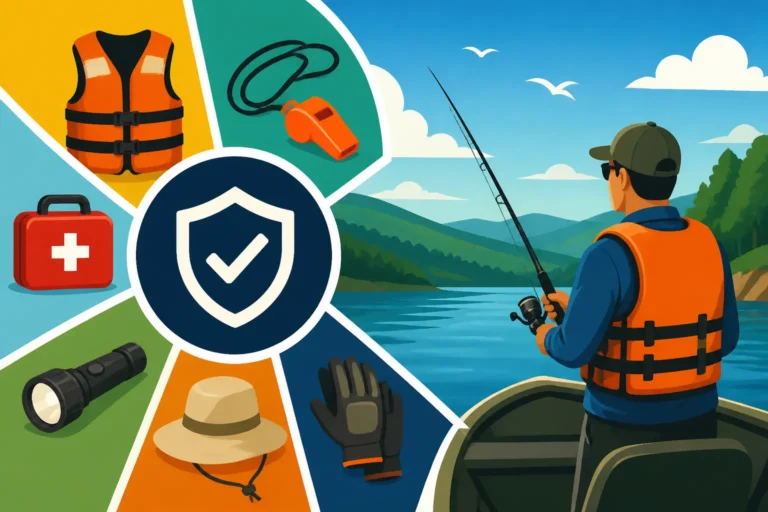
Other Must-Have Safety Items
Beyond the life jacket, there's a host of other crucial gear that every kayak angler should have on board. These items are often small, inexpensive, but incredibly valuable in a pinch:
- Whistle or Horn: You need a sound-producing device to signal other boats or call for help. A simple marine whistle attached to your life jacket is perfect.
- Light Source: If you're out near dawn, dusk, or ever plan to Night Fishing Spots on Kentucky Lake, Tennessee, you need a 360-degree white light to make yourself visible to other boaters. A headlamp is also great for personal visibility.
- Paddle Leash: This simple strap keeps your paddle attached to your kayak, preventing it from floating away if you drop it or capsize. Trust me, you don't want to be stranded without a paddle.
- Bailing Device/Sponge: Kayaks can take on water, especially in choppy conditions. A small sponge or bilge pump can help you get water out quickly.
- First-Aid Kit: Accidents happen. A compact, waterproof first-aid kit can address minor cuts, scrapes, or other injuries that might occur while fishing or paddling.
- Knife/Line Cutter: Essential for cutting tangled line, dealing with anchor ropes, or freeing yourself from snags.
- Sun Protection: Sunscreen, a wide-brimmed hat, and polarized sunglasses are vital for long days on the water.
- Communication Device: A fully charged cell phone in a waterproof case, or even a marine VHF radio for larger bodies of water, can be critical for calling for help.
Having a robust Essential Safety Gear Checklist Before a Tennessee Fishing Trip and checking it before every outing is a habit that will serve you well, no matter how short or long your trip.
Brand Mentions for Safety Gear
When it comes to purchasing quality safety gear, you don't have to break the bank, but investing in reliable equipment is always a smart move. Stores like Bass Pro Shops are fantastic resources, offering a wide array of life jackets designed specifically for fishing, including those with extra pockets and comfort features. They also carry high-quality whistles, paddle leashes, and waterproof bags for electronics. You can often try on life jackets in person to ensure a comfortable and safe fit, which is highly recommended.
For convenience and often competitive pricing, Amazon is another excellent option. You can find everything from marine first-aid kits to 360-degree kayak lights and waterproof phone pouches. Just be sure to read reviews and confirm that products meet U.S. Coast Guard approval standards where applicable. Whichever route you choose, prioritize safety and durability in your gear selections. Remember, this equipment isn't just an expense; it's an investment in your well-being and countless enjoyable hours on Tennessee's beautiful waters.
Disclaimer
This article is for general informational purposes only and does not constitute professional advice. Laws, prices and regulations vary by location and change over time. Consult a qualified professional for guidance on your specific situation.