Best Lures for Striped Bass in Deep Water
There's a special kind of challenge that comes with targeting striped bass in the deep, vast waters of Tennessee's reservoirs. These powerful fish often retreat to the cooler, darker depths, making them a puzzle for many anglers. If you've ever found yourself staring at a fish finder screen, seeing those tell-tale arches deep below, but struggling to get a strike, you're not alone. This guide is all about unraveling that mystery, helping you choose the best lures and techniques to successfully entice those big stripers out of their deep-water hideouts.
Understanding Striped Bass Behavior in Deep Water
Catching striped bass in deep water isn't just about dropping a heavy lure; it's about understanding why they're down there in the first place and what makes them tick in those darker environments. Stripers are apex predators, and their movements are largely dictated by temperature, oxygen, and their preferred forage.
Why Striped Bass Seek Deeper Depths
As the seasons change, especially when surface waters warm up, striped bass in Tennessee's reservoirs like Watts Bar, Norris, and Cherokee Lakes will often migrate to deeper, cooler sections of the water column. This isn't just about comfort; it's a physiological necessity. Like many fish, stripers need specific water temperatures to thrive. When the sun beats down and the shallows heat up, the deeper parts of the lake become their sanctuary.
They're not just escaping the heat, though. Deeper water often holds more stable oxygen levels, which can be critical during hot summer months when oxygen near the surface can deplete. And, of course, their food follows suit. Baitfish like gizzard shad and threadfin shad, which are crucial to the striper diet, also seek out these cooler, oxygen-rich zones, creating a ready-made buffet for the stripers. It’s a whole ecosystem moving down, and if you want to find the stripers, you have to go where their dinner is.
Identifying Deep Water Structures
When we talk about "deep water," we're not just talking about open, featureless expanses. Striped bass are still structure-oriented, even in the depths. They'll relate to submerged humps, old creek channels, river ledges, and deep points. Think of it like a cityscape beneath the waves; they're not just randomly swimming, they're cruising along underwater roads and congregating around submerged buildings.
Using your boat's electronics, particularly a good fish finder, becomes absolutely paramount here. You're looking for sudden drops, the old riverbed where current once flowed, or the tops of drowned timber fields. These features offer ambush points, shelter from current, and often concentrate baitfish. If you can identify a thermocline (that distinct layer where water temperature changes rapidly) on your sonar, look for bait and stripers just above, in, or directly below it, depending on the oxygen levels available. This kind of detailed scouting is what really pays off when you're trying to figure out How to Fish Deep Water for Striped Bass.
Essential Characteristics of Effective Deep-Water Striped Bass Lures
Once you've located those deep-water stripers, or at least the areas they should be, the next step is presenting a lure they can't resist. This isn't the time for finesse or tiny presentations; you need lures that can handle the journey down and make an impact when they get there.
Weight and Sink Rate: Reaching the Strike Zone
The most obvious, yet often overlooked, characteristic of a good deep-water lure is its weight. You need something heavy enough to reach depths of 30, 50, even 80 feet or more, without taking half an hour to get there. Lighter lures simply won't cut it, especially if there's any current or wind creating a drift. You need a lure that gets down quickly and stays down in the target zone.
This isn't just about raw weight, though. The design of the lure also dictates its sink rate. A slender, dense spoon will plummet faster than a bulky, plastic swimbait, even if they weigh the same. You want something that offers good control on the drop, allowing you to feel the bottom or any subtle bites on the way down. Having a selection of weights and sizes in your tackle box, maybe even a few different options you've sourced from Amazon, will give you versatility when conditions change.
Action and Vibration: Making an Impression in the Dark
In deep water, light penetration is minimal. This means stripers rely less on sight and more on their lateral line system to detect prey. Therefore, the action and vibration a lure produces become incredibly important. You want something that sends out strong pressure waves through the water, mimicking a struggling baitfish.
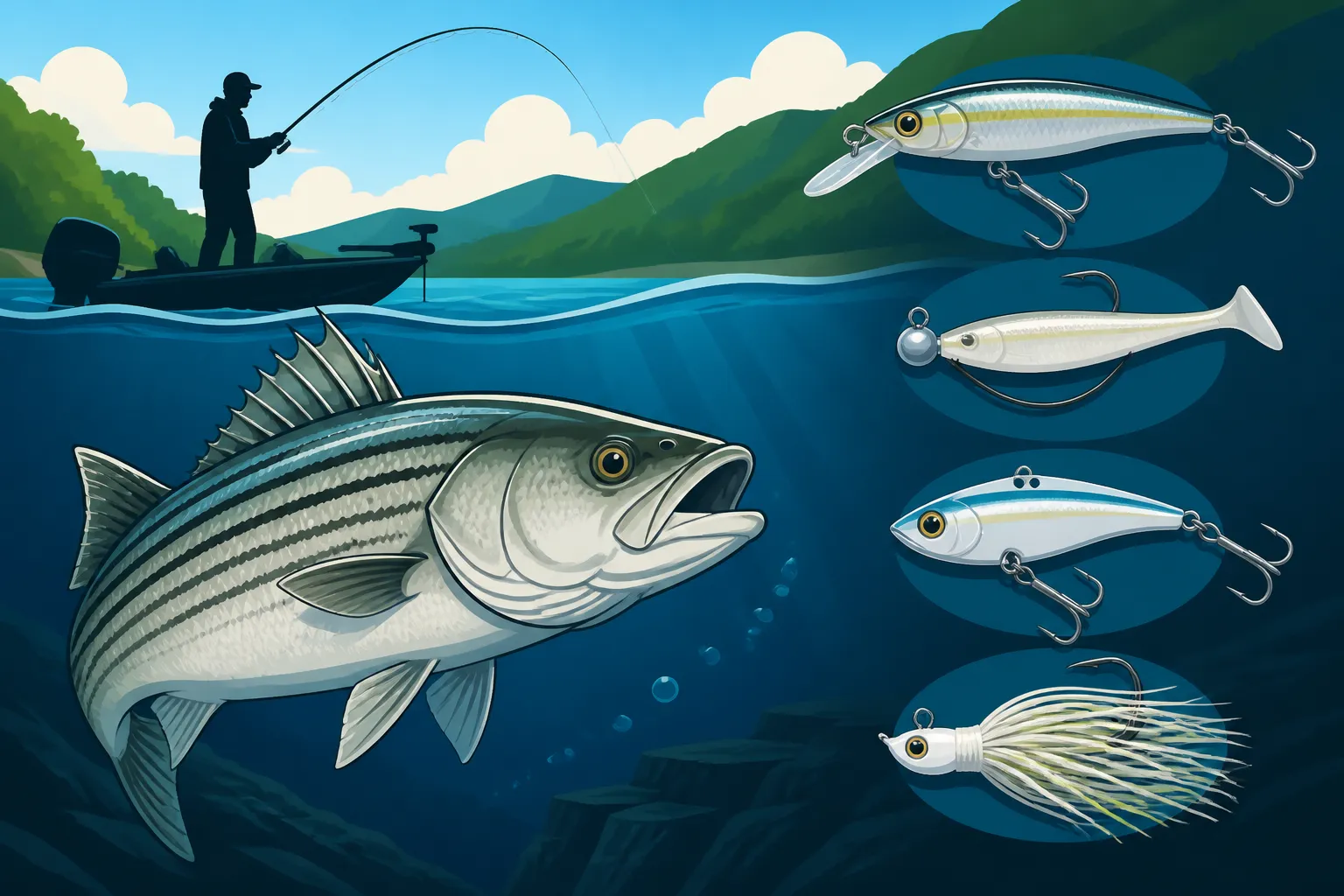
Metal jigging spoons are fantastic for this, offering a distinct flutter or wobble on the fall and a sharp thud when ripped. Deep-diving crankbaits create a lot of turbulence and vibration as they churn through the water. Even soft plastics, when paired with a heavy lead head, can be made to quiver and undulate in a way that signals "food" to a distant striper. Don't underestimate the power of sound either; some lures incorporate rattles that can further attract attention in the murky depths. This combination of visual flash, strong vibration, and subtle sound is what makes a lure truly effective in deep water.
Durability and Hook Strength: Withstanding the Fight
Striped bass are notorious fighters. They have incredible power, often making blistering runs and head shakes that can put a serious strain on your gear. A cheap lure with flimsy components just won't cut it, especially when you're dealing with larger fish. Imagine finally hooking into a monster striper after hours of effort, only for the hook to straighten or the split ring to fail – it's a heartbreaker.
Look for lures constructed with heavy-duty components: strong, sharp treble hooks or stout single hooks, robust split rings, and durable bodies that won't crack or shatter under pressure. Many seasoned striper anglers will even upgrade the hooks and split rings on their factory lures, especially if they’re targeting trophy fish. Paying a little extra for quality upfront will save you a lot of frustration and lost fish down the line. It's not just about getting the bite; it's about landing the fish once you do.
Top Lure Categories for Deep-Water Striped Bass
Now that we know what to look for in a deep-water striper lure, let's dive into some of the most effective categories that consistently put fish in the boat across Tennessee's mighty lakes.
Heavy Spoons and Jigs: Vertical Presentations
When stripers are schooling tightly or holding directly on deep structure, vertical presentations are often your most direct route to a strike. This is where heavy spoons and jigs truly shine.
Jigging Spoons
These are arguably one of the most classic and effective deep-water striper lures. Jigging spoons, like the old reliable Hopkins Shorty or even some modern casting spoons, are designed to flutter and flash on the drop, mimicking a dying baitfish. Their dense metal construction means they plummet quickly to the desired depth. You simply drop them down, let them hit bottom (or your desired depth just above the fish), and then aggressively snap them upwards a few feet before letting them flutter back down on a semi-slack line. Most strikes occur on the fall, so you have to pay close attention to your line for any subtle twitch or sudden weightlessness. They come in various sizes and weights, making them versatile for different depths and baitfish sizes. You can often find great multi-packs of these on Amazon to stock up your tackle box.
Bucktail Jigs
While often associated with shallower water, heavy bucktail jigs are incredibly effective in deep water when paired with a robust jig head. The natural pulsing action of the deer hair, combined with a quick drop, makes them irresistible to stripers. You can tip them with a soft plastic trailer, a piece of cut bait, or even a live shad for added attraction. The key here is getting them down to the fish and then working them with a series of sharp lifts and falls, making the hair flare and contract. They offer a more subtle, yet highly effective, presentation than a spoon, especially when fish are a bit wary.
Deep-Diving Crankbaits: Covering Expansive Water
Sometimes stripers aren't tightly balled up; they might be spread out, cruising along a deep contour or suspended over open water. This is when deep-diving crankbaits, often employed through trolling, become invaluable for covering water efficiently.
The Power of Trolling
Trolling with deep-diving crankbaits allows you to present a lure at a consistent depth over vast areas, effectively searching for active fish. Lures like large Rapala Deep Divers or Bandit Walleye Deep are designed with oversized lips to drive them down to impressive depths when pulled behind a boat. You'll want to experiment with different crankbaits to find out which ones get to the desired depth and have the action that stripers respond to. What Speed Should You Troll for Striped Bass in Tennessee? is a crucial factor, so make sure to vary your boat speed until you find what triggers bites.
Matching the Hatch and Color Selection
While vibration is key, color and profile still matter, even in deep water. Try to match the size and color of the dominant baitfish in the reservoir. Shad patterns (silver, white, grey) are almost always a safe bet in Tennessee. However, don't be afraid to experiment with brighter or darker colors, especially on cloudy days or in particularly stained water. Sometimes, a bright chartreuse or fire tiger can trigger a reaction strike, even if it doesn't perfectly mimic a natural prey item. Consider having a few different color options on hand when you're stocking up, perhaps even ordering a few varied options from Amazon.
Live Bait Rigs: The Unbeatable Option
Let's be honest: sometimes, nothing beats live bait. When stripers are finicky or extremely lethargic in deep water, a struggling live baitfish is often the only thing that will get their attention.
Gizzard and Threadfin Shad
These are the kings of striper bait in Tennessee. Gizzard shad, being larger, are excellent for targeting bigger fish, while threadfin shad, though smaller, are often abundant and irresistible to stripers of all sizes. Catching them with a cast net is a skill in itself, but having a well-stocked livewell with healthy shad gives you a distinct advantage.
Presenting Live Bait in Deep Water
To get live bait down to deep-holding stripers, you'll typically use a weighted free-line or a downline rig. A weighted free-line involves a large egg sinker (1-3 ounces, depending on depth and current) above a swivel, then a leader (2-4 feet of fluorocarbon) to a sturdy circle hook. The circle hook is essential for minimizing gut-hooking and ensuring a solid hook-up in the corner of the fish's mouth. For even more precise depth control, especially if the stripers are suspended, a Best Downriggers for Tennessee Striped Bass Trolling setup can be invaluable, allowing you to present a live bait or lure at an exact depth and hold it there. This method is often unbeatable when fish are concentrated in specific zones.
Techniques for Presenting Deep-Water Striped Bass Lures
Having the right lure is only half the battle; knowing how to present it effectively in deep water is what truly sets successful anglers apart.
Vertical Jigging Strategies
When you've pinpointed a school of stripers on your fish finder, or you're working a deep hump where you know they congregate, vertical jigging is a highly active and rewarding technique.
Controlled Drops and Aggressive Rips
The basic action involves dropping your spoon or jig directly over the fish. As it descends, keep a watchful eye on your line. Often, a striper will hit the lure on the fall, and your line might just pause, jump, or go slack. Once it reaches the desired depth, engage your reel, and make a sharp, aggressive sweep upward with your rod tip, lifting the lure several feet. This makes the spoon flash and dart, mimicking an escaping baitfish. Immediately drop your rod tip back down, allowing the lure to flutter and fall freely on a controlled slack line. Repeat this motion, varying the speed and height of your rips until you find what the fish prefer. Sometimes a short, sharp twitch is all it takes, while other times a long, sweeping rip is necessary to trigger a strike. It’s all about experimenting and paying attention to what the fish are telling you.
Using Electronics to Your Advantage
Your fish finder isn't just for locating fish; it's a critical tool for vertical jigging. Position your boat directly over the fish arches you see on screen. As you drop your lure, you should be able to track its descent on the sonar, watching it fall right into the middle of the school. If the fish move, you move. If they rise or fall in the water column, adjust your jigging depth accordingly. Modern side-imaging and down-imaging units make this even easier, allowing you to see exactly where your lure is in relation to the fish. Mastering this interplay between your lure and your electronics is the cornerstone of effective deep-water jigging.
Trolling with Deep-Diving Lures and Planer Boards
For those times when stripers are more scattered, or you want to cover a lot of ground quickly, trolling with deep-diving lures or live bait can be incredibly effective.
Matching Speed and Lure Dive Depth
The challenge with trolling in deep water is getting your lure to the correct depth and keeping it there consistently. Different lures are designed to dive to different maximum depths at specific trolling speeds. It's often a matter of trial and error, but many lure manufacturers provide dive charts that can give you a starting point. Adjust your trolling speed, line diameter, and the amount of line you let out until your lure is running right in the strike zone. Sometimes adding lead core line or a small trolling weight a distance in front of your lure can help it achieve even greater depths.
Leveraging Planer Boards and Rod Holders
To spread out your lines and cover a wider swath of water, especially when multiple anglers are fishing, planer boards are a fantastic addition. These devices clip to your main line and pull your lures out to the side of the boat, preventing tangles and allowing you to present more baits simultaneously. When you get a strike, the planer board releases, allowing you to fight the fish directly. Rod Holder and Planer Board Setup for Reservoir Striper Trolling can be a game-changer, giving you the ability to cover vast areas and present numerous offerings to those cruising stripers. You'll want sturdy rod holders securely mounted to your boat to handle the powerful strikes and long fights.
Advanced Depth Control: Downriggers and Lead Core Line
For ultimate precision in deep-water striper fishing, especially when fish are suspended at a specific depth, advanced depth control methods are indispensable.
The Precision of Downriggers
Downriggers are mechanical devices that use a heavy ball weight and a release clip to carry your lure or live bait down to an exact, pre-set depth. Your fishing line is clipped into a release, and when a fish strikes, the line pops free, allowing you to fight the fish directly on your rod. This is particularly effective when you've identified a thermocline or a specific depth range where stripers are actively feeding. You can run multiple lines at different depths, systematically searching the water column until you find the fish. Downriggers allow you to present light lures or live bait that wouldn't otherwise reach those depths, making them incredibly versatile. Learning the nuances of a Best Downriggers for Tennessee Striped Bass Trolling setup can significantly increase your success.
Understanding Lead Core Line
Lead core line is another method for achieving depth without heavy weights directly on your leader. This specialized line has a lead core encased in a braided or nylon sheath, causing it to sink. The general rule of thumb is that each "color" (usually 10 yards) of lead core line will sink to a certain depth at a specific trolling speed, although this can vary greatly with lure size and current. It's often used for trolling, allowing you to get smaller crankbaits or bucktail jigs down deep. While it doesn't offer the exact precision of a downrigger, it's a simpler setup and can be very effective for covering those mid-to-deep ranges when stripers are suspended. The key is to learn how much line you need to deploy to hit your target depth.
Gear Considerations for Deep-Water Striped Bass Fishing
Landing these powerful fish from the depths requires not just the right lures and techniques, but also a robust and reliable gear setup. You can't bring a knife to a gunfight, and you certainly can't bring ultralight tackle to a deep-water striper battle.
Rods, Reels, and Line Strength
When you're fighting a 20-pound striper from 60 feet down, your equipment is put to the test.
Rods
You'll want a rod with a strong backbone and a medium-heavy to heavy action. This provides the power needed to set the hook deeply, fight a strong fish, and also to properly work heavy jigging spoons or deep-diving crankbaits. A rod length of 7 to 8 feet is often ideal, providing good leverage for casting and fighting, especially from a boat. Look for rods specifically designed for saltwater or heavy freshwater applications. While a Best Rods for Largemouth Bass might suffice for smaller stripers, dedicated striper rods will give you the confidence you need.
Reels
Matching your rod, a stout reel is crucial. A conventional (baitcasting) reel with a strong drag system and high line capacity is often preferred for deep-water trolling and jigging, especially for larger stripers. For vertical jigging, some anglers prefer spinning reels due to their ease of use, but ensure it's a larger model capable of holding ample heavy line and handling immense pressure. The drag system is paramount – it needs to be smooth and powerful to prevent break-offs during those initial explosive runs.
Line
Braided line is almost a necessity for deep-water striper fishing. Its lack of stretch provides unparalleled sensitivity, allowing you to feel subtle bites even at extreme depths. It also offers a much thinner diameter for its breaking strength compared to monofilament, meaning less water resistance and a faster sink rate for your lures. Use a main line of 30-50 lb test braid, then attach a 3-5 foot fluorocarbon leader of similar or slightly lower breaking strength. Fluorocarbon is nearly invisible underwater and offers good abrasion resistance, which is important when fishing around rocky structures. Consider a high-quality, high-visibility braid that you can easily track as it enters the water and watch for those tell-tale twitches on the drop.
The Role of Fish Finders and GPS
I've touched on this already, but it bears repeating: your electronics are your eyes underwater. They are not optional for successful deep-water striper fishing.
Advanced Sonar Technology
A quality fish finder with CHIRP sonar, down-imaging, and side-imaging capabilities will transform your deep-water game. CHIRP sonar provides incredibly clear target separation, allowing you to distinguish between baitfish and larger predator arches. Down-imaging gives you a photographic-like view directly beneath your boat, revealing subtle structure details. Side-imaging is fantastic for scouting large areas, locating submerged humps, creek channels, and even schools of baitfish off to the sides of your boat. Learning to interpret these displays effectively is a skill that will pay dividends. Many reputable brands offer excellent units, and you can explore options on Amazon.
GPS and Mapping
Once you find productive areas, you'll want to mark them on your GPS. Waypoints for deep humps, ledges, or areas where you found active fish are invaluable for future trips. A detailed mapping chip for your specific reservoir (like Kentucky Lake, Chickamauga Lake, or Norris Lake) will show you contour lines, old riverbeds, and other submerged features that might not be visible on standard charts. This combination of real-time sonar data and accurate GPS mapping allows you to precisely navigate to and fish the most productive deep-water spots, saving you countless hours of aimless searching. Best Fish Finders for Tennessee Reservoir Fishing are an investment, but they are absolutely worth it for serious striper anglers.
| Lure Type | Best Application | Key Features | Pros | Cons |
|---|---|---|---|---|
| Jigging Spoons | Vertical jigging over schools, deep structure | Heavy, dense metal; various sizes; strong hooks | Fast sink rate; strong flash and vibration; effective on suspended fish | Requires active rod work; can get snagged easily |
| Deep-Diving Crankbaits | Trolling to cover expansive water, specific depths | Large diving lip; buoyant body; rattling chambers (often) | Covers large areas; stable depth control (with proper setup); enticing action | Can be depth-limited without downriggers; specific speed requirements |
| Heavy Bucktail Jigs | Vertical jigging, casting to visible structure | Lead head with deer hair skirt; can add trailers; various weights | Natural pulsing action; versatile; good feel through the water | Less flash than spoons; can require tipping with bait |
| Live Bait Rigs | Finicky fish, trophy hunting, precise depth | Live shad (gizzard/threadfin); heavy sinker; swivel; fluorocarbon leader; circle hook | Often irresistible when other lures fail; natural presentation; large fish magnet | Requires catching/keeping live bait; can be more passive |
Final Thoughts on Deep-Water Striper Lures
Successfully targeting striped bass in the deep waters of Tennessee's reservoirs is a highly rewarding endeavor that requires patience, the right tools, and a good understanding of fish behavior. There's nothing quite like the thump of a big striper hitting your lure far below the surface, followed by that electrifying first run. Remember to always prioritize safety when boating on these large lakes, and be mindful of Tennessee Fishing Regulations Explained for striped bass. The fish are out there, deep down, waiting for the right presentation.
Disclaimer
This article is for general informational purposes only and does not constitute professional advice. Laws, prices and regulations vary by location and change over time. Consult a qualified professional for guidance on your specific situation.