What Speed Should You Troll for Striped Bass in Tennessee?
Trolling for striped bass in Tennessee reservoirs can be incredibly rewarding, but it often leaves anglers scratching their heads about one crucial factor: speed. It's not just about putting your lure in the water and driving around; finding that sweet spot for your boat speed can be the difference between a triumphant cooler full of fish and a frustrating day of dragging a lifeless line. This guide is all about helping you dial in your trolling speed to maximize your chances of hooking into those powerful Tennessee stripers, taking into account the nuances of their behavior and the environments they call home.
Understanding Striped Bass Behavior and Why Trolling Works
Striped bass, often called "stripers" by us seasoned anglers, are powerful, predatory fish that thrive in the expansive reservoirs and rivers of Tennessee. Unlike some species that might hold tight to structure, stripers are often pelagic, meaning they roam open water, constantly on the hunt for baitfish like shad. This nomadic lifestyle is precisely why trolling is such an effective strategy – it allows you to cover vast amounts of water and present your lure to these actively foraging predators.
The Striper's Predatory Instincts
Think about a striper's world: they're constantly looking for an easy meal. They're built for speed and aggression, often herding schools of baitfish into "balls" before crashing through them. When you're trolling, you're essentially mimicking a struggling or fleeing baitfish, triggering that innate predatory response. The speed at which your lure moves directly impacts how realistic or enticing that presentation appears. Too fast, and it might look unnatural or too quick to catch; too slow, and it might seem like easy prey that something else already got to, or just not pique their interest. It’s a delicate balance that changes based on many factors. Knowing How to Identify a Striped Bass is the first step, then understanding their feeding habits.
Why Trolling is a Go-To Technique
Trolling isn't just a casual cruise; it's a strategic way to present multiple baits at various depths and distances behind your boat. This method allows you to systematically search for active fish, especially when they're scattered across open water or suspended at specific depths. By using a combination of different lures, depths, and speeds, you can effectively locate where the stripers are feeding. This is particularly useful in massive bodies of water like Cherokee Lake or Watts Bar Lake, where finding a scattered school of fish would be nearly impossible otherwise. It's about bringing the lure to the fish, rather than waiting for the fish to come to you. You can learn more about general techniques in How to Troll for Striped Bass.
Optimal Trolling Speeds for Striped Bass in Tennessee
Let's cut to the chase: there's no single "magic number" for trolling speed. It's a range, and it varies. However, most experienced Tennessee striper anglers will tell you that a general sweet spot falls between 2.0 to 4.0 miles per hour (mph). This range provides a good starting point, but you'll need to be willing to experiment and adjust based on the conditions and the specific lures you're deploying.
The Standard Speed Range
Within that 2.0 to 4.0 mph range, many anglers find success around 2.5 to 3.5 mph for many typical striper trolling setups. At these speeds, most common trolling lures like bucktails, spoons, and diving crankbaits will exhibit their intended action. They'll wobble, dart, or pulsate in a way that looks natural and irresistible to a hungry striper.
When the stripers are actively feeding and aggressive, you might push towards the higher end of that range, even hitting 4.0 mph, to cover ground quickly and provoke reaction strikes. Conversely, if the fish seem lethargic, perhaps due to a cold front or simply a slower bite, slowing down to 2.0-2.5 mph can sometimes tempt them into striking a lure that appears to be an easier target.
Adjusting for Different Lure Types
The type of lure you're using will heavily influence your ideal trolling speed. A deep-diving crankbait, for instance, is designed to work effectively at certain speeds to reach its maximum depth and produce its signature wobbling action. Too slow, and it might not dive deep enough or have enough action. Too fast, and it might blow out, meaning it loses its intended action and just spins unnaturally.
For umbrella rigs, which are incredibly popular for stripers in Tennessee, you'll generally troll at slower speeds, often in the 2.0-3.0 mph range. These rigs, with their multiple baits, are meant to mimic a small school of baitfish. Trolling them too fast can make them appear unnatural or tangled. Similarly, live bait, when trolled, usually requires slower speeds, often 1.0-2.0 mph, to keep the bait alive and swimming naturally, rather than dragging lifelessly. If you're using big swimbaits, they might need a bit more speed to get their tail wagging correctly, pushing you toward the 3.0-4.0 mph mark. You'll want to choose the Best Lures for Striped Bass in Deep Water carefully and match your speed to them.
Factors Influencing Your Trolling Speed
As I mentioned, it's not a one-size-fits-all situation. Several factors play a critical role in determining the optimal trolling speed on any given day. Paying attention to these subtle cues can dramatically improve your success.
Water Temperature and Fish Activity
Water temperature is arguably one of the most significant factors affecting striper activity. In colder water, typically below 50 degrees Fahrenheit, stripers tend to be more sluggish. Their metabolism slows down, and they're less likely to chase a fast-moving bait. In these conditions, slowing your troll to the lower end of the spectrum (2.0-2.5 mph) often proves more effective. The lure looks like an easier meal, requiring less energy expenditure from the fish. On the flip side, warmer water (say, 60-70 degrees Fahrenheit) usually means more active, aggressive fish. This is when you can confidently bump up your speed, potentially reaching 3.5-4.0 mph, to trigger those reaction strikes from chasing stripers. Understanding How Water Temperature Affects Fish Activity is crucial for any angler.
Forage Base and Baitfish Behavior
What are the stripers eating? The size and behavior of the local baitfish will give you clues. If stripers are feeding on large, fast-moving gizzard shad, a quicker troll with larger lures might be the ticket. If they're keying in on smaller, slower-moving threadfin shad or alewives, then a more moderate speed and smaller presentation might be better. Observing how baitfish schools are acting on your fish finder, or even seeing them jump at the surface, can provide invaluable information. If the bait is scattered and moving slowly, the stripers might be less aggressive, calling for a slower approach. If the bait is tightly balled up and darting, expect a faster, more violent strike, and adjust your speed accordingly.
Depth and Current Considerations
The depth at which you're targeting stripers also impacts your trolling speed. When fishing deeper, using downriggers or heavy weights, you might need a slightly faster speed to maintain your lure's action at those depths, especially if there's any subsurface current. Current itself is a huge factor in river systems like the Tennessee River. When trolling upstream against a strong current, your boat's speed over ground (SOG) might be 2.5 mph, but your lure's speed through the water could be much higher due to the opposing current. Conversely, trolling with the current means you'll need to increase your SOG to achieve the desired lure speed through the water. Always monitor your boat's speed over ground but also mentally adjust for how the current might be affecting your lures. Getting a handle on How to Fish Deep Water for Striped Bass often involves mastering these depth and current dynamics.
Gear and Techniques for Effective Trolling
Beyond just the speed, having the right setup and understanding how to use it makes all the difference when targeting Tennessee stripers. This involves everything from your boat's capabilities to your rod, reel, line, and the array of terminal tackle designed for trolling.
Essential Trolling Gear
To troll effectively for stripers, you'll need more than just a basic fishing rod. For starters, a good quality sonar or fish finder is non-negotiable. Devices from brands like Humminbird or Lowrance (available at Bass Pro Shops or on Amazon) can help you identify baitfish schools and suspended stripers, allowing you to target specific depths and areas. Beyond that, consider:
- Trolling Motor: A reliable electric trolling motor with GPS capabilities (like those from Minn Kota or Garmin) is incredibly useful for maintaining precise speeds, especially in windy conditions or when following contour lines.
- Rod Holders: You'll want sturdy rod holders mounted securely to your boat to handle the powerful strikes of stripers.
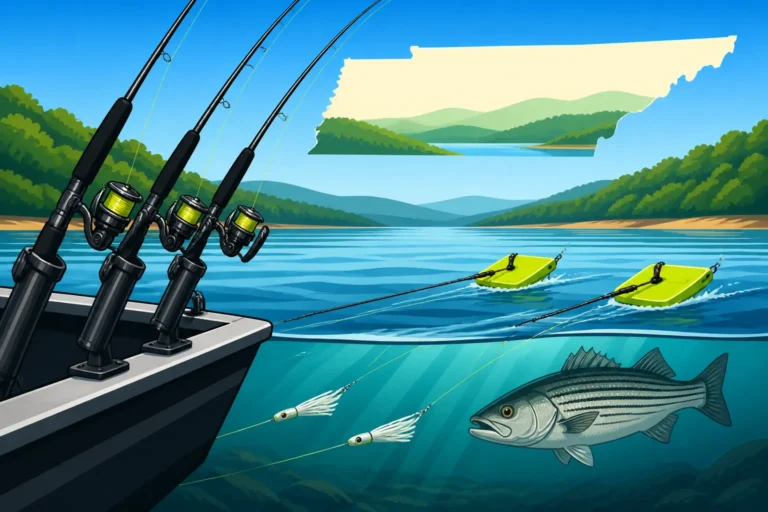
- Downriggers or Planer Boards: These tools are vital for presenting lures at specific depths or spreading multiple lines out from the boat. Downrigger Basics for Striped Bass is a great place to start learning about these. Planer boards help you cover a wider swath of water, while downriggers precisely place your lures at a desired depth.
- Heavy-Duty Rods and Reels: Stripers are tough fighters. Use medium-heavy to heavy action rods paired with conventional or robust spinning reels spooled with strong braided or monofilament line. The Best Trolling Gear for Tennessee Striped Bass often includes setups capable of handling large fish and heavy tackle.
Monitoring and Adjusting Your Speed
Accuracy is key. Your boat's speedometer or GPS will give you your speed over ground (SOG). However, sophisticated fish finders often offer "speed through water" readings, which can be more accurate for understanding how your lures are truly moving, especially when currents are at play.
Start by setting your boat to that general 2.5-3.5 mph range. Then, watch your rod tips and the action of your lures (if they're visible). Do they look natural? Are they diving to the right depth? Pay attention to strikes. If you get a bite, note your exact speed, depth, and the lure that worked. If the bite slows, try incrementing your speed up or down by 0.2 to 0.5 mph. Sometimes, such a small change is all it takes to trigger more strikes. Keep a mental log, or even a physical one, of what worked under what conditions. This experience will build your intuition for future trips to places like Chickamauga Lake: Tennessee's Top Bass Fishing Destination which also holds big stripers.
| Factor | Recommended Speed Adjustment | Typical Speed Range (mph) | Notes |
|---|---|---|---|
| Active Fish / Warm Water | Increase speed | 3.0 – 4.0+ | Triggers reaction strikes, covers water faster. |
| Lethargic Fish / Cold Water | Decrease speed | 2.0 – 2.5 | Presents easier meal, allows fish more time to react. |
| Umbrella Rigs | Slower, steady speed | 2.0 – 3.0 | Mimics school of bait, prevents tangling. |
| Large Diving Crankbaits | Moderate to faster speed | 2.5 – 4.0 | Ensures proper lure action and depth. |
| Live Bait | Very slow, just enough to move | 1.0 – 2.0 | Keeps bait alive and natural. |
| Upstream Current | Increase SOG to maintain lure speed | Adjust SOG accordingly | Lure speed through water is key. |
| Downstream Current | Decrease SOG to maintain lure speed | Adjust SOG accordingly | Lure speed through water is key. |
| Clear Water | Often slightly slower, more natural | 2.0 – 3.0 | Fish have more time to inspect; presentation must be impeccable. |
| Turbid Water | Can go slightly faster, reaction bites | 2.5 – 3.5 | Fish rely more on vibration/flash; quick presentation can work. |
Remember, this table is a guideline. Always let the fish tell you what they prefer on any given day. Good luck out there on the water, and may your rod bend often!
Disclaimer
This article is for general informational purposes only and does not constitute professional advice. Laws, prices and regulations vary by location and change over time. Consult a qualified professional for guidance on your specific situation.