Downrigger Basics for Striped Bass
It's a familiar scenario for many Tennessee anglers: you're out on one of our vast reservoirs, the sun is shining, and your sonar is lighting up with what looks like massive schools of baitfish, often surrounded by bigger marks. You know those big, powerful striped bass are down there, cruising in the cool, deep water, but no matter what you throw, nothing seems to reach them or stay in their strike zone long enough. This guide is going to peel back the layers on downrigger basics for striped bass, showing you how this specialized trolling technique can consistently put your lures right in front of those elusive deepwater giants, turning frustration into fish-catching success.
Understanding the Downrigger: Your Secret Weapon for Deep Stripers
Fishing for striped bass in Tennessee's big reservoirs like Watts Bar, Norris, or Percy Priest often means dealing with significant depths. These fish frequently suspend in the water column, sometimes 30, 50, or even 100 feet down, chasing baitfish that also hold at specific depths where temperature and oxygen levels are just right. Getting your lure down to exactly that depth and keeping it there, especially when you're moving, is where traditional fishing methods often fall short. That's precisely where downriggers shine, acting as an indispensable tool for serious striper anglers.
What is a Downrigger, Really?
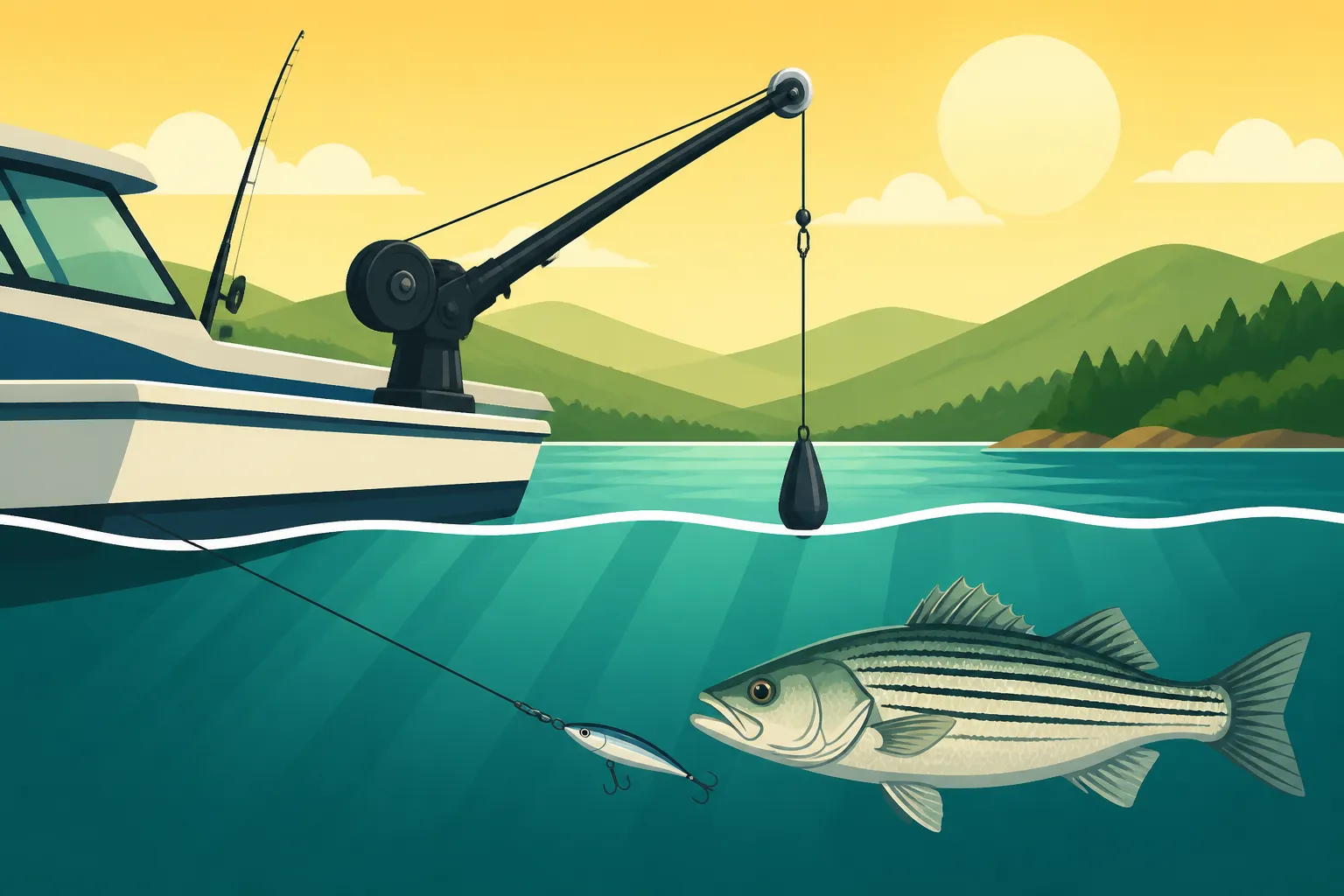
At its heart, a downrigger is a specialized piece of equipment designed to accurately present your fishing lure at a precise depth while trolling. Think of it as a heavy-duty elevator for your bait. It consists of a weighted ball (the "downrigger ball" or "cannonball") attached to a strong cable, which is lowered and raised by a cranking mechanism, either manual or electric. Your fishing line, with its lure, isn't directly tied to this ball. Instead, it's held by a "release clip" that's clamped onto the downrigger cable, just above the ball. When a fish strikes your lure, the tension causes the release clip to pop open, freeing your fishing line so you can fight the fish directly without the added weight of the downrigger ball. This system allows you to cover vast amounts of water at specific depths, which is absolutely crucial when targeting suspended fish. Without one, you're often guessing and hoping your lure dips deep enough or stays in the zone long enough.
Why Downriggers are Essential for Tennessee Striped Bass
Striped bass, particularly the larger ones, are often found holding in cooler, oxygen-rich water strata during warmer months. They'll follow schools of shad or other forage fish into these deeper zones. Trying to reach them with standard casting or even weighted trolling methods can be hit-or-miss. For instance, if you're marking a school of stripers at 45 feet over 100 feet of water, a crankbait might dive to 20 feet, and a heavy jig might sink past them too quickly, or be too slow to get back up if you're trying to stay with them.
Downriggers eliminate this guesswork. They allow you to consistently present your chosen lure – whether it's a spoon, a bucktail jig, a swimbait, or even live bait – at the exact depth where the fish are holding. This precision is a game-changer for Striped Bass Fishing in Tennessee Reservoirs. You can literally put your bait right through the middle of a fish school shown on your sonar, increasing your chances exponentially. Moreover, downriggers let you use lighter lines and lures that wouldn't normally dive deep on their own, giving your presentation a more natural, enticing action. When you're trying to emulate a school of fleeing baitfish or present a single, easy meal, that natural movement can make all the difference between a follow and a solid strike.
Picking the Perfect Downrigger for Tennessee Waters
Choosing the right downrigger isn't just about grabbing the first one you see; it’s about matching the equipment to your fishing style, your boat, and the specific demands of Tennessee’s diverse waterways. The main considerations often boil down to how much control and convenience you desire versus your budget and the type of fishing you do most frequently.
Manual vs. Electric: Which is Right for You?
The most fundamental choice you'll face is between manual and electric downriggers. Each has its pros and cons, especially when you're spending long days on the water.
-
Manual Downriggers: These are operated by a hand crank, much like a traditional fishing reel. They are generally more affordable, making them a great entry point for anglers looking to try downrigging without a significant initial investment. They're also less complex, meaning fewer electronic components that could potentially malfunction. For smaller boats or those who fish less frequently, a manual downrigger can be perfectly adequate. You'll definitely get an arm workout, though, especially if you're checking your bait often or fishing very deep. Imagine reeling up a 10-pound ball from 80 feet repeatedly – it can be tiring! Brands like Cannon and Scotty offer reliable manual options that are widely available, including on Amazon.
-
Electric Downriggers: As the name suggests, these are powered by your boat's 12-volt battery, raising and lowering the downrigger ball with the push of a button. This convenience is a huge advantage, especially when fishing deep, needing frequent bait checks, or running multiple downriggers. They allow you to focus more on boat control and reading your electronics rather than physical labor. Many electric models also come with advanced features like auto-up, which automatically retrieves the ball when a fish hits, or cycle features that raise and lower the ball slightly to vary lure depth, creating an enticing "yo-yo" effect. For serious striper anglers who spend a lot of time on the water, the investment in electric models often pays off in reduced fatigue and increased efficiency. They are heavier and more complex, which means more to potentially go wrong, but their reliability has improved vastly over the years.
Key Features to Look for in a Downrigger
Beyond the manual or electric decision, several other features can enhance your downrigger fishing experience on Tennessee's lakes.
-
Boom Length: This refers to the length of the arm that extends out from the downrigger base. Longer booms (typically 3-5 feet) are excellent for spreading out your lines, which is crucial when running multiple downriggers or if you're trying to keep lines clear of your propeller and boat hull. However, longer booms also require more space on your boat and can sometimes be unwieldy on smaller craft. Consider your boat size and deck layout.
-
Retrieval Speed: For electric models, a faster retrieval speed means less downtime between re-rigging or when a fish hits. This might seem minor, but when the bite is hot, every second counts. Check the specifications – some models boast significantly quicker retrieve rates.
-
Line Counter: A good, accurate line counter is non-negotiable. It allows you to precisely know how much cable is deployed, ensuring your lure is at the desired depth. Most downriggers, manual or electric, include one, but accuracy and ease of reading can vary. Digital counters on electric models are often clearer and more precise.
-
Rod Holders: Many downriggers come equipped with integrated rod holders, which can be incredibly convenient, especially if your boat has limited space for mounting separate rod holders. Look for adjustable holders that can accommodate different rod angles.
-
Swivel Bases: A swivel base allows you to rotate the downrigger in its mount, making it much easier to deploy and retrieve the ball, especially if you have long booms. This feature can make a huge difference in comfort and safety, allowing you to swing the downrigger inboard for easier access.
When considering these features, think about your typical fishing trip. Are you usually solo, or do you have a crew? How deep are the waters you usually fish, and how big are the fish you target? A robust downrigger with a strong motor and reliable clutch system is key for battling large Tennessee stripers.
Rigging Up for Success: Setting Up Your Downrigger System
Getting your downrigger properly set up is more than just bolting it to the boat; it involves a whole system designed for efficiency and, most importantly, for catching fish. Every component, from the mounting to the release clip, plays a role in presenting your lure effectively and ensuring a smooth fight once a striper is on the line.
Attaching the Downrigger to Your Boat
Proper mounting is crucial for safety and functionality. Downriggers, especially with heavy balls and the forces exerted by big fish, can put a lot of strain on your boat's gunwale. Most downriggers come with a mounting base that needs to be securely bolted to a flat, sturdy surface on your boat. If your boat doesn't have existing downrigger mounting plates, you might need to reinforce the area.
- Permanent Mounts: These involve drilling holes and bolting the base directly to the boat. This is the most secure method and recommended for larger downriggers and aggressive fishing. Ensure you use backing plates underneath the gunwale to distribute the load and prevent gelcoat cracking or structural damage.
- Clamp-on Mounts: Some smaller, usually manual downriggers offer clamp-on bases, which are less invasive. These are suitable for lighter setups and smaller boats, but always double-check their stability, especially if you encounter rough water or hook into a trophy striper.
- Rail Mounts: Adapters are available to mount downriggers to boat rails. Again, ensure the rail is strong enough and the mount is secure. These are often a good option for kayaks or smaller craft where gunwale space is limited.
When positioning your downrigger, consider accessibility for operation, clearance for rod tips, and keeping the downrigger cable clear of your propeller and other lines. Many anglers mount them towards the stern, sometimes slightly angled out to help spread the lines. Remember, if you plan on running multiple downriggers, proper spacing is key to avoid tangles.
Getting Your Line Set Up with the Release Clip
The release clip is a small but mighty component of your downrigger system. It's what holds your fishing line to the downrigger cable, allowing it to "release" when a fish strikes. There are several types, each with slightly different characteristics.
- Stacker Release Clips: These allow you to run multiple lines off a single downrigger cable. One clip attaches directly to the cable with the main line, and a second clip attaches further up the cable, allowing you to run an additional lure at a shallower depth. This is an excellent way to cover more of the water column, especially when the fish's exact depth is unknown or when you observe fish at varying depths on your sonar. However, remember that running multiple lines off one downrigger adds drag and can make precise depth control slightly more challenging.
- Adjustable Tension Clips: Many modern release clips feature adjustable tension, letting you set how easily your line pops free. For larger, harder-hitting fish like stripers, you'll want a higher tension setting to prevent false releases from boat movement or currents. For lighter-biting fish or if you're using very light tackle, you'd set it lighter. Experiment to find the sweet spot that holds your line securely but releases cleanly when a fish hits.
- Attaching Your Line: Your fishing line is threaded through the release clip's jaws. Once set, the clip is then attached to the downrigger cable. You'll typically leave a good amount of "free line" (often 10-30 feet, sometimes more) between your rod tip and the release clip. This slack, or "setback," allows your lure to swim freely behind the downrigger ball and cable, presenting a more natural action and keeping it out of the immediate proximity of the ball's disturbance. It also provides a shock absorber when a fish first hits.
Choosing Your Downrigger Ball and Line
The downrigger ball is literally the anchor of your system, responsible for taking your lure down to the desired depth.
- Downrigger Ball Weight: The weight of the ball directly impacts how well it holds depth, especially in current or at faster trolling speeds. Common weights range from 6 to 15 pounds. For deep-water striper fishing in Tennessee's larger reservoirs, a 10-pound or 12-pound ball is often a good all-around choice. If you're encountering strong currents or really pushing your trolling speed, you might need to go up to a 15-pound ball to minimize "blowback" (where the ball is pushed back and up in the water column, losing depth). Lighter balls are suitable for shallower water or slower speeds.
- Downrigger Ball Shape: Most balls are cannonball-shaped, but some specialized shapes, like pancakes or finned balls, are designed to reduce blowback and track truer behind the boat.
- Downrigger Cable: Most downriggers come spooled with stainless steel cable, which is very strong and durable. However, some anglers prefer braided downrigger line, often with a lead core, as it offers a quieter operation and can be less prone to kinking. If you opt for braided line, ensure it's specifically designed for downriggers. Always keep an eye on your cable for frays or damage, replacing it if any wear is visible. You can find replacement cables and even downrigger balls on Amazon or at local tackle shops.
Here's a quick comparison of downrigger ball types:
| Ball Type | Shape | Primary Benefit | Ideal Use Case | Considerations |
|---|---|---|---|---|
| Cannonball | Spherical | Simple, effective, widely available | General purpose, moderate depths and speeds | More blowback at high speeds/strong currents |
| Pancake | Flat disc | Reduced blowback, cuts water well | Faster trolling speeds, deeper depths, strong currents | Can be less stable in very choppy water |
| Finned/Winged | Hydrodynamic | Excellent tracking, minimal blowback | Precision trolling, high speeds, deep water, for when consistent depth is critical | More expensive, can be prone to snagging on bottom |
| Torpedo | Elongated | Reduced resistance, good stability | Fast trolling, less resistance than cannonball | Still some blowback, less common than others |
Downrigger Techniques for Consistent Striped Bass Catches
Once your downrigger is set up, the real fun begins: learning how to use it effectively to put those Tennessee striped bass in the boat. It's a blend of science and art, requiring attention to detail, a good understanding of your electronics, and a feel for lure presentation.
Controlling Depth and Speed
Precision is the name of the game with downriggers. Your fish finder is your best friend here.
- Reading Your Sonar: Watch your sonar closely for baitfish schools and individual fish arches. Stripers often suspend just above or within bait schools. Once you pinpoint the depth of interest, use your downrigger's line counter to send your lure to that exact depth. If you see a striper mark at 50 feet, aim for 45-55 feet to get your lure into its strike zone. Don't be afraid to adjust depth by a few feet up or down if you're not getting bites. Fish can be finicky.
- Managing Blowback: As mentioned earlier, "blowback" is when the downrigger ball is pushed backward and upward in the water column due to boat speed and current, making your actual lure depth shallower than what your counter indicates. To counteract this, you can:
- Increase Ball Weight: Go to a heavier downrigger ball.
- Slow Down: Reduce your trolling speed.
- Adjust Counter Reading: Once you know how much blowback you typically get at a certain speed with a certain ball, you can compensate by deploying more cable. For example, if you want your lure at 40 feet but know you get 5 feet of blowback, you'd deploy 45 feet of cable. Using a specialized downrigger depth finder (like those from Humminbird or Lowrance) can give you real-time ball depth, eliminating guesswork.
- Trolling Speed: For Trolling for Striped Bass, typical speeds range from 2 to 4 miles per hour, but this can vary depending on the lure, water temperature, and fish activity. Experiment! Sometimes a slight increase or decrease in speed can trigger a strike. Faster speeds might require heavier downrigger balls or more advanced hydrodynamic ball shapes to maintain depth. A good speed is one that gives your lure its best action.
Lure Selection and Presentation
The beauty of downriggers is that they allow you to use a vast array of lures effectively, as the downrigger itself provides the depth.
- Favorite Lures: Popular choices for Tennessee stripers include:
- Bucktail Jigs with Soft Plastic Trailers: White, chartreuse, or pearl are common colors. The jig's weight isn't as critical for depth, allowing you to use lighter jigs for a more natural presentation.
- Spoons: Casting spoons or trolling spoons in silver, gold, or chrome flash attract stripers from a distance. Flutter spoons like the Dixie Jet are classic choices.
- Swimbaits: Larger paddle-tail swimbaits or soft jerkbaits rigged on lighter jigheads can be incredibly effective, especially when stripers are focused on larger shad.
- Live Bait: Gizzard shad or herring are prime live baits for stripers. You can rig them on a single hook or a baitfish rig and send them down on the downrigger. Always check local regulations for live bait use.
- The Setback: The distance between your release clip and your lure is your "setback." A longer setback (20-50 feet) gives your lure more room to swim freely and creates separation from the downrigger ball and cable, which can spook wary fish. It also helps your lure appear more natural. Shorter setbacks might be used in muddy water or when fish are extremely aggressive.
- Staggering Depths and Distances: If you're running multiple downriggers, stagger your depths and your setbacks. For example, one downrigger at 40 feet with a 20-foot setback, and another at 50 feet with a 30-foot setback. This covers more of the water column and tests different presentations. You can also vary your lure choices. Remember, some Lake-Specific Fishing Rules That Override Tennessee's Statewide Limits might apply, so always double-check.
Reading Your Electronics with Downriggers in Mind
Your sonar is indispensable for downrigging. It's not just about finding fish; it's about understanding the underwater landscape and how your gear interacts with it.
- Understanding Thermoclines: In summer, Tennessee's reservoirs develop thermoclines – distinct layers of water with different temperatures. Stripers and baitfish often congregate at or just above the thermocline where oxygen and cooler water are optimal. Your sonar can help you identify these layers, giving you a target depth for your downrigger. Knowing How Water Temperature Affects Fish Activity is critical.
- Identifying Structure: Even though you're targeting suspended fish, knowing the bottom structure is vital. Downriggers allow you to run lures very close to submerged humps, points, or creek channels without snagging, which can be prime ambush points for stripers. Your GPS (often integrated into modern fish finders) is crucial for marking these spots and staying on course.
- Marking Bait and Fish: When you see dense schools of baitfish on your sonar, especially if you see larger arches around them, that's your cue to deploy your downriggers to that depth. Pay attention to how the fish are positioned relative to the bait. Are they below? Above? Right in the middle? Adjust your downrigger depth accordingly. For example, if you see stripers at 60 feet, but the bait is at 50, you might run one lure at 55 feet and another at 65 feet to cover both bases.
- Utilizing Side Imaging/Down Imaging: If your electronics have these advanced features, they can give you an even clearer picture of the underwater world. Side imaging can show you fish and structure off to the sides of your boat, helping you plan your trolling passes. Down imaging provides a photographic-like view directly below, making it easier to distinguish fish from structure or bait. This can greatly enhance your Deep Water Techniques for Striped Bass.
Mastering downrigger techniques requires practice, but the reward of consistently catching those powerful Tennessee striped bass makes the effort more than worthwhile. Don't forget that if you're exploring our deeper lakes, you'll need the right boat. Check out guides like Best Boats for Kentucky Lake Striped Bass in Tennessee for ideas on suitable vessels. And if you're wondering How to Troll for Striped Bass with other methods, there are plenty of options beyond downriggers to explore! For general inquiries about when and how to pursue these magnificent fish, learning How to Find Striped Bass in Summer can give you an edge, regardless of your gear.
Disclaimer
This article is for general informational purposes only and does not constitute professional advice. Laws, prices and regulations vary by location and change over time. Consult a qualified professional for guidance on your specific situation.