Best Gear for Bank Fishing in Tennessee
Oh, bank fishing in Tennessee! There’s just something so wonderfully pure about it, isn't there? You don't need a fancy boat or a hefty fuel budget; just a stretch of shoreline, your gear, and a whole lot of anticipation. But if you’ve ever tried to haul too much equipment down a muddy path or found yourself wishing for a specific tool you left in the truck, you know the struggle is real. This guide is all about simplifying that experience, helping you pack smart so you can maximize your time enjoying the peaceful waters of Tennessee from the bank.
The Unique Charms and Challenges of Bank Fishing in Tennessee
Bank fishing offers a serene escape, a chance to connect with nature without all the complexities that come with boat ownership. Yet, it comes with its own set of considerations that seasoned anglers quickly learn to navigate.
Embracing Accessibility and Simplicity
One of the biggest draws of bank fishing is, quite simply, its accessibility. Almost anyone can find a spot to cast a line along Tennessee's vast network of rivers, lakes, and ponds. Think about it: you can pull up to a state park, walk a short trail, and be casting in minutes. There's no worrying about boat ramp etiquette, launching, or retrieving. It’s often quieter, too, giving you a chance to truly unwind and soak in the sounds of the water and the wildlife. For many, it's how they first fell in love with fishing – a simple rod, a worm, and the thrill of a tug on the line. It's fantastic for impromptu trips, a quick hour or two after work, or introducing kids to the joy of fishing without a huge investment. Places like Percy Priest Lake or Old Hickory Lake offer abundant shoreline access, making these spots perfect for a spontaneous outing.
The peace you find on the bank can be incredibly therapeutic. No roaring engines, no crowded marinas, just you and the fish. You can walk stretches of riverbank on the Clinch River or the Caney Fork, looking for that perfect eddy or fallen tree that screams "fish hideout." It forces you to slow down, observe the water, and hone your casting skills in a more intimate setting. It's also an excellent way to explore new waters without the commitment of trailering a boat. You might discover a hidden gem of a fishing spot that very few people know about, all because you took the time to explore on foot.
Overcoming Bankside Hurdles
Now, while bank fishing is wonderfully simple, it’s not without its quirks. The biggest challenge often boils down to mobility and managing your gear. Unlike fishing from a boat where you have ample storage space and can cover vast distances, bank anglers are limited to what they can comfortably carry and the areas they can reach on foot. You might find yourself wanting to move to a different spot but dreading the thought of packing up and hauling all your stuff over uneven terrain. This means every item you bring needs to be carefully considered for its necessity and portability.
Another common frustration is dealing with snags. Bank fishing often means casting near shorelines, fallen trees, or rocky bottoms – all prime spots for fish, but also prime spots for losing lures. And without a boat to maneuver directly over a snag, you often have to break off your line, losing precious tackle. How to Fish From the Bank for Beginners touches on some excellent strategies to mitigate these issues. Access can be tricky too; sometimes that perfect-looking spot is behind a thorny thicket, or the bank is too steep or muddy to safely fish. You learn quickly that flexibility and a compact gear setup are your best friends. It’s a constant dance between wanting to bring everything you might need and only bringing what you can realistically manage.
Your Core Toolkit: Rods, Reels, and Line for Tennessee Shores
When you’re bank fishing, your rod, reel, and line are truly your lifeline to the water. Choosing the right setup makes all the difference in your comfort, casting ability, and success.
Choosing the Right Rod for Versatility
For bank fishing in Tennessee, versatility is key. You're unlikely to bring multiple rod and reel setups if you're hiking a bit to your spot. Most bank anglers find a medium-light to medium-heavy spinning rod, typically in the 6 to 7.5-foot range, to be the sweet spot. A rod around 6’6” to 7’ is long enough to make decent casts, giving you good reach from shore, but not so long that it becomes cumbersome to carry through brush or cast in tight quarters with overhanging trees.
The "medium-light" action is perfect for smaller panfish like bluegill or crappie, offering enough sensitivity to feel those delicate bites, while "medium-heavy" gives you the backbone needed to wrestle a feisty largemouth bass out of cover or haul in a decent catfish. This balance allows you to target a wide variety of species without switching gear. Think about the types of fish you’re most likely to encounter: if you're near a known bass hotspot like Chickamauga Lake, you might lean towards the heavier end, but if you're just looking for panfish in a local pond, a lighter action is more fun. This kind of all-around rod is what many consider the Best Rod and Reel Combo for Beginners because it covers so many bases.
Reels that Can Handle the Job
When it comes to reels for bank fishing, the spinning reel is often considered the undisputed champion. Why? Because they are incredibly user-friendly, excel at casting lighter lures and baits, and are much less prone to the dreaded "bird's nest" backlash that can plague baitcasters, especially for new anglers. A good quality spinning reel with a smooth drag system is essential. You want a reel in the 2500 to 3000 size range, which balances line capacity with overall weight. This size is beefy enough to handle most sport fish you’ll encounter from the bank but light enough not to tire your arm out after a long day of casting.
Look for a reel with a decent gear ratio, something around 5.2:1 to 6.2:1, which gives you good versatility for different retrieve speeds. A higher number means faster retrieve, great for covering water with crankbaits, while a lower number offers more cranking power, helpful for bringing in heavier fish or lures. Brands like Penn, Shimano, or Daiwa offer reliable options, many of which you can find at Bass Pro Shops or conveniently online through Amazon. Having a reliable reel means you can focus on the fishing, not on fighting your equipment, which is a huge relief when you’re dealing with the limited vantage point of the bank.
Line Choices: Strength and Visibility
Your fishing line is the direct connection between you and the fish, so choosing wisely is crucial. For bank fishing, a monofilament line in 8 to 12-pound test is a fantastic all-around choice. It’s relatively inexpensive, has good knot strength, and offers a bit of stretch, which can be forgiving when a fish makes a sudden run. The stretch also helps cushion the shock of hard hooksets, reducing the chance of pulling the hook free. However, monofilament can be more visible in clear water and has some memory, leading to coils.
For those wanting a bit more sensitivity and casting distance, especially with lighter lures, a braided line in the 10 to 20-pound test range is an excellent alternative. Braid has virtually no stretch, so you can feel even the most subtle bites, and its thinner diameter means you can cast further with less wind resistance. Just remember that braid is highly visible, so you'll often want to tie on a fluorocarbon leader (4-8lb test) to your main braided line. Fluorocarbon is nearly invisible underwater, providing that stealth factor, and offers excellent abrasion resistance – a big plus when fishing around rocks or submerged timber that bank anglers frequently encounter. The combination of braid for strength and sensitivity, with a fluorocarbon leader for stealth, is a powerhouse setup for diverse bank fishing scenarios in Tennessee.
| Line Type | Pros | Cons | Best Uses |
|---|---|---|---|
| Monofilament | Good stretch, knot strength, easy to use | Visible, less sensitive, can have memory | All-around, forgiving, general purpose |
| Fluorocarbon | Nearly invisible, abrasion resistant, sensitive | Stiffer, more expensive, can be tricky to tie | Leaders, clear water, finesse fishing |
| Braided Line | High strength/diameter, no stretch, casts far | Highly visible, can fray, more expensive | Main line, heavy cover, long casts, with leader |
The Essential Tackle Box for Diverse Tennessee Species
A well-organized tackle box or bag is a bank angler's best friend. Since you can’t bring everything, you need to be strategic. Here’s what should definitely make the cut for fishing Tennessee's diverse waters.
Universal Baits and Lures
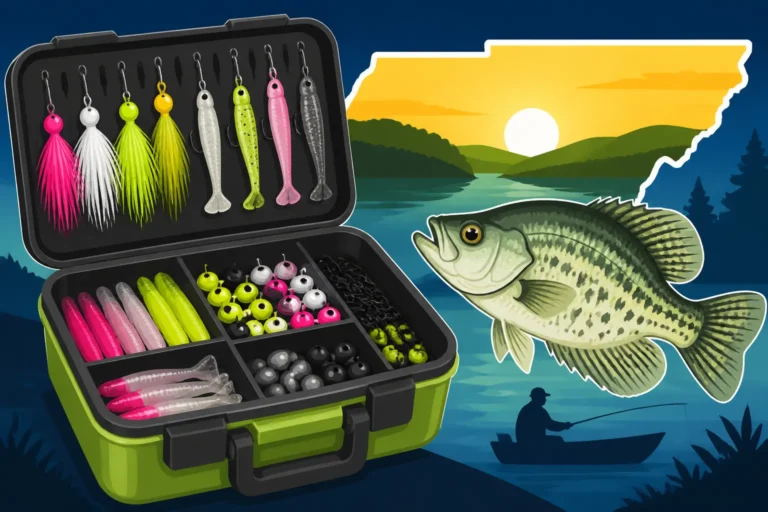
You want to cover your bases with baits and lures that appeal to a wide range of Tennessee fish species. For panfish like bluegill and crappie, it’s hard to beat good old live bait like redworms, crickets, or even corn. These are universally appealing and can be fished under a bobber with great success. When it comes to artificials, small rooster tail spinners are fantastic for trout, bass, and panfish. Crappie jigs, especially in colors like chartreuse, white, or black, are lethal on slabs in lakes like Reelfoot or Kentucky Lake. Tennessee Crappie Fishing Guide by Season offers more insights into the best times for these.
For bass, pack a few different soft plastic options: Texas-rigged worms (like a good ol' Zoom Trick Worm) are great for covering water and punching through cover, while senkos or stick baits fished weightless can entice even finicky bass. A couple of small to medium-sized crankbaits and a spinnerbait or two will also give you options for covering different water depths and conditions. Don't forget some versatile jig heads in various weights (1/16 oz to 1/4 oz) to pair with soft plastics for a variety of presentations. This compact selection allows you to adapt to whatever the fish are biting, whether you're targeting Tennessee Bass Fishing Seasons and Patterns or just whatever comes along.
Terminal Tackle You Can't Do Without
This is the bread and butter of your tackle box, the small but mighty components that make your fishing possible.
- Hooks: Bring an assortment of hooks. Size 8 to 10 for panfish (like small Aberdeen or bait holder hooks), size 1/0 to 3/0 for bass (EWG or worm hooks for soft plastics), and size 2 to 4/0 for catfish (circle hooks are excellent for preventing gut hooks).
- Sinkers: Split shot sinkers are incredibly versatile for adding a little weight to a bobber rig or a finesse setup. Bullet weights (1/8 oz to 3/8 oz) are essential for Texas rigging soft plastics. A few slip sinkers (1/2 oz to 1 oz) are great for bottom fishing for catfish, allowing the fish to take the bait without feeling immediate resistance.
- Bobbers: A few clip-on bobbers are easy to use for live bait. For deeper presentations, especially with crappie, a slip bobber setup is invaluable as it allows you to fish at precise depths.
- Swivels: Small barrel swivels or snap swivels (size 7-12) can help prevent line twist and make changing lures quicker.
Having a range of these basic items means you’re prepared for almost any scenario. It’s frustrating to run out of the right hook size when the fish are biting, so a small variety is truly important for a Tackle Box Setup for Bass Fishing or panfish.
Handy Tools for Every Bank Angler
Beyond the hooks and lures, a few essential tools will make your bank fishing experience much smoother and safer.
- Pliers/Forceps: Absolutely indispensable for removing hooks, cutting line, and crimping weights. Get a pair with a good grip and a line cutter.
- Line Clippers: Small, sharp clippers (or a multi-tool with clippers) are much easier than fumbling with a knife.
- Fish Stringer or Small Cooler: If you plan on keeping your catch, a collapsible stringer will keep fish alive in the water. For longer trips or warmer weather, a small, soft-sided cooler with some ice is perfect for keeping your fish fresh, along with your drinks and snacks.
- Measuring Tape: Crucial for ensuring your catch meets Tennessee Fishing Season and Catch Limits or other local regulations before you keep it.
- Small Landing Net: A compact, foldable net is a game-changer for landing larger fish from the bank, especially when the bank is steep or you're using light line. It reduces the chance of losing a fish right at your feet. Many of these items can be found readily at Bass Pro Shops or on Amazon.
Comfort, Safety, and Convenience by the Water's Edge
Being comfortable and safe while fishing from the bank isn't just about enjoyment; it’s about making sure your trip is successful and trouble-free. Don’t overlook these aspects!
Staying Comfortable Through the Day
Bank fishing often means long periods of standing, walking, or sitting in potentially awkward spots. Your clothing and accessories can make or break your comfort.
- Layered Clothing: Tennessee weather can be unpredictable. Dressing in layers allows you to adapt to changing temperatures throughout the day. Moisture-wicking fabrics are a bonus, keeping you dry and comfortable.
- Hat and Sunglasses: Essential for sun protection and seeing through the glare on the water. Polarized sunglasses are a true superpower, revealing submerged structure and even fish you'd otherwise miss.
- Comfortable, Closed-Toe Shoes: You’ll be walking on uneven terrain, potentially through mud or over rocks. Good hiking shoes or waterproof boots are a must. Avoid flip-flops or open-toed sandals.
- Small Chair or Cushion: Standing for hours can be exhausting. A lightweight, foldable stool or even a thick cushion can provide much-needed relief and make those waiting periods much more enjoyable. Trust me, your back and feet will thank you!
- Rain Gear: A lightweight rain jacket packed in your bag can save your day if an unexpected shower rolls through. There’s nothing worse than being soaked and cold on the bank.
Essential Safety Items
Safety should always be a top priority, especially when you’re away from immediate help.
- First-Aid Kit: A small kit with bandages, antiseptic wipes, pain relievers, and any personal medications is non-negotiable. Hook accidents happen, and it’s better to be prepared.
- Insect Repellent: Mosquitoes, ticks, and gnats can turn a relaxing day into an irritating ordeal. A good bug spray is essential, especially during warmer months or when fishing near standing water.
- Sunscreen: Protect your skin! Even on cloudy days, UV rays can cause sunburn. Reapply regularly.
- Water and Snacks: Dehydration and hunger can quickly sap your energy and enjoyment. Pack plenty of water, especially on hot days, and some energy-boosting snacks like granola bars or fruit.
- Knife/Multi-tool: Beyond fishing tasks, a sharp knife or multi-tool can be invaluable for many unexpected situations.
- Light Source: If you plan on fishing anywhere near dawn or dusk, or even just leaving after sundown, a headlamp or small flashlight is critical for navigating paths and packing up safely. Night Fishing Techniques for Catfish often requires good lighting.
Smart Storage and Portability
Since you're hoofing it, how you carry your gear is just as important as the gear itself.
- Backpack or Fishing-Specific Tackle Bag: This is where Bass Pro Shops and Amazon shine with a huge selection. A sturdy backpack with multiple compartments is ideal for distributing weight evenly and keeping gear organized. Many fishing-specific tackle bags are designed with external rod holders, tool pockets, and waterproof bases, which are perfect for setting down on damp ground. Look for something that can hold your tackle, water, snacks, and extra layers without feeling like you’re carrying a boulder.
- Small, Soft-Sided Cooler: As mentioned earlier, this serves double duty for your catch and your refreshments. Choose one with a comfortable strap if it's not going inside your main pack.
- Rod Straps/Bungees: To keep your rod secure and prevent damage while walking, a simple rod strap or bungee cord can make a world of difference. This frees up a hand and makes navigating through brush much easier.
Elevating Your Bank Fishing Experience with Smart Additions
Once you've got the basics down, there are a few extra items that can significantly enhance your bank fishing outings, taking them from good to truly great.
Technology for the Shoreline
Even without a boat, technology can give you an edge.
- Portable Fish Finder: Yes, you can get these for bank fishing! Devices like portable, castable fish finders (often called "castable sonars") allow you to get a picture of what's under the water from the bank. You simply cast it out, reel it back in, and it transmits data to an app on your smartphone or a dedicated display. This can help you locate submerged structure, depth changes, and even schools of fish, turning a blind cast into an informed one. Knowing the depth and bottom contour can be incredibly helpful in understanding where fish might be holding.
- Power Bank for Your Phone: Your smartphone is likely doing double duty as your camera, GPS, and maybe even your fish finder display. A portable power bank ensures your device stays charged throughout the day, preventing that frustrating moment when your phone dies just when you're about to snap a photo of a trophy catch or need to check a map. This is a small item that provides huge peace of mind, especially if you're exploring some Tennessee's Most Remote Fishing Spots.
Specialized Gear for Specific Targets
While versatility is important for a general bank fishing setup, sometimes you want to dial in your approach for a particular species.
- Dedicated Crappie Jigging Setup: If you know you're headed to a lake renowned for crappie, a lightweight, sensitive rod (5-6 feet) paired with a small reel (1000-2000 series) and light line (4-6lb monofilament or braid with a fluorocarbon leader) can make a huge difference. This setup allows for precise jigging and casting of tiny lures. It's often overkill for other species, but for consistent crappie action, it's worth the consideration.
- Catfish-Specific Rigs: For serious catfishing from the bank, you might want a heavier rod (7-9 feet, medium-heavy to heavy action) and a larger spinning reel (4000-6000 series) spooled with 15-30lb mono or braid. Paired with larger hooks, heavy slip sinkers, and robust swivels, you're ready to tackle blue or flathead catfish. Catfish Bottom Fishing Basics requires different gear than finesse bass fishing.
- Compact Fly Fishing Gear: For those who love fly fishing, a smaller, lighter fly rod (3-5 weight, 7-8 feet) can be surprisingly effective on Tennessee's numerous trout streams, even from the bank. Paired with a small fly box, a net, and a vest, it’s a beautifully minimalist approach. Fly Fishing Basics for Trout from the bank offers a unique challenge and reward.
Making the Most of Your Trip
These items might seem minor, but they add comfort and enjoyment to your day.
- Small Collapsible Cooler: I know, I mentioned it before, but for refreshments, it’s a lifesaver. Warm drinks on a hot day are a real morale killer!
- Camera or Phone Case: Protect your devices from splashes and drops. An inexpensive waterproof phone case can prevent heartbreak. And don’t forget to capture those memories!
- Trash Bag: Always pack out what you pack in, and perhaps even a little more. Keeping Tennessee's beautiful fishing spots clean is everyone's responsibility. It shows respect for the environment and for fellow anglers.
By thoughtfully curating your bank fishing gear, focusing on portability, versatility, and safety, you'll be well-equipped to enjoy the incredible fishing opportunities that Tennessee has to offer, all from the simplicity and serenity of the shoreline. Happy fishing!
Disclaimer
This article is for general informational purposes only and does not constitute professional advice. Laws, prices and regulations vary by location and change over time. Consult a qualified professional for guidance on your specific situation.