Fly Fishing Basics for Trout
The world of fly fishing for trout can feel incredibly intimidating when you're just starting out, almost like everyone else already knows a secret language and you're stuck on the outside looking in. All those specialized knots, the delicate casting, and the sheer variety of flies can make it seem like an impossible hobby to pick up. But trust me, it’s not. This comprehensive guide will break down the fundamentals of fly fishing for trout in Tennessee, helping you move from feeling overwhelmed to confidently casting on our beautiful streams.
Understanding the Allure of Fly Fishing for Trout in Tennessee
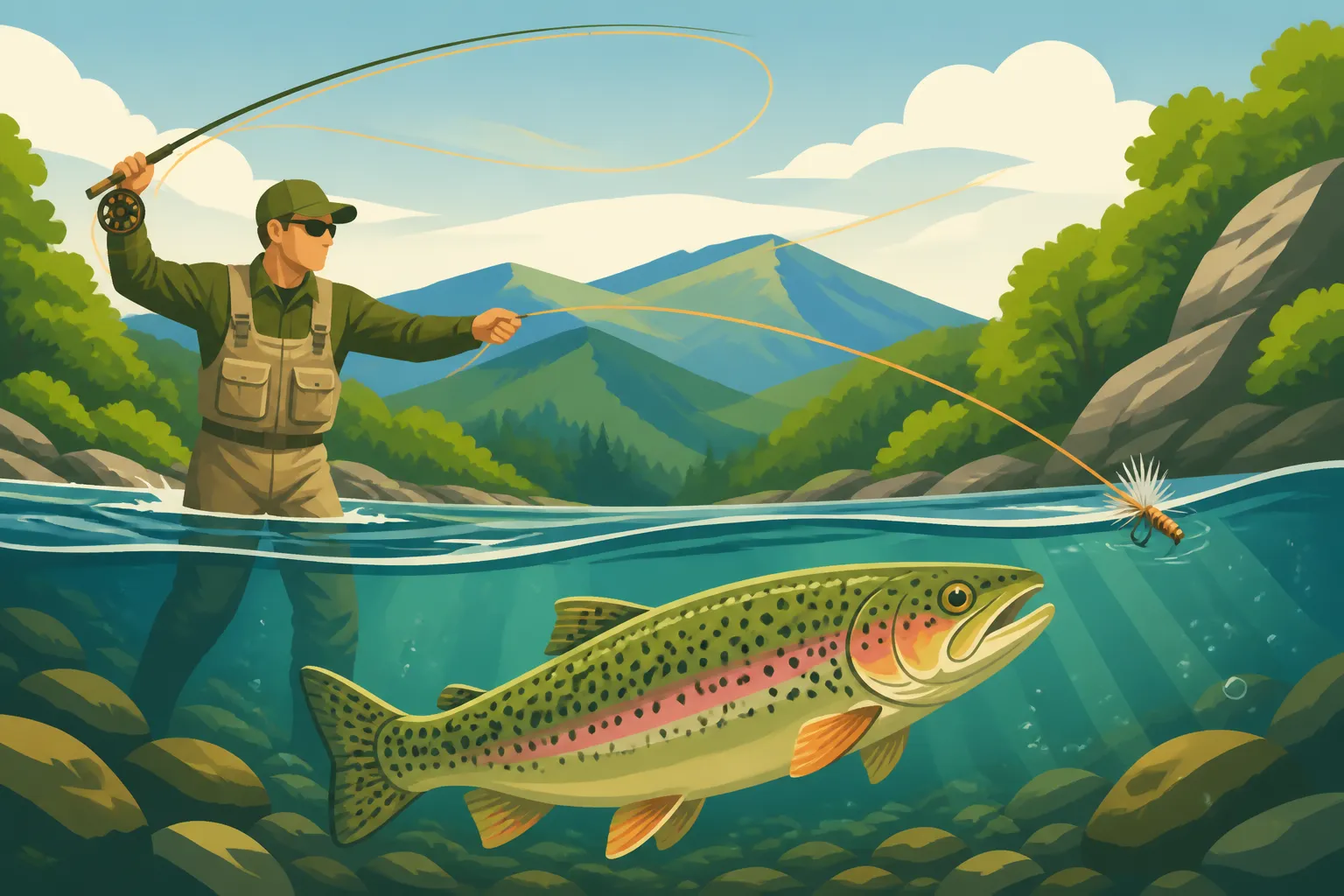
Fly fishing isn't just another way to catch a fish; it's a completely different interaction with the aquatic world. When you choose to pick up a fly rod, you're not just throwing bait or a lure; you're attempting to mimic the very insects and small prey that trout naturally feed on, inviting them to strike with a deceptive bit of feather and fur. This unique approach is what makes it so captivating, especially in the clear, pristine waters of Tennessee's trout streams.
Why Fly Fishing Feels Different
Many anglers who grew up spinning or baitcasting often wonder why anyone would bother with the seemingly complex dance of a fly rod. The truth is, it offers a distinct challenge and reward that sets it apart. Instead of relying on the weight of a lure to cast your line, fly fishing uses the weight of the line itself to propel a nearly weightless fly. This fundamental difference requires a more graceful, rhythmic motion and a keen understanding of how the line behaves in the air. You're not just flicking a wrist; you're painting a picture with your line.
There’s a deep satisfaction that comes from mastering that delicate presentation, watching your hand-tied fly drift naturally on the water, and seeing a trout rise to take it. It fosters a much closer connection to the natural environment, forcing you to pay attention to insect hatches, water currents, and the subtle movements of the fish themselves. For instance, standing in a river like the Clinch River Trout Fishing in East Tennessee, with its cool, clear flows, and presenting a tiny fly to a rising trout feels almost like a conversation between you and the fish. It’s a pursuit that often prioritizes the experience and the artistry over simply filling a stringer.
The Satisfaction of the Catch
The "fight" in fly fishing often begins long before a fish is hooked. It starts with reading the water, observing the subtle clues that tell you where a trout might be holding, and then executing a precise cast to get your fly into the feeding zone. This mental chess match is a huge part of the allure. When a trout finally takes your fly, especially after you've worked to match the hatch or delicately drifted a nymph through a deep run, the triumph is profound.
It's not about brute force; it's about finesse and understanding. The lighter tackle often associated with trout fly fishing means that even a modest fish can put up an exciting struggle, bending the rod and testing your drag system. The quiet beauty of Tennessee's landscapes, from the rolling hillsides to the dense forests bordering our waterways, only amplifies this experience. You're not just catching a fish; you're engaging with an entire ecosystem, one cast at a time. The learning curve can feel steep initially, but with each successful cast and every trout brought to hand, that initial intimidation gives way to a deep, abiding passion.
Essential Gear for Starting Your Fly Fishing Journey
Embarking on your fly fishing adventure requires some specialized equipment, but don't let the sheer volume of options overwhelm you. For beginners, a basic, reliable setup is far more important than owning the most expensive gear. The right tools make the learning process smoother and more enjoyable, especially when you're tackling the diverse trout waters found across Tennessee.
Rods, Reels, and Lines: The Core Setup
This trio forms the heart of your fly fishing arsenal, and understanding their individual roles is key. Think of them as a system, each component working in harmony to deliver your fly.
When it comes to fly rods, the "weight" is a crucial factor. This refers to the power of the rod and the corresponding weight of fly line it's designed to cast. For most trout fishing in Tennessee, a 3-weight, 4-weight, or 5-weight rod is ideal. A 3-weight or 4-weight is fantastic for smaller streams and delicate presentations to smaller trout, like those you might find in the high country of the Great Smoky Mountains. A 5-weight is often considered the most versatile "all-around" trout rod, capable of handling larger streams, bigger flies (like streamers), and moderately sized trout. For beginners, a medium-fast action rod is often recommended as it offers a good balance of casting power and sensitivity, making it more forgiving to learn on than a super-fast action rod. Many reputable brands offer excellent entry-level rods that are surprisingly affordable and can be found easily on platforms like Amazon, offering a convenient starting point.
Fly reels, unlike spinning reels, don't typically do most of the "work" in fighting a trout. Their primary functions are to store your fly line and provide a smooth drag system for larger fish. For trout, a simple, single-action click-and-pawl reel or a basic disc-drag reel that balances well with your chosen rod is perfectly adequate. You don't need an expensive, super-smooth drag system unless you're specifically targeting much larger, harder-fighting fish. Just ensure it matches your rod's weight (e.g., a 5/6 weight reel for a 5-weight rod).
The fly line is arguably the most important component, as its weight is what loads the rod and allows you to cast. A typical fly line setup consists of three parts:
- Backing: This is a thin, strong braided line that's spooled onto your reel first. Its main purpose is to fill the spool so the fly line sits properly and to provide extra line in case a large fish makes a long run.
- Fly Line: This is the specialized, weighted line that you actually cast. For trout, a weight-forward floating line (WF-F) is the most common choice. "Weight-forward" means the weight is concentrated towards the front of the line, making it easier to cast longer distances, while "floating" means it stays on the surface of the water, ideal for dry flies and indicator nymphing. You might also encounter double-taper lines (DT) which are great for delicate presentations but can be harder for beginners to cast long distances.
- Leader: This is a tapered monofilament or fluorocarbon line that connects your fly line to your fly. It’s thick at the butt end (where it connects to the fly line) and gradually tapers down to a thin tip, allowing for a smooth transfer of casting energy and a subtle presentation of your fly.
- Tippet: This is a thin, level piece of monofilament or fluorocarbon tied to the end of your leader, and then your fly is tied to the tippet. Its purpose is to prolong the life of your leader (you only replace the tippet after tying on many flies or breaking off) and to provide an even finer, less visible connection to your fly. Tippet spools come in various "X" sizes (e.g., 5X, 6X, 7X), with higher numbers indicating thinner line, perfect for small flies and wary trout.
Waders, Boots, and Vest/Pack: Staying Comfortable and Organized
Your comfort and ability to access various parts of a stream are crucial for a successful fly fishing trip. This is where quality wading gear comes into play.
Waders are essential for staying dry and warm when standing in the water. In Tennessee, where temperatures can vary widely, breathable chest waders are often the best choice for year-round comfort. They allow perspiration to escape, preventing you from getting clammy in warmer weather, while still providing insulation when layered properly in colder conditions. Stockingfoot waders (which have neoprene "socks" and require separate wading boots) are generally preferred over bootfoot waders (where the boots are permanently attached) because they offer a better fit and more ankle support. Being able to wade confidently and comfortably means you can access more prime fishing spots and spend more time on the water.
Paired with your stockingfoot waders, wading boots provide crucial grip and ankle support on slippery riverbeds. Choosing between felt soles and rubber soles depends on local regulations and personal preference. Felt soles traditionally offer superior grip on slick rocks but can potentially transfer invasive species between waterways (check local rules!). Rubber soles are becoming increasingly popular due to their versatility and often allow for the addition of studs for enhanced traction, which can be a lifesa; on certain Tennessee river bottoms. Safety first, always!
Finally, a fishing vest or pack is indispensable for keeping your myriad of small essential items organized and within reach. There’s nothing more frustrating than needing a specific fly or tool and having to fumble through a cluttered bag or walk back to your vehicle. A vest, chest pack, or sling pack allows you to carry fly boxes (full of your carefully selected patterns), multiple spools of tippet in different sizes, nippers (for cutting line), forceps or hemostats (for removing hooks), floatant (to keep dry flies buoyant), extra leaders, and a small net. Having everything organized means less time digging and more time fishing. Many convenient and affordable options for these organizational tools are readily available, often with quick shipping, making them perfect to acquire from places like Amazon as you build your kit.
Decoding Trout Flies: What They Mimic and Why
The sheer number of fly patterns available can be overwhelming, making it feel like you need a degree in entomology just to choose one. However, the beauty of fly fishing lies in understanding the basic categories of what trout eat and selecting flies that imitate those natural food sources. In Tennessee, knowing what's hatching or present in the water is often the key to success.
Understanding the Aquatic Food Chain
Trout, especially wild trout, are opportunistic feeders, but they primarily key in on insects, small crustaceans, and baitfish found in their aquatic environment. The most important insects for fly anglers to understand are:
- Mayflies: These delicate insects have distinct upright wings when they hatch (emerge) and sail downstream. Their nymphs are common food sources underwater.
- Caddisflies: Often mistaken for moths, caddisflies are important trout food, both as larvae (some build cases from pebbles or sticks), pupae (emerging from their cases), and adults (which often skate across the water surface).
- Stoneflies: Larger than mayflies or caddis, stonefly nymphs are stout and cling to rocks. Adults are also large and provide a substantial meal.
- Midges: These tiny insects are present year-round, often in huge numbers. Their larvae and pupae are a constant food source for trout, particularly in colder months.
Trout feed on these insects at different life stages: the larval or nymph stage (underwater), the emerger stage (as they ascend to the surface), and the adult or dry stage (on the surface). Understanding this cycle and what might be prevalent at a given time is crucial. For instance, the timing of the Tennessee Trout Stocking Schedule and Season can sometimes coincide with periods when natural insects are more abundant, meaning trout are already keyed into feeding. It's not about being a bug expert overnight, but simply being observant. Look for insects flying around, or even turn over a few rocks in the stream to see what nymphs are crawling beneath.
Key Fly Categories for Tennessee Trout
While there are thousands of patterns, they generally fall into a few core categories, each designed to imitate a specific food source or life stage.
Dry Flies are designed to float on the surface of the water, mimicking adult insects that have hatched or fallen into the stream. The thrill of watching a trout sip your dry fly off the surface is arguably one of the most exciting aspects of fly fishing. They are most effective when trout are actively feeding on the surface during an insect hatch. Classic patterns like the Elk Hair Caddis, Adams, and Parachute Adams are perennial favorites and work well on many Tennessee waters. You'll want to use a floatant to keep them riding high on the water.
Nymphs are tied to imitate the underwater larval and pupal stages of aquatic insects. Since trout spend a vast majority of their time feeding below the surface, nymphs are often considered the most productive fly type. You'll fish them subsurface, typically with an indicator (a small bobber) to detect strikes, or with a tight-line method for more direct feel. Examples include the Pheasant Tail Nymph, Hare's Ear Nymph, and Prince Nymph. Getting your nymphs down to the fish's feeding lane, near the bottom of the stream, is critical. This is where most of the actual feeding occurs, making nymphing a technique that consistently fools fish.
Streamers are larger flies designed to imitate baitfish, leeches, or other larger prey items like sculpins or crawfish. These flies are retrieved with strips and pauses, mimicking the erratic movement of a small fish. Streamers are excellent for targeting more aggressive trout, especially larger Brown Trout Identification Tips for Tennessee Anglers which often feed on smaller fish. Patterns like the Woolly Bugger (a must-have in various colors), Clouser Minnow, and Sculpzilla are highly effective. You often feel a more aggressive "thump" when a trout hits a streamer.
Lastly, Terrestrials are flies that imitate land-dwelling insects that accidentally fall into the water, such as grasshoppers, ants, beetles, and crickets. These flies are most effective during warmer months (late spring through fall) when these insects are active along the stream banks. They can be incredibly effective when trout are looking for a bigger, easy meal. Patterns like the Chernobyl Ant, Foam Hopper, and various beetle imitations are great to have in your fly box. Understanding these categories, rather than memorizing every single fly pattern, will give you a solid foundation for choosing the right fly for the right situation on Tennessee's diverse trout fisheries. To effectively entice a bite, knowing Best Fly Patterns for Stocked Trout can certainly increase your odds.
Fundamental Casting Techniques for Beginners
For many, the elegant arc of a fly line sailing through the air is the iconic image of fly fishing. It can look incredibly graceful and, at the same time, incredibly difficult. But like any skill, fly casting is a learned motion built on a few fundamental principles. You don't need to be a tournament caster to catch fish, but a solid grasp of the basics will make your time on the water much more enjoyable and productive.
The Basic Forward Cast: Getting Started
The heart of fly casting lies in the basic forward cast, often described as the "10 to 2" or "stop and go" principle. Imagine your rod tip moving along the face of a clock.
You start with the rod tip low, pointing towards your target (let's say 9 o'clock).
- The Pickup: With a smooth acceleration, lift the rod tip straight up, accelerating to a firm, crisp stop at around 1 o'clock or 2 o'clock. This is your "backcast." The line should unfurl behind you. Don't let your rod hand go past your ear, or you'll lose control. The key here is a smooth, quick acceleration followed by an immediate stop. It's the sudden stop that loads the rod (bends it), which then acts like a spring to propel the line backward.
- The Pause: This is perhaps the most critical, yet most often rushed, part for beginners. You must pause and allow the line to unfurl completely behind you. The length of the pause depends on how much line you have out and how high your backcast went. Watch your line (or imagine it) as it straightens out behind you. If you start your forward cast too early, you'll "ding" yourself in the back of the head or create a "tailing loop" where the line tangles on itself.
- The Forward Cast: Once the line has straightened behind you, with another smooth acceleration, drive the rod tip forward and downward, stopping crisply at around 10 o'clock or 9 o'clock. Just like the backcast, it's the sudden stop that propels the line forward. As the line unrolls in front of you, you'll want to gradually lower the rod tip to lay the fly gently on the water.
Common mistakes include "throwing rocks" (moving the rod too much with your arm and not enough with the wrist, resulting in a wide loop that dissipates energy), and the aforementioned "tailing loops" (starting the forward cast too soon or applying too much power at the beginning of the cast). Practice this motion on grass or a local pond without a fly first. Focus on smoothness, acceleration, and crisp stops. The "feel" will come with practice, and eventually, it will become second nature.
False Casting and Presentation Casts
Once you've got the basic forward cast down, you'll quickly discover that fishing involves more than just one perfect cast. You need to adjust, extend, and precisely place your fly.
False casting is a series of back and forth casts that don't actually put the fly on the water. It's an essential technique for several reasons:
- Drying your fly: After catching a fish or if your dry fly gets waterlogged, false casting helps to shake off the water and makes the fly float better.
- Extending your line: Each false cast allows you to gradually peel more line off the reel and into the air, extending your reach to a distant target.
- Changing direction: You can subtly alter the direction of your cast during the false cast, allowing you to fine-tune your aim without having to fully retrieve and recast.
- Timing: It helps you get into a rhythm, feeling the weight of the line and timing your pause.
However, don't overdo it. Too many false casts can spook fish, especially in clear, shallow water. Aim for efficiency: one or two false casts to load the rod and aim, then the final presentation cast.
Beyond the basic cast, there are several "presentation casts" that help you manage your line on the water to achieve a natural drift, free from drag.
- The Roll Cast: This is a lifesaver in tight quarters where you don't have room for a backcast (think overgrown banks on a small stream like one of Tennessee's smaller mountain creeks). To execute a roll cast, gather your line in front of you, raise your rod tip slowly until the line forms a "D" loop behind you, then drive the rod forward in a powerful, crisp motion, rolling the line out across the water. It’s surprisingly effective for short to medium distances.
- The Mend: This isn't a casting technique in the traditional sense, but it’s crucial for controlling how your fly drifts on the water. Current can pull your line, causing your fly to move unnaturally fast (a phenomenon called "drag"), which immediately tells a wary trout that something is amiss. A "mend" involves lifting a section of your fly line and flipping it either upstream or downstream to counteract the current, allowing your fly to drift at the natural speed of the water. For example, if the current between you and your fly is faster than the current around your fly, you'd throw an "upstream mend" to put a belly of line upstream, delaying the pull. Mastering the mend is often more important for catching trout than casting long distances. It allows your fly to mimic a truly free-floating insect.
Learning these casting fundamentals requires patience and practice. Don't get discouraged if your first attempts look more like a tangled mess than a graceful arc. Persistence, combined with watching instructional videos and perhaps even getting a lesson from a local expert, will get you there. Eventually, the casting motion will become fluid, allowing you to focus more on the water and the fish, rather than the mechanics of the cast itself. You can find many instructional videos and beginner fly casting kits on platforms like Amazon that can help you practice these techniques at home.
Reading the Water: Finding Where Trout Live
One of the biggest hurdles for new fly anglers isn't necessarily the casting, but knowing where to cast. Trout aren't randomly distributed throughout a stream; they hold in specific locations that offer them food, oxygen, and protection from predators and strong currents. Learning to "read the water" is an art form that develops with experience and keen observation. It’s about understanding the subtle language of the stream and what it tells you about where trout are likely to be.
Identifying Prime Trout Habitat
Trout are constantly making calculations about energy expenditure versus food reward. They want to be in places where food is delivered to them efficiently, where they can conserve energy by not fighting strong currents, and where they feel safe.
- Riffles, Runs, and Pools: These are the basic structural elements of almost any trout stream.
- Riffles are shallow, fast-moving sections of water with a broken surface. They are highly oxygenated and often dislodge insects from the bottom, sending them downstream. Trout rarely hold in the fastest part of a riffle, but they will position themselves just downstream of it or along its edges, waiting for food to be swept to them.
- Runs are deeper, smoother sections of flowing water, often below a riffle or cascade. These are prime feeding lanes. Trout will hold in the middle or along the edges of runs, particularly where the current is a bit slower but still delivering food.
- Pools are deeper, slower-moving sections of water. While trout might not be actively feeding in the slowest parts of a pool, they often use them as resting areas and will move to the head (where the water enters) or tail (where the water exits) of a pool to feed. Deeper pockets within pools also offer excellent holding water, especially for larger fish.
- Seams and Current Breaks: These are absolute magnets for trout. A "seam" is where two currents of different speeds meet. The slower side offers a place for trout to rest, while the faster side acts as a conveyor belt delivering food. Think of the edge of a fast run next to slower, slack water. Any structure that breaks the current, such as a large rock, a log, or even a slight change in the riverbed, creates a current break. Trout will sit in the calmer water directly behind or beside these obstructions, darting out to grab passing food. These are high-percentage spots, so always approach them with stealth.
- Structure: Trout are constantly seeking cover. This can be anything from large boulders that provide a visual break and a current cushion, to fallen logs and branches that create submerged habitat, to undercut banks where they can hide from predators above. Overhanging vegetation also provides shade and drops terrestrial insects into the water. In the Best Trout Streams for Fly Fishing in Tennessee, you'll find plenty of these natural structures. Always look for these features, as they almost always indicate a potential holding lie for a trout.
Understanding Trout Behavior and Feeding Lies
Beyond just identifying structure, understanding why trout choose certain spots is crucial. It comes down to their biological needs and behaviors.
Water temperature is a huge factor. Trout are cold-water fish and are most active and comfortable within a specific temperature range, typically 45-65°F (7-18°C). If the water is too cold, they become lethargic and won't feed aggressively. If it's too warm, they become stressed, seek out cooler, more oxygenated water, and often won't feed at all. This ties into factors such as the How Water Temperature Affects Trout Stocking Timing in Tennessee. For example, during hot summer months, trout will often be found in the deepest, most shaded parts of a stream or near spring-fed tributaries where water temperatures are cooler. Conversely, in winter, they might prefer slightly deeper, slower water that offers more thermal stability.
Stealth is paramount when approaching any potential trout lie. Trout have excellent eyesight and are incredibly wary of movement and shadows. Always approach a spot from downstream, if possible, moving slowly and keeping a low profile. Avoid walking on gravel bars right next to the water, as vibrations can travel far. Cast from a distance, and try to make your first cast count, as it's often your best chance at an unspooked fish.
Observe the water before you cast. Are there any fish rising to take insects off the surface? If so, you'll want to use a dry fly that matches the size and color of the natural insects. If there's no surface activity, trout are likely feeding sub-surface on nymphs or baitfish, indicating that nymphing or streamer fishing might be more effective. Knowing the general Tennessee Trout Fishing Season Explained can also give you clues about seasonal feeding patterns.
Remember, trout are creatures of habit. If you catch a fish from a particular type of spot, chances are similar spots further up or downstream will also hold fish. By patiently observing the water, understanding the underlying currents, and thinking like a trout, you'll dramatically increase your chances of finding and catching fish on your fly rod.
Practical Fishing Strategies for Tennessee Trout Streams
Once you have your gear and a basic understanding of casting and reading the water, it's time to put it all into practice. While fly fishing offers endless variations, focusing on a few core techniques will allow you to effectively target trout in almost any situation you encounter on Tennessee's diverse waterways, from the mountain freestone streams to the tailwater rivers.
Nymphing Techniques: The Most Productive Approach
If there’s one technique that consistently catches trout, it’s nymphing. This makes sense because trout spend the vast majority of their feeding time eating insects that are drifting or crawling along the bottom of the stream. Mastering nymphing will drastically increase your catch rate.
Indicator Nymphing is probably the most common and easiest nymphing method for beginners. It involves attaching a small, buoyant strike indicator (think of it as a specialized bobber) to your leader, a foot or two above your fly (or flies, as it's common to fish two nymphs). The indicator floats on the surface, allowing you to visually detect even the most subtle takes from a trout, which often feel like nothing more than a slight pause or twitch of the indicator. Below the indicator, you'll attach one or two nymphs, often with a small amount of split shot (tiny lead-free weights) to help them sink to the bottom quickly.
The key to successful indicator nymphing is achieving a natural, drag-free drift. Your nymphs need to tumble along the bottom at the same speed as the natural current, just like real insects. This means constantly mending your line upstream to avoid the current pulling your indicator and flies unnaturally. The depth at which you fish is critical; your nymphs should be bouncing lightly along the bottom. A good rule of thumb is to set your indicator about 1.5 to 2 times the depth of the water you're fishing. For instance, if the water is 3 feet deep, set your indicator 4.5 to 6 feet above your first fly. You can easily adjust this depth as you move to different sections of the stream. This technique is especially effective on larger, deeper stretches of water where trout hold close to the bottom.
Tightline Nymphing, sometimes called Euro Nymphing, is a more advanced technique that eliminates the strike indicator, relying instead on direct contact with your flies to detect strikes. This method uses a longer, lighter leader with a section of brightly colored line (sighter) to help you visually track the drift and detect strikes. The rod tip is held high, keeping almost all the fly line off the water, minimizing drag and allowing for an incredibly sensitive presentation. While it has a steeper learning curve, it's incredibly effective in complex currents and for wary fish because there's no indicator to spook them. It also allows for extremely precise depth control. It's a fantastic technique to explore once you're comfortable with the basics. If you want to dive deeper, you can find more specific guidance on Fly Fishing Techniques for Trout that cover these and other methods.
Dry Fly Fishing and Streamer Tactics
While nymphing might be the most consistent, nothing beats the visual excitement of dry fly fishing or the aggressive take on a streamer.
Dry fly fishing is the quintessential image of fly fishing, and for good reason. It involves presenting a buoyant fly on the surface of the water, mimicking an adult insect. This technique is most effective when trout are actively feeding on the surface, which usually happens during a "hatch"—when a mass of insects is emerging from the water. The joy comes from watching a trout rise from below and sip or smash your fly.
Successful dry fly fishing requires a delicate presentation and a drag-free drift. Your fly must float naturally on the surface, without any drag created by your line being pulled by different currents. This is where those precise mends come into play, along with accurate casting. You'll need to observe the water carefully, looking for rising fish and trying to identify the natural insect they're eating. Matching the size, shape, and color of the natural insect with your fly is crucial. Sometimes, even if there's no obvious hatch, a well-placed terrestrial (like a foam hopper or beetle) can entice an opportunistic strike, especially in late summer on streams with overhanging vegetation.
Streamer fishing offers a completely different experience. Instead of mimicking small, delicate insects, streamers imitate baitfish, leeches, or larger aquatic critters. This is a highly effective way to target larger, more aggressive trout, especially during periods when they're not feeding on insects. Streamers are typically fished subsurface, and the technique involves casting the fly across or downstream and then retrieving it with varying strips and pauses, mimicking the erratic movement of fleeing prey.
The retrieve is key here. Experiment with short, quick strips; long, slow pulls; or a stop-and-go motion. Sometimes a sudden pause will trigger a strike. Streamers can be fished effectively in a variety of waters, from deep pools to faster runs, and are particularly good in higher, off-color water when trout's visibility might be reduced. You can often feel a distinct, aggressive tug when a trout takes a streamer. It's a more active style of fishing compared to the subtle nature of dry fly or nymph fishing, and it can be incredibly rewarding when you connect with a powerful fish. Don't forget to check the Tennessee Trout Limits and Season Rules before you head out, regardless of your chosen technique.
Etiquette, Conservation, and Continued Learning
Beyond the mechanics of casting and the strategies for catching fish, fly fishing carries with it a strong tradition of respect for the environment, fellow anglers, and the resource itself. Embracing this ethos is as much a part of becoming a fly angler as mastering a roll cast. In a state as beautiful and ecologically diverse as Tennessee, our responsibility to protect these waters is paramount.
Leave No Trace and Angler Etiquette
Adhering to "Leave No Trace" principles is non-negotiable in fly fishing. This means packing out everything you pack in, including all trash, broken leader material, and anything else you bring to the stream. Take a small trash bag with you, even if you don't think you'll need it. The goal is to leave the environment cleaner than you found it.
Respecting private property and fellow anglers is also critical. Always be aware of property lines and gain permission before entering private land. On public waters, give other anglers ample space. If someone is fishing a stretch of water, either start well upstream or downstream from them, or ask if you can pass respectfully. Never crowd another angler's space or wade through a run they are actively fishing. Common courtesy goes a long way in fostering a positive community on the water.
Wading safety and minimizing disturbance are important for both your safety and the health of the stream. Always wade carefully, testing the bottom with each step. Use a wading staff for added stability, especially in unfamiliar or fast-moving water. Avoid shuffling your feet excessively, as this can dislodge bottom-dwelling insects, making them unavailable for trout, or stir up silt, degrading water quality. Be mindful of spawning redds (nests), which are typically clear, gravelly depressions in the streambed, and avoid walking on them at all costs.
Finally, practicing catch and release responsibly is a cornerstone of trout conservation, especially in heavily pressured waters or those with fragile wild trout populations. If you intend to release a fish, handle it minimally and gently. Keep the fish in the water as much as possible, use wet hands, and use forceps to quickly remove the hook. Avoid excessive handling or netting the fish in a way that damages its protective slime coat. If you want to take a photo, do it quickly and keep the fish wet. Always be aware of the Tennessee Fishing Regulations Explained and specific rules for the body of water you're fishing, particularly any special regulations regarding catch and release or bait restrictions. The health of our trout fisheries depends on responsible angling.
Resources for Improving Your Fly Fishing Skills
Fly fishing is a journey, not a destination. There's always something new to learn, a technique to refine, or a different hatch to understand. Embracing this continuous learning is part of what makes the sport so engaging.
One of the best resources available is your local fly shop. These establishments are often staffed by passionate anglers who have an intimate knowledge of the local waterways, current conditions, and what flies are working. They can offer invaluable advice, suggest specific patterns for the Tennessee Trout Guide: Rainbow, Brown, and Brook Trout in the area, and even recommend good starting spots. Building a relationship with your local fly shop is one of the quickest ways to accelerate your learning.
Online communities and forums dedicated to fly fishing can also be a treasure trove of information. You can ask questions, share experiences, and learn from more experienced anglers. Just remember to filter information and consider the source. Websites and blogs, often providing detailed reports and tips, are also excellent for staying up-to-date.
Don't underestimate the power of books and videos. Many classic texts offer deep insights into entomology, casting mechanics, and trout behavior. Online video platforms host countless tutorials on casting, knot tying, and specific fishing techniques. You can find a vast library of instructional materials, including beginner guides and advanced technique videos, available through platforms like Amazon, making it easy to learn from the comfort of your home.
Finally, consider investing in a guided trip, especially on technical waters like the Caney Fork River Trout Fishing. A good guide can provide hands-on instruction, accelerate your learning curve, and put you on fish, giving you practical experience that books and videos can't replicate. They can correct casting flaws, teach you local nuances, and introduce you to new techniques in real-time. This is often the best way to consolidate all the information you've gathered and apply it effectively on the water. Fly fishing is a lifelong pursuit, and the joy of continuous learning is a big part of its enduring appeal.
| Rod Weight | Ideal Trout Size/Water | Primary Technique Focus | Key Benefit for Beginners |
|---|---|---|---|
| 3-Weight | Small to Medium Trout, Small Streams | Dry Flies, Light Nymphs | Delicate Presentation, Fun with Small Fish |
| 4-Weight | Small to Medium Trout, Medium Streams | Dry Flies, Nymphs | Versatile, Good Balance of Power and Finesse |
| 5-Weight | Medium to Large Trout, Larger Rivers | Nymphs, Streamers, Larger Dries | Most Versatile, Handles Wind and Larger Flies |
| 6-Weight | Large Trout, Larger Rivers, Some Bass | Streamers, Heavier Nymphs | More Power for Big Fish/Wind, Less Delicate |
Disclaimer
The information provided in this guide is for general informational purposes only. Fishing regulations, seasons, and local conditions in Tennessee can change. Always consult the most current regulations published by the Tennessee Wildlife Resources Agency (TWRA) before planning any fishing trip. Adherence to all local, state, and federal laws is the responsibility of the angler. Fly fishing involves inherent risks; always prioritize safety and use appropriate protective gear.