Largemouth Bass Size Chart: How Big Do They Get?
It's a question every angler asks, whether they've been fishing for decades or just picked up a rod: "How big do these largemouth bass actually get?" There's nothing quite like the thrill of feeling a big fish on the end of your line, but sometimes our expectations clash with reality. You might see a monster bass on social media and wonder if you'll ever encounter something similar in your local Tennessee waters. This guide is here to shed some light on the true growth potential of largemouth bass in our beautiful state, helping you understand what constitutes a truly big fish and what factors help them reach those impressive sizes.
Understanding Largemouth Bass Growth in Tennessee
Largemouth bass are one of the most popular sport fish in Tennessee, known for their aggressive strikes and powerful fights. But their growth isn't uniform; it's a dynamic process influenced by a range of environmental and genetic factors. Understanding these elements can help you better appreciate the fish you catch and even improve your chances of targeting bigger bass.
Factors Influencing Size and Weight
Just like people, not all bass grow up to be the same size, even in the same lake. There's a complex interplay of factors that dictate how large a largemouth bass can get and how quickly it reaches that size.
One of the biggest drivers is food availability. If a lake is teeming with forage like shad, bluegill, or smaller sunfish, bass have a constant buffet to fuel their growth. Think of a lake like Chickamauga or Kentucky Lake; these places are renowned for their abundant prey, which directly translates to bigger, healthier bass. Conversely, in waters where food is scarce, bass might be numerous but often remain stunted, never quite reaching their full potential. It's a fundamental principle of nature: more food equals more growth.
Water temperature and climate also play a critical role. Tennessee's generally mild climate and long growing season are quite favorable for largemouth bass. Warmer water generally means a higher metabolism for fish, leading to more feeding and faster growth, provided food is available. However, extreme heat can also stress fish, and overly cold winters can slow down or halt growth entirely. The sweet spot is a consistent period of warm water where bass can actively feed and thrive.
Genetics are often overlooked but are incredibly important. Some bass are simply predisposed to grow larger than others, carrying "big bass genes" that allow them to reach trophy sizes. This is why certain strains, like the Florida-strain largemouth, are often introduced into lakes to try and boost the trophy potential. You can't see a bass's genetics, of course, but you certainly see the results when a truly massive fish comes out of a particular waterbody.
Finally, habitat quality and fishing pressure can't be ignored. Lakes with ample cover – submerged timber, aquatic vegetation, rock piles, and ledges – provide bass with both ambush points for hunting and protection from predators. Good habitat means less stress and more energy directed towards growth. Heavy fishing pressure, especially catch-and-release, can also impact a fishery, as bass might become warier or experience stress from being caught repeatedly. However, responsible catch-and-release practices are crucial for maintaining healthy populations and allowing fish to grow larger.
Average Size vs. Trophy Potential
When we talk about largemouth bass, there's a huge difference between what constitutes an "average" fish and what gets called a "trophy." In most Tennessee lakes and rivers, a typical largemouth bass you might catch on a casual outing could be anywhere from 1 to 3 pounds and measure between 12 to 16 inches. These are healthy, fun-to-catch fish that make for a great day on the water. They're abundant, cooperative, and represent the backbone of our bass fisheries.
However, the "trophy potential" is where the dream really kicks in. A true trophy largemouth in Tennessee is generally considered to be anything over 5 pounds, with some anglers drawing the line at 8 pounds or even 10 pounds for a truly once-in-a-lifetime catch. A 5-pound bass might be around 18-20 inches long, while a 10-pounder could easily stretch over 23 inches, sometimes even pushing 25-26 inches. These are the fish that require specific tactics, patience, and often a bit of luck. Places like Chickamauga Lake Tennessee Trophy Bass Season Timing are legendary precisely because they consistently produce these larger-than-average fish, drawing anglers from all over. The average angler might go years without catching a 5-pounder, while dedicated trophy hunters focus all their efforts on these giants. It truly highlights the spectrum of sizes you can encounter, and it's why understanding these differences helps set realistic expectations for your fishing trips.
Breaking Down the Largemouth Bass Size Chart
Understanding the growth patterns of largemouth bass isn't just about guessing; there's a more scientific approach to it. While every fish is unique, there are general length-to-weight ratios and age-related growth milestones that can give you a pretty good idea of what you've got on the line or what you might expect to catch.
Length-to-Weight Ratios Explained
When you catch a largemouth bass, its length is usually easier to measure accurately than its weight, especially if you're practicing catch and release quickly. But length and weight are intimately connected, though not always in a perfectly linear way. A 20-inch bass in one lake might weigh 5 pounds, while a 20-inch bass in another, fatter lake might weigh 6 or even 7 pounds. This difference is often due to the fish's "condition factor" – essentially, how healthy and well-fed it is. A plump, well-fed bass will weigh more for its length than a long, skinny one.
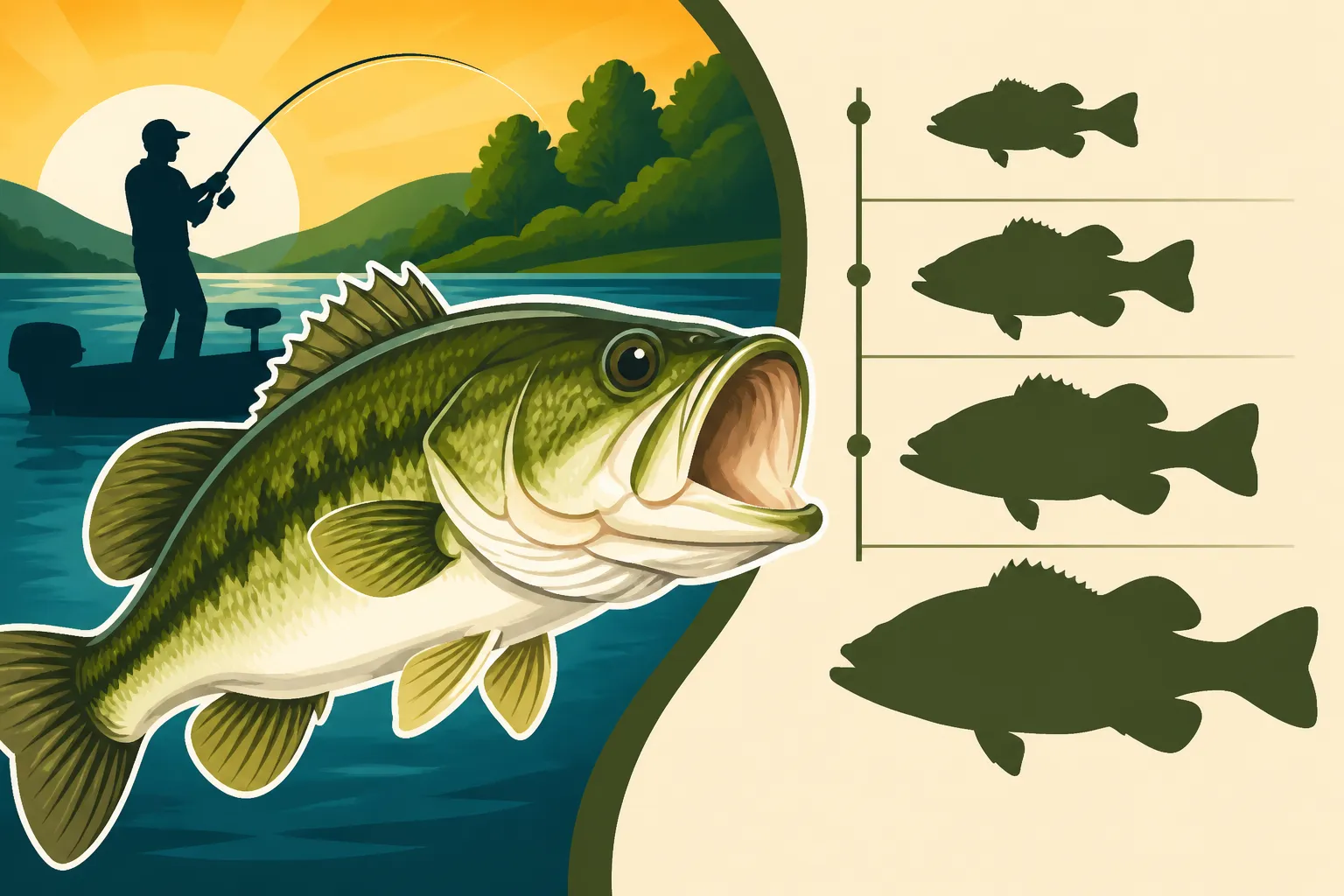
Generally, for a healthy Tennessee largemouth bass, you can use these rough estimations. Keep in mind these are averages, and your specific fish might vary. This kind of chart is super handy for quickly estimating a fish's weight if you only have a measuring tape, or just to get a general idea of how your catch stacks up. Many anglers keep a small, waterproof length-to-weight chart in their tackle box, or even download an app on their phone for quick reference. Some anglers even prefer measuring tape that is directly affixed to a cooler lid or boat deck for rapid and easy measurement, which you can often find on Amazon.
| Length (Inches) | Estimated Weight (Pounds) | Notes |
|---|---|---|
| 10 | 0.5 – 0.8 | Small, juvenile bass |
| 12 | 0.8 – 1.2 | Legal keeper in some areas |
| 14 | 1.2 – 2.0 | Common size, good fighter |
| 16 | 2.0 – 2.8 | Solid keeper, often a strong pull |
| 18 | 2.8 – 3.8 | Approaching "nice" fish territory |
| 20 | 3.8 – 5.5 | Considered a very good bass |
| 22 | 5.5 – 7.5 | Trophy potential for many anglers |
| 24 | 7.5 – 9.5 | True trophy, often over 8 pounds |
| 25+ | 9.5+ | Potential double-digit lunker |
As you can see, the weight range for a given length can vary. Factors like the time of year (pre-spawn bass are often heavier with eggs) and the individual fish's diet can cause fluctuations. However, this table provides a solid benchmark for what to expect from largemouth bass in Tennessee.
Age and Growth Milestones
Just like people grow through different stages, so do largemouth bass. They start as tiny fry, grow into juveniles, then sub-adults, and finally mature adults capable of reproducing and reaching larger sizes. The speed at which they pass through these stages is highly dependent on the factors we discussed earlier, like food and climate.
In Tennessee's favorable conditions, largemouth bass can grow quite quickly in their first few years. A bass might reach 6-8 inches in its first year, and by its second or third year, it could be a foot long and weighing a pound or more. This rapid early growth is crucial for survival, as it allows them to consume a wider variety of prey and avoid becoming prey themselves.
As they mature, their growth rate typically slows down. A 5-pound bass might be anywhere from 4 to 8 years old, depending on the richness of its environment. Those truly massive 10-pound-plus fish could be 10 years old or even older. These ancient lunkers have survived countless challenges, from predators to harsh weather and angling pressure. It's truly a testament to their resilience and the health of the fishery when such a fish is caught. Understanding these milestones can help you appreciate the journey a fish takes to become a trophy, and reinforces the importance of practicing careful catch and release, especially for larger breeding-size fish.
Tennessee's Largemouth Bass Records and Management
For many anglers, the ultimate goal is to catch a record-setting fish. While most of us will never achieve that, it's still fascinating to know the upper limits of what's possible in Tennessee waters and how the state manages its fisheries to foster these big bass.
State Records and Trophy Waters
Tennessee has a rich history of big bass, and the state record for largemouth bass is a testament to the incredible potential of our waters. While I can't give you exact numbers that might change, Tennessee has indeed produced some absolutely monstrous largemouth bass over the years, often pushing well into the double-digit pound range. These record-setting fish usually come from waters known for their rich forage bases and excellent habitat.
Lakes like Chickamauga Lake: Tennessee's Top Bass Fishing Destination have garnered national attention for their ability to produce trophy-sized largemouth bass consistently. Other notable waters often include Kentucky Lake, Watts Bar Lake, and even some smaller, well-managed impoundments. What makes these lakes stand out? It often boils down to that perfect storm of abundant food, ideal water temperatures, and strong genetics, sometimes enhanced by the introduction of Florida-strain bass. Anglers looking for their personal best largemouth often spend countless hours targeting these specific "trophy waters," studying their depths and structure, hoping to hook into a true giant. It's a challenging pursuit, but the rewards are unforgettable.
How TWRA Manages for Size
The Tennessee Wildlife Resources Agency (TWRA) plays a crucial role in managing our fisheries to ensure healthy and sustainable populations of largemouth bass, including promoting the growth of larger fish. They employ several strategies to achieve this.
One primary tool is length limits. You might encounter regulations like "no bass between 14-18 inches may be kept," or "only one bass over 18 inches." These slot limits or size restrictions are designed to protect a certain size class of fish, allowing them to grow larger and contribute to the breeding population before being harvested. By protecting these middle-sized fish, the TWRA aims to increase the number of larger bass in the lake. It means that while you might catch several fish in a day, only certain ones can go in the livewell, reinforcing the idea of conserving the prime breeding stock. For specific regulations, always check the Tennessee Fishing Regulations Explained before you head out.
Another important management tool is creel limits, which dictate the maximum number of fish an angler can keep per day. For largemouth bass, Tennessee usually has a daily creel limit for combined bass species, ensuring that anglers don't overharvest the population. This limits the total number of fish removed from the system, helping to maintain a healthy breeding stock and allowing more fish to survive and grow to larger sizes. The combination of length and creel limits is a carefully balanced approach to ensure both recreational opportunities and the long-term health of the largemouth bass population. Responsible anglers understand these rules aren't just arbitrary; they're essential for preserving the quality of fishing for everyone, for generations to come. Having a good quality measuring board, perhaps something from Amazon that's easy to read and use, can make following these regulations simple and stress-free.
When you're out on the water, you might also notice specific rules for certain lakes that differ from the statewide standard, as detailed in Lake-Specific Fishing Rules That Override Tennessee's Statewide Limits. This customization allows the TWRA to address unique conditions and population dynamics in individual water bodies, further tailoring their management efforts to specific needs. For instance, a lake that has a particularly strong forage base and good genetics might have more restrictive length limits to truly cultivate trophy bass, whereas another might have different rules to address population density or unique environmental factors. These nuanced approaches demonstrate the commitment to fostering healthy, growing bass across the state.
Disclaimer
This article is for general informational purposes only and does not constitute professional advice. Laws, prices and regulations vary by location and change over time. Consult a qualified professional for guidance on your specific situation.