Blue Catfish vs Channel Catfish Identification
It's a common scenario for anglers across Tennessee: you reel in a beautiful catfish, a real fighter, and as it splashes in your net, you start wondering, "Is this a channel cat, or did I just land a blue?" The truth is, these two popular species can look remarkably similar at first glance, leading to confusion and sometimes even misidentification. This guide is here to clear up that mystery, offering practical, easy-to-understand tips to help you confidently tell the difference between a blue catfish and a channel catfish in Tennessee waters.
The Catfish Conundrum: Why Identification Matters
Catching a catfish is a thrill, plain and simple. Their powerful fights and delicious table fare make them a favorite among Tennessee anglers. But for all their popularity, distinguishing between the different species can be surprisingly tough. Many people assume "a cat is a cat," but knowing exactly what you've landed isn't just about bragging rights; it has practical implications that can genuinely enhance your fishing experience and even help you stay within the rules.
More Than Just a Name: Legal and Culinary Implications
While both blue and channel catfish are prized catches, they aren't always treated the same under the law. Size and creel limits can vary, sometimes subtly, between species on specific lakes or rivers. Accidentally keeping an undersized blue when you thought it was a channel, or vice versa, could lead to a less-than-pleasant conversation with a game warden. Beyond regulations, their culinary qualities, while both excellent, can differ slightly. Blue catfish tend to grow much larger and often have firmer, flakier white meat, especially from cooler waters. Channel catfish, particularly the smaller ones, are famous for their classic "catfish" flavor and texture. Knowing which you have allows you to make informed decisions about whether to keep or release, and how best to prepare your catch. For more on general regulations, check out Tennessee Fishing Regulations Explained.
The Appeal of Catfish in Tennessee Waters
Catfish are a cornerstone of the Tennessee fishing scene, thriving in almost every major river and reservoir. They're accessible to anglers of all skill levels, from folks casting a line off the bank with a simple worm to those running sophisticated jug lines or trotlines. Our waters boast incredible populations of both channel and blue catfish, providing endless opportunities for exciting catches. From the sprawling Tennessee River system to the quieter bends of our smaller streams, these fish provide consistent action. Their sheer numbers and willingness to bite make them a fantastic target, especially for families introducing kids to fishing. Plus, they offer a powerful fight that keeps even seasoned anglers coming back for more.
Diving Deep into Channel Catfish Characteristics
Let's start by getting up close and personal with the channel catfish. Often simply called "channel cats," these are arguably the most widely recognized and frequently caught catfish species in Tennessee. They are abundant, adaptable, and a fantastic target for anglers of all stripes. Knowing their specific traits will give you a solid baseline for comparison when you encounter other catfish species.
Body Shape and Fin Features
When you pull in a channel catfish, one of the first things you'll notice is its distinct body shape. They typically have a slender, elongated body, which is what gives them that "streamlined" look. This body tapers gracefully towards a deeply forked tail, a key visual cue we'll return to later. Their head is relatively small in proportion to their body, with a noticeable slope from the top of the head down to their snout. As for fins, pay close attention to the anal fin, which is the fin located on the underside of the fish, behind the anus. A channel catfish's anal fin is typically rounded and has between 24 to 29 fin rays. Counting these rays can be tricky in the field, but it's a reliable scientific indicator. The dorsal fin (on its back) and pectoral fins (on its sides, near the gills) also have sharp, serrated spines, which is why handling them requires a bit of care.
The overall impression of a channel catfish is one of agility and speed. Their sleek build helps them navigate various aquatic environments, from slow-moving rivers to large, open reservoirs. The deeply forked tail acts like a powerful propeller, enabling quick bursts of speed to pursue prey or escape danger. You might also notice their relatively smooth skin, lacking the scales of many other fish species. This smooth, slick feel is another classic catfish characteristic.
Coloration and Spotting Patterns
This is often where the real confusion begins, as coloration can vary greatly. However, a "classic" channel catfish is usually olive-brown to greenish-gray on its back and sides, fading to a creamy white or silver belly. The most iconic feature for many channel catfish, especially younger ones, is the presence of small, dark, irregular spots scattered across their sides. These spots are highly variable; some fish will have many prominent spots, while others might have very few or even none at all. Older, larger channel catfish, particularly males, often lose these spots entirely and can develop a darker, almost blackish coloration, especially during spawning season.
Environmental factors like water clarity, diet, and even the type of substrate they live near can influence a channel cat's color. Fish from clear, rocky rivers might appear lighter and more vibrant, while those from murky, muddy bottoms could be darker and duller. Don't let slight variations in color or the absence of spots completely throw you off – always consider the other identification points in combination. A good waterproof field guide, easily found on Amazon, can be a great help for quick reference.
Mouth and Whisker Details
The mouth of a channel catfish is another important identifier. It's typically terminal or slightly sub-terminal, meaning it's located at the very front of the head or just slightly underneath. Their upper jaw often extends a bit beyond the lower jaw. Surrounding the mouth are eight barbels, or "whiskers." There are two longer barbels extending from the corners of their mouth, two shorter ones on their chin, and two even shorter ones near each nostril. These barbels are packed with taste buds and play a crucial role in helping the catfish find food in murky water or low-light conditions.
The position and size of these barbels are fairly consistent, though their exact length can vary slightly. The skin around the mouth might be a bit softer and more pliable compared to the firmer skin on a blue catfish. Pay attention to the overall proportion of the head and mouth to the rest of the body; it generally looks more proportional on a channel cat than on its larger blue cousin.
Unpacking the Traits of Blue Catfish
Now, let's turn our attention to the blue catfish, the true giants of Tennessee's waters. These incredible fish are known for their immense size, powerful fights, and increasingly, their popularity among anglers looking for a trophy catch. While they share some family resemblances with channel catfish, several key features set them apart.
Distinctive Body and Fin Structure
Blue catfish generally possess a more robust, "stocky" body than channel cats. They are heavier-bodied, especially as they grow larger, giving them a more imposing presence. Their head tends to be larger and broader, with a distinct hump or rise in front of the dorsal fin, especially pronounced in mature individuals. The most defining feature of a blue catfish is its anal fin. Unlike the rounded anal fin of a channel cat, the anal fin of a blue catfish is long and straight-edged, almost appearing rectangular. It typically has a higher ray count, ranging from 30 to 35 rays. This is one of the most reliable distinguishing features between the two species and a crucial one to learn.
Their tail is also forked, but often appears less deeply forked than that of a channel catfish, sometimes described as having a shallower, more subtle fork. The overall impression is one of power and bulk, built for sustained fights against strong currents and for consuming large prey. These fish can grow to truly enormous sizes in Tennessee, with record-breaking catches making headlines regularly. You can learn more about Blue Catfish Identification and Habitat in Tennessee in another one of our guides.
Color and Skin Texture
The common name "blue catfish" is a good indicator of their typical coloration. They are usually slate blue to silvery-gray on their backs and sides, gradually lightening to a white or off-white belly. Unlike channel catfish, blue catfish rarely, if ever, have spots. Their skin is generally smooth, but mature fish, especially males, can develop a rougher texture on their heads and backs during certain times of the year, particularly during spawning season. This lack of spotting is a strong indicator, although remember that older channel cats can also lose their spots.
Again, environmental factors can play a role. A blue catfish from a clear, rocky river may appear a vibrant steely blue, while one from a muddy impoundment might have a duller, more grayish hue. Still, the underlying blue or silver tone without distinct spots is a consistent trait to look for. When shopping for specialized catfish gear, you'll find a wide selection of heavy-duty rods and reels perfect for handling these brutes available on Amazon.
Head and Mouth Differences
The head of a blue catfish is typically larger and more prominent than that of a channel catfish. Their mouth is usually sub-terminal, meaning it's positioned slightly underneath the snout, with the upper jaw extending noticeably beyond the lower jaw. This gives them a somewhat "downward-facing" mouth, which is adapted for feeding on the bottom, often on mussels, crawfish, and smaller fish. Like channel cats, they have eight barbels, but these can sometimes appear thicker and more robust on a blue catfish due to its larger overall size and more powerful build.
The overall profile of a blue catfish's head often seems blunt and broad, reflecting its powerful feeding habits. When examining a large specimen, you'll notice the sheer mass of muscle and bone in the head area, a testament to their strength. These subtle differences in mouth placement and head size are critical for accurate identification, especially when other features might be less obvious.
Side-by-Side: Key Distinguishing Features
Now that we've explored the individual characteristics of both species, let's put them head-to-head. Comparing specific features directly is the best way to develop an eye for these differences. This is where you'll really hone your identification skills.
The Fin Ray Count Rule of Thumb
This is perhaps the most reliable scientific method for distinguishing between the two species without genetic testing, and it's something you can practically apply with a bit of care. As mentioned, the anal fin is the key.
- Channel Catfish: Have a rounded anal fin with 24 to 29 rays.
- Blue Catfish: Have a straight-edged anal fin with 30 to 35 rays.
To count the rays, you'll need to carefully spread the anal fin out. Start counting from the front, including any tiny, unbranched rays at the very beginning, all the way to the last ray at the back. It takes practice, and it's best done gently to avoid harming the fish. While it might seem daunting at first, practicing this a few times with a live fish or even a clear photograph can make you quite proficient. This method is often definitive, especially if other visual cues are ambiguous due to age or environmental variations.
| Feature | Channel Catfish | Blue Catfish |
|---|---|---|
| Body Shape | Slender, elongated, less robust | Stocky, heavier-bodied, often with a hump near dorsal fin |
| Tail Shape | Deeply forked | Less deeply forked, sometimes with a shallower "V" |
| Anal Fin Shape | Rounded, convex | Long, straight-edged, almost rectangular |
| Anal Fin Ray Count | 24 to 29 rays | 30 to 35 rays |
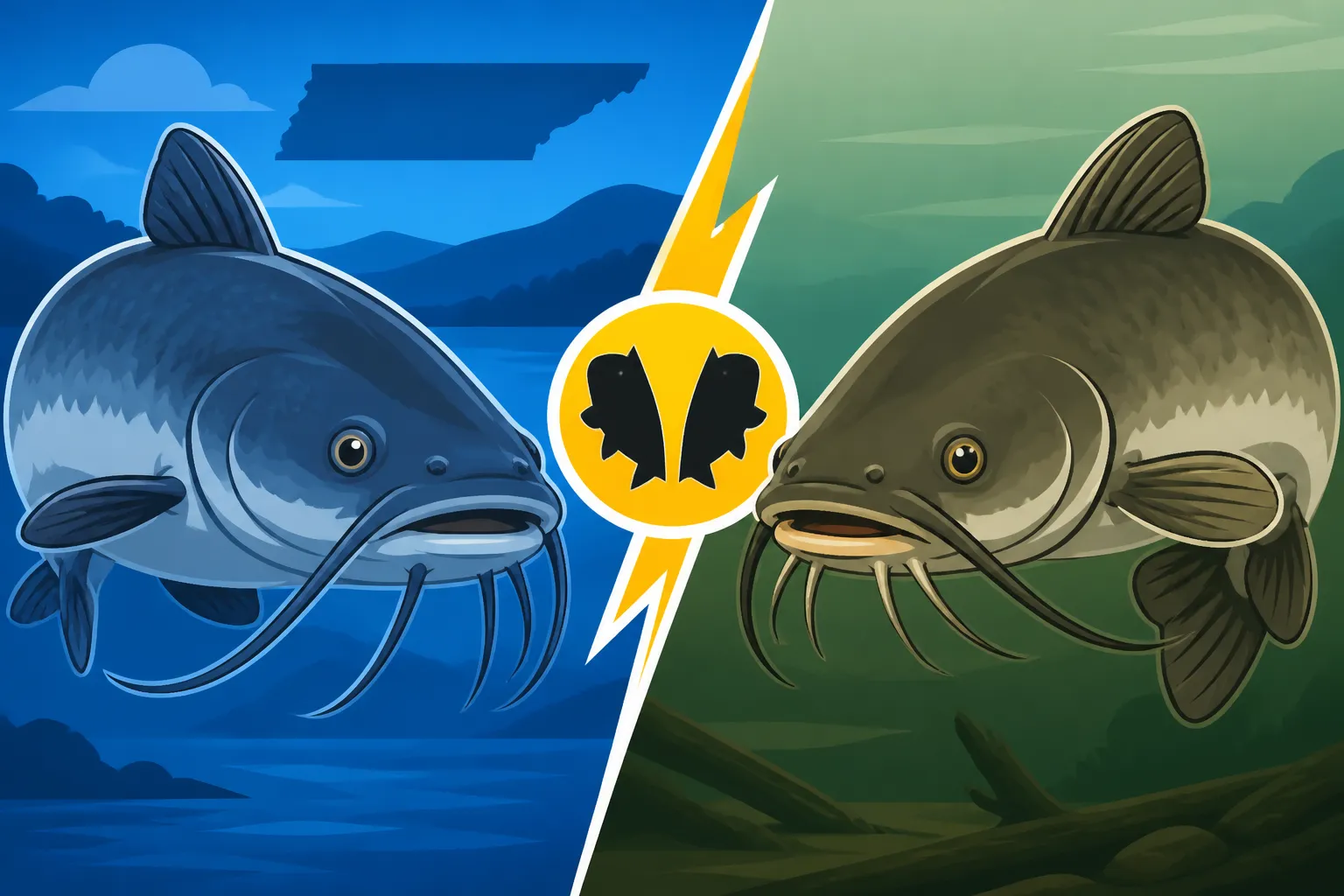
| Coloration | Olive-brown/greenish-gray, often with spots (especially juveniles) | Slate blue/silvery-gray, rarely or never with spots |
| Head Shape | Proportionally smaller, more pointed | Proportionally larger, broader, often blunt |
| Mouth Position | Terminal or slightly sub-terminal | Sub-terminal (upper jaw extends beyond lower jaw) |
| Maximum Size | Up to 40-50 lbs (typically much smaller) | Can exceed 100 lbs (trophy potential) |
Tail Shape: Forked vs. Less Forked
The shape of the caudal fin, or tail, is another quick visual cue, though perhaps less definitive than the anal fin ray count. Both species have forked tails, but the depth of that fork can offer a hint.
- Channel Catfish: Exhibit a deeply forked tail, often described as having a sharp, distinct "V" shape. The upper and lower lobes of the tail are usually quite pointed. This deep fork contributes to their agile, streamlined appearance.
- Blue Catfish: While also forked, their tail tends to be less deeply forked, sometimes appearing more subtle or almost blunt at the ends of the lobes. The "V" shape is often wider and shallower compared to a channel cat's.
It's important to note that damage or regeneration can alter the appearance of a tail, so this feature should always be considered alongside other characteristics. However, for a healthy, intact fish, the tail's fork depth can be a useful, immediate differentiator. It’s part of the overall body morphology that gives each species its distinctive silhouette in the water.
Common Misconceptions and Tricky Situations
Even with all these tips, sometimes identifying a catfish can feel like a riddle. There are a few scenarios that commonly trip up even experienced anglers, and it's good to be aware of them. The river isn't always a textbook, and fish don't always read the rulebook!
Juvenile Fish and Hybrids
One of the biggest challenges comes with identifying juvenile fish. Young channel catfish often have very prominent spots, making them relatively easy to identify. However, as they grow, these spots can fade. Meanwhile, juvenile blue catfish might not yet have developed the full bulk or the distinct head shape of an adult, making them look more generic. Their anal fin might also appear less dramatically straight-edged than an older fish. This is where the fin ray count becomes even more critical, as it's a more stable anatomical feature even in younger fish.
Another less common but still possible scenario is encountering a hybrid. While pure blue and channel catfish don't typically hybridize in the wild, some aquaculture facilities produce "hybrid catfish" by crossing channel catfish males with blue catfish females for stocking purposes. These hybrids often exhibit a mix of traits, which can make identification extremely difficult without genetic testing. If you catch a fish that seems to have a blend of characteristics, it might just be one of these stocked hybrids, though they are usually not found in wild populations outside of specific, contained scenarios. Learning How to Identify Tennessee's State Fish, the Smallmouth Bass is another common identification challenge for many anglers.
Environmental Factors Affecting Appearance
As we touched on earlier, a fish's environment plays a huge role in its appearance. Water clarity, diet, and even the type of riverbed or lake bottom can significantly influence coloration. For instance, a channel catfish living in a deep, clear, rocky reservoir might appear much lighter and steelier than one from a shallow, muddy river with tannin-stained water. Similarly, a blue catfish from nutrient-rich, turbid waters might appear darker and less vibrantly blue than its counterpart from a pristine, clear-water lake.
These environmental influences can sometimes mask or alter the "classic" appearance you might expect based on field guide descriptions. That's why relying on a combination of features – especially the more stable anatomical ones like fin ray count and overall fin shape – is always better than relying on a single, variable trait like color. A healthy fish from a pristine environment might look quite different from a stressed fish in a less-than-ideal habitat, even if they're the same species.
Why Accurate Identification Enhances Your Fishing Experience
Knowing your fish goes beyond just following rules; it actually makes you a better, more observant, and ultimately, more successful angler. It deepens your understanding of the aquatic ecosystem and connects you more intimately with the fish you pursue.
Targeting Specific Species
Once you can confidently tell the difference between a blue and a channel catfish, you can start to refine your fishing strategies to target one species over the other. Blue catfish, for example, tend to prefer deeper, main-river channels and large open water areas, often feeding on larger cut bait. Channel catfish are often found in a wider range of habitats, including shallower flats, tributary mouths, and around structure, and respond well to a variety of baits from worms to stink baits. Knowing what you've hooked allows you to adjust your bait, rig, and location for the species you're truly after. This targeted approach can significantly increase your success rate and make your time on the water more productive. For specific bait recommendations, you might find our guides on Best Bait for Channel Catfish Fishing and Best Bait for Blue Catfish Fishing helpful.
Furthermore, if you're chasing trophy fish, knowing how to identify a blue catfish is paramount. While channel cats can grow large, blue catfish consistently reach much greater sizes, often exceeding 50 or even 100 pounds in Tennessee's most productive waters. If a record-breaking catch is your goal, understanding the nuances of blue catfish behavior and habitat – which starts with identification – is absolutely essential.
Contributing to Conservation Efforts
Accurate species identification isn't just for anglers; it's also vital for fisheries biologists and conservationists. When you report your catches accurately, or when data is collected from tournaments and creel surveys, correctly identified fish provide better information. This data helps state wildlife agencies, like the Tennessee Wildlife Resources Agency (TWRA), make informed decisions about stocking programs, regulation changes, and habitat management. For instance, understanding the population dynamics of blue catfish versus channel catfish in a particular reservoir can influence how many of each species are stocked, or whether specific size limits need to be adjusted to promote healthy populations.
By taking the time to properly identify your catch, you're indirectly contributing to the broader conservation efforts that ensure future generations of anglers can enjoy the same fantastic fishing opportunities we have today. It's a small but significant way for every angler to give back to the resource. Plus, learning more about Catfish Species Found in Tennessee Waters can help you understand the full diversity of these fascinating fish and their role in the ecosystem.
Ultimately, becoming proficient in blue catfish vs. channel catfish identification is a skill that will serve you well on every Tennessee fishing adventure. It adds another layer of appreciation and understanding to your time on the water, turning every catch into a learning experience and every outing into a more informed pursuit. So, next time you feel that familiar tug on your line, take a moment to really look at your catch. You might be surprised at what you discover!
Disclaimer
This article is for general informational purposes only and does not constitute professional advice. Laws, prices and regulations vary by location and change over time. Consult a qualified professional for guidance on your specific situation.