How to Identify a Striped Bass
You've just had an epic fight on the end of your line, a true powerhouse that left your arms aching, and now you're looking at your catch, wondering, "Was that a true striped bass, or one of its cousins?" It's a common dilemma for anglers across Tennessee, especially with so many similar-looking species swimming our waters. Getting a solid identification is key, not just for bragging rights, but also for ensuring you're following the right regulations, as limits can vary greatly between stripers and other types of bass. This guide is here to walk you through the distinct features of the striped bass, helping you confidently identify this magnificent game fish on your next Tennessee fishing adventure.
Understanding the Striped Bass: A Powerhouse of Our Waters
The striped bass, often just called "striper" by those of us who chase them, is a true leviathan in many Tennessee reservoirs. These fish are renowned for their incredible fighting ability and their schooling behavior, which can lead to some truly exhilarating fishing experiences. But before you can properly target or enjoy catching them, you need to know exactly what you're looking at. They have a unique set of characteristics that, once you know them, make identification much clearer, even when battling a fish at the side of the boat.
Body Shape and Overall Impression
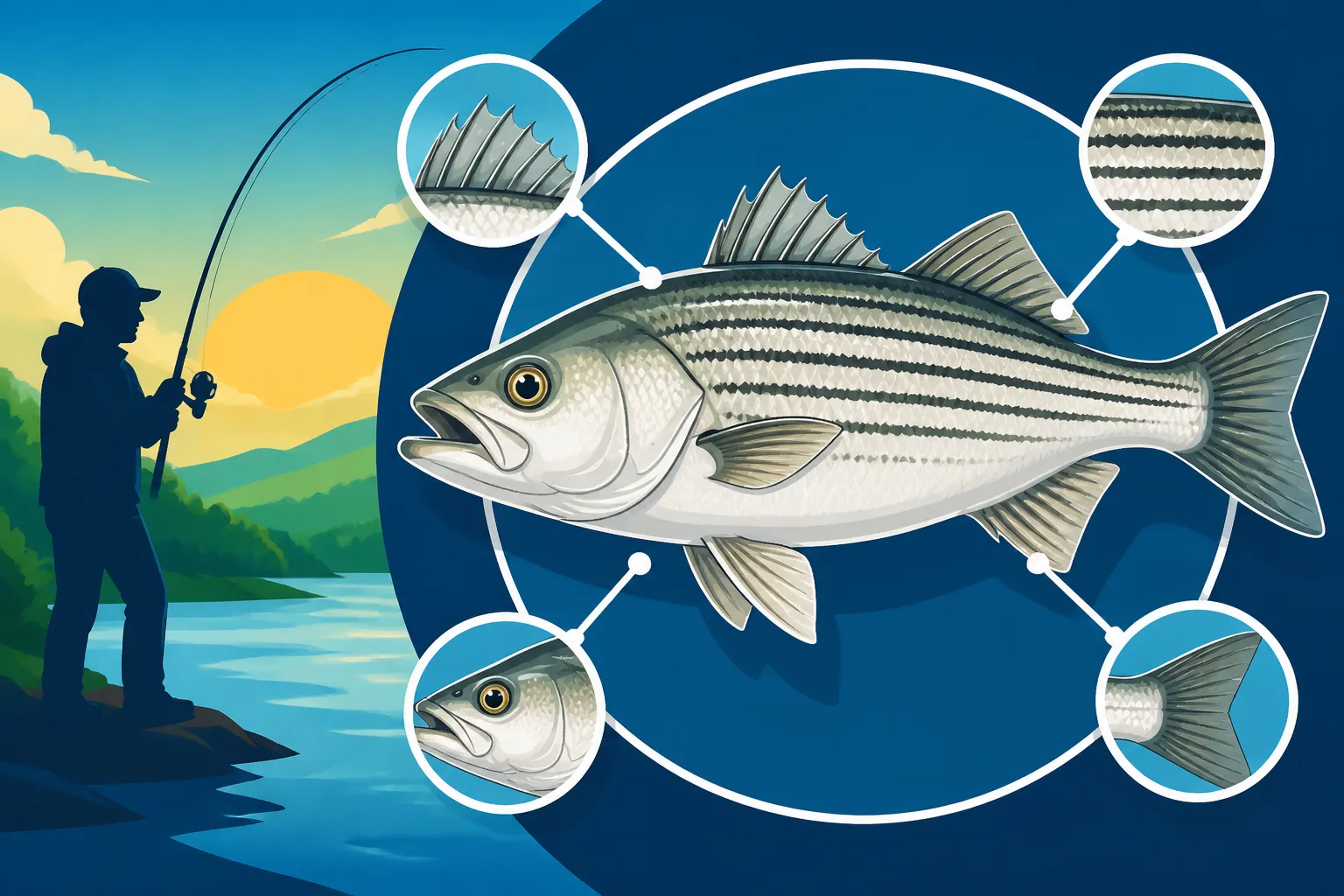
When you first lay eyes on a striped bass, what often strikes you is its streamlined, torpedo-like body. These aren't dainty fish; they're built for power and speed in open water. Their body is longer and more slender than, say, a largemouth bass, giving them a more cylindrical or football-like appearance. The back is typically arched, leading to a strong, muscular tail that drives their powerful runs.
Imagine you're out on Kentucky Lake Fishing on the Tennessee Side, and a huge school of fish busts the surface. As you motor over, you hook into one. As you bring it closer, you’ll notice that distinct shape. It's designed for cruising and chasing baitfish like shad across vast expanses of water, not for hiding in weeds or tight cover. This strong, elongated profile is your first big clue. Their overall impression is one of raw power and endurance, perfectly adapted for the large, open waters of Tennessee's biggest reservoirs where they thrive.
Striping Patterns and Coloration
The most obvious distinguishing feature of the striped bass, as its name suggests, is its prominent stripes. These dark, horizontal lines run along its silvery-white sides, from just behind the gill plate all the way to the tail. What's really important to observe is that these stripes are typically unbroken and clearly defined. They usually number between seven and nine, and they don't fade out or become disjointed as they move towards the tail.
The coloration can vary slightly depending on the water clarity and the fish's diet, but generally, they will have a dark, often greenish-gray or bluish-black back, fading to those bright, silvery sides with the distinct black stripes, and then a clean white belly. If you're comparing it to other species, pay close attention to the continuity of those lines. A true striper's stripes are like solid painted lines, not dashed or broken up. This characteristic is so reliable that it’s often the first thing experienced anglers look for to confirm their catch.
Head and Mouth Characteristics
Now let's zoom in on the head, as this area holds some very telling features. The head of a striped bass is relatively large compared to its body, and its mouth is quite spacious, allowing it to engulf sizable prey. The lower jaw protrudes slightly beyond the upper jaw, giving it an "underslung" or "predatory" look. This jaw configuration is perfect for snatching baitfish from below or head-on.
But here’s a critical detail: examine the two patches of teeth on its tongue. Most true striped bass will have two distinct patches of teeth on their tongue. This is a subtle but incredibly reliable identifier that can settle any doubts, especially when you're looking at a fish that might otherwise resemble a hybrid. You might need to gently open its mouth and feel for these patches, or use a small mirror if you have one. Additionally, the gill plate (operculum) usually has two sharp spines on its lower edge. These might not be as immediately obvious as the stripes, but they are consistently present and help round out the identification puzzle. Keep a waterproof fish identification card, easily found on Amazon, handy for quick comparisons while on the water.
Distinguishing Striped Bass from Similar Species
This is where many anglers get tripped up! Tennessee waters are home to a few species that look remarkably similar to striped bass, and a quick glance can be deceiving. The most common culprits for mistaken identity are hybrid striped bass (often called "wipers") and white bass. Knowing the subtle differences can prevent confusion and ensure you're compliant with all fishing regulations. Understanding these nuances is crucial because Tennessee Striped Bass Season and Regulations can differ from other species.
Striped Bass vs. Hybrid Striped Bass
The hybrid striped bass is, as its name suggests, a cross between a striped bass and a white bass. They were specifically bred for stocking in many reservoirs, including some in Tennessee, because they grow fast and fight hard, often surpassing the growth rate of a pure white bass. Visually, they share many similarities with the true striper, which is why they cause so much confusion. This is precisely why articles like Striped Bass vs Hybrid Striped Bass: What's the Difference? exist, to help anglers like you make these fine distinctions.
The main differentiating factor for hybrids lies in their stripes. While they have the same dark stripes as a true striper, the hybrid's stripes are typically broken or interrupted, especially those below the lateral line, or they might appear quite faded and indistinct, particularly towards the tail. It's almost like someone took a brush and smudged or dashed some of the lines. Some hybrids might have one or two solid stripes, but usually, several will be visibly broken. Remember that two patches of teeth on the tongue for a pure striper? Hybrids often have only one patch, or sometimes a very irregular, scattered second patch. This tongue patch detail is often the definitive way to tell them apart when the stripes alone aren't clear enough. Hybrid striped bass also tend to have a slightly deeper, more compressed body shape than the pure striper, appearing a bit "stubby" or "stocky" in comparison to the striper's elongated form, though this is a less reliable indicator than the stripes and tongue patches.
Striped Bass vs. White Bass
White bass are the smallest of the three, but they are prolific and often school up, leading to exciting topwater action. They can easily be confused with juvenile striped bass or hybrids, especially in a feeding frenzy when you're just trying to get a lure into the action. If you're catching a lot of fish in the 1-3 pound range that are hitting like trucks, you might be on a school of white bass.
The primary difference with white bass is their body shape and the clarity of their stripes. White bass have a much deeper, more compressed body than a striped bass, making them appear "taller" from back to belly. Their stripes are also generally fewer and much fainter, sometimes almost disappearing, especially on smaller fish. They usually only have one prominent stripe extending to the tail, whereas stripers have multiple. White bass almost always have only one single patch of teeth on their tongue. This is a critical distinction from both stripers (two patches) and many hybrids (often one, sometimes irregular two). Their overall color is usually a lighter, silvery-white without the greenish or bluish tint on the back seen in stripers. When you see them side-by-side, the difference in body shape is immediately apparent, but when a fish is fresh out of the water, the stripes and tongue patches are your best bet for accurate identification.
Here's a quick comparison table to help solidify these differences:
| Feature | Striped Bass (Striper) | Hybrid Striped Bass (Wipper) | White Bass |
|---|---|---|---|
| Body Shape | Elongated, torpedo-like, cylindrical | Deeper, more stocky, somewhat compressed | Deepest, most compressed, "tall" |
| Stripes | 7-9 distinct, unbroken, solid lines | Several broken or interrupted lines | Fainter, usually one strong stripe to tail |
| Tongue Patches | Two distinct patches of teeth | One patch, or irregular second patch | One single patch of teeth |
| Jaw | Lower jaw protrudes slightly | Lower jaw protrudes slightly | Jaws meet evenly, or upper jaw protrudes |
| Size | Can grow very large (20+ lbs common) | Medium to large (5-15 lbs common) | Small (1-3 lbs common) |
Habitat and Behavior Clues for Identification
Beyond physical characteristics, understanding where and how striped bass behave can give you crucial clues for identification even before you get the fish in the boat. Their preferred environments and feeding strategies are quite distinct from other species, helping you narrow down your possibilities. This knowledge can also greatly improve your chances of success, leading you to Where to Catch Striped Bass in Tennessee.
Typical Habitats in Tennessee Reservoirs
Striped bass are fundamentally open-water fish. They are anadromous in their native range, meaning they migrate between freshwater and saltwater, but in landlocked Tennessee, they thrive in large, deep reservoirs like Norris Lake, Watts Bar Lake, or Cherokee Lake. They prefer areas with a strong current, deep main lake channels, and abundant schools of baitfish, primarily shad. You won't typically find them lurking in shallow, weed-choked coves or hiding among dense brush piles like a largemouth bass might.
Instead, look for stripers around dam discharges, deep points, humps, ledges, and channels, especially where water flows or currents converge. They're often found suspended in the water column, patrolling for baitfish. In the spring and fall, they might move shallower to chase bait, but their comfort zone is generally deeper, cooler water. If you're fishing a shallow, muddy pond, you're almost certainly not dealing with a striped bass. If you're on a massive reservoir and see big schools of baitfish on your fish finder, perhaps near a thermal stratification line, you’re likely in prime striper territory. Check out Fish Finders and Electronics for Tennessee Reservoirs for tips on spotting these deep-water schools.
Feeding Behavior and Schooling Patterns
Striped bass are voracious predators and exhibit highly distinctive feeding behaviors. They are schooling fish, often hunting in large groups, which can lead to spectacular feeding frenzies known as "topwater busts" or "boils." When a school of stripers drives baitfish to the surface, the water can erupt in a chaotic explosion of splashing fish, often with seagulls diving in to join the feast. This aggressive, communal feeding behavior is a hallmark of striped bass.
If you observe these kinds of violent surface disruptions in deep, open water, it's a strong indicator that you've found stripers or perhaps their hybrid cousins. They will often chase baitfish relentlessly, pushing them against the surface or into tight balls, making them easy targets. When they're not busting on top, stripers are often found relating to structure or bait schools in deeper water, following predictable patterns as they patrol their territory. You might use heavy jigs, large swimbaits, or troll with big crankbaits to target them. Many anglers find Deep Water Techniques for Striped Bass or How to Fish Deep Water for Striped Bass essential for consistently hooking these deep-dwelling giants. Even Best Trolling Gear for Tennessee Striped Bass can make a huge difference in covering water and finding active fish.
Practical Tips for On-the-Water Identification
When you're out on the water, battling a fish, and adrenaline is pumping, clear identification can be tough. But with a few practical tips and the knowledge we've covered, you can quickly and confidently confirm if you've landed a true striped bass.
What to Look For Quickly and Efficiently
The moment you get the fish boat-side or bank-side, make a quick visual scan. Your eyes should immediately go to the stripes. Are they solid and unbroken all the way down the body? If so, that's a huge clue. If they're dashed or broken, especially below the lateral line, you're likely looking at a hybrid. If the fish is smaller, with a very deep body, and faint stripes, it's probably a white bass.
Another quick check, if you're comfortable and safe handling the fish, is the tongue. Gently pry open the mouth and look for those two distinct patches of teeth. This is often the most reliable "tie-breaker" when the stripes aren't perfectly clear. You might also notice the strong, muscular feel of a striper's body, particularly in the tail section, which hints at its power. Having a good, clear photo of your catch can also help for later identification, and many anglers even keep a camera or phone in a waterproof case, readily accessible when fishing. It's smart to have a ruler or measuring board on your boat for Striped Bass Size Records and Growth Rates too, so you can quickly release fish outside of legal length limits.
Using a Fish Identification Guide
Even seasoned anglers sometimes need a refresher or encounter a fish that just doesn't quite fit the mold. This is where a reliable fish identification guide becomes your best friend. There are many excellent, waterproof guides specifically for freshwater fish in the Southeast that you can carry with you on the boat or keep in your tackle box. These guides often feature detailed drawings or photographs, along with bullet points highlighting key identification features for each species.
Before you even head out, spend a few minutes reviewing the differences between striped bass, hybrid stripers, and white bass in your guide. Familiarize yourself with the visual cues, especially the stripe patterns and tongue patches. Many of these guides are readily available on platforms like Amazon, and investing in one is a small price to pay for confident identification and ensuring you adhere to local regulations. If you're ever unsure after reviewing your catch against the guide, it's always safest to err on the side of caution and release the fish unharmed, or consult with a local game warden or experienced angler. After all, protecting our fisheries ensures great fishing for years to come.
Disclaimer
This article is for general informational purposes only and does not constitute professional advice. Laws, prices and regulations vary by location and change over time. Consult a qualified professional for guidance on your specific situation.