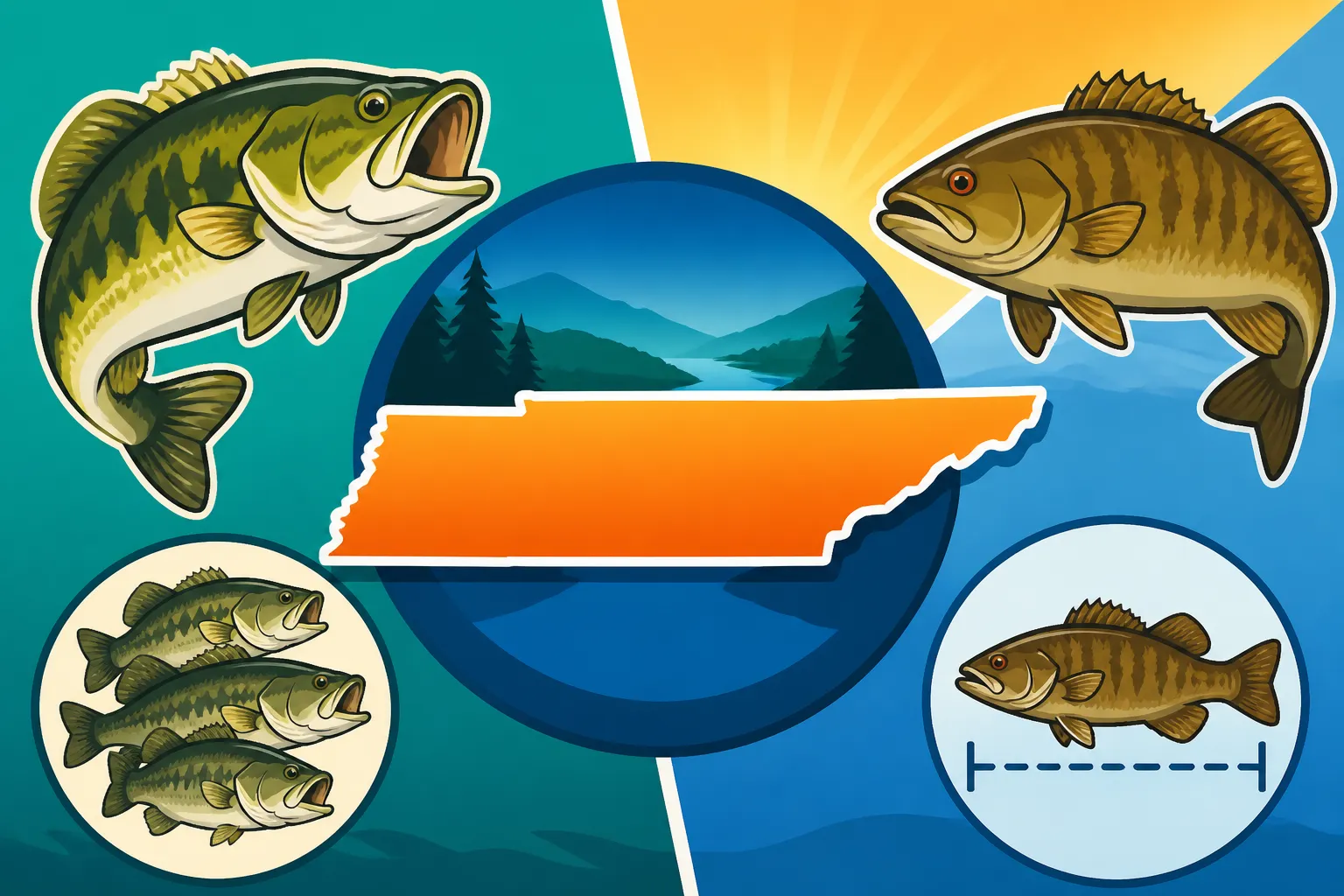
Tennessee’s daily bass limits split by species and by size
There's nothing quite like the thrill of feeling a strong tug on your line, knowing you've hooked into a feisty bass here in Tennessee. But that excitement can quickly turn to a bit of a headache when you start wondering, "Wait, what are the rules for keeping this one? Is it too big? Too small? And does it matter what kind of bass it is?" It’s a common frustration, and honestly, with our state’s incredible diversity of bass species, it's easy to get confused. This guide is here to untangle all those lines, making sure you understand Tennessee's daily bass limits, broken down by species and size, so you can fish with confidence and stay on the right side of the law.
The Cornerstone of Sustainable Fishing: Understanding Bass Limits
Fishing isn't just about catching fish; it's also about ensuring there are plenty of fish for future generations to enjoy. That's where daily limits and size restrictions come into play. These regulations aren't just arbitrary rules designed to make your life harder; they are carefully crafted by wildlife biologists to protect fish populations and maintain healthy ecosystems.
Why Regulations Exist
The Tennessee Wildlife Resources Agency (TWRA) sets these rules based on extensive research and monitoring of fish populations across the state. They look at factors like spawning success, growth rates, natural mortality, and fishing pressure. Without these regulations, certain species could easily be overfished, leading to a decline in their numbers and potentially devastating impacts on the entire aquatic food web. Imagine if everyone kept every trophy bass they caught; those genetics for large fish would quickly disappear from the population.
These rules also help balance the angling experience. By limiting the number and size of fish you can keep, it encourages catch and release, especially for larger breeding fish, while still allowing anglers to take home a meal. It's about finding that sweet spot where both conservation and recreation can thrive. So, when you're out on the water, remember that every limit serves a purpose, contributing to the health of our amazing Tennessee waters.
The Role of TWRA in Conservation
The TWRA is at the forefront of managing our state's fisheries. They don't just set the rules; they actively work to enhance fish habitats, stock fish when necessary, and conduct research to ensure their management strategies are effective. For instance, they might implement specific slot limits or harvest restrictions in certain bodies of water if a particular bass population is struggling or, conversely, thriving. Their efforts are what allow us to have such fantastic bass fishing opportunities, from the largemouth havens of Chickamauga Lake to the smallmouth strongholds in our cooler rivers.
Their dedicated staff of biologists and enforcement officers work tirelessly. Game wardens, for example, aren't just there to hand out tickets; they're educators and guardians of our natural resources, often the first point of contact for anglers with questions about local rules or conservation efforts. Adhering to Tennessee Fishing Regulations Explained is a direct way you contribute to these conservation goals, ensuring the vitality of Tennessee's aquatic environments.
Largemouth Bass Limits in Tennessee
The largemouth bass is arguably the most popular sport fish in Tennessee, and for good reason! These powerful predators can grow to impressive sizes, offering a thrilling fight for any angler. However, their popularity also means they require specific management to maintain healthy populations. The rules for largemouth bass are quite specific, focusing on both the number of fish you can keep and their size.
Daily Creel Limit for Largemouth
When you're chasing those green giants, remember that the statewide daily creel limit for largemouth bass in Tennessee is 5 fish per day. This means, no matter how good the bite is, you can only legally keep five largemouth bass in your livewell or cooler during a single day of fishing. This limit is designed to spread the harvest among more anglers and prevent overfishing, especially in heavily pressured waters.
It's a straightforward rule, but one that's easy to forget in the heat of a productive fishing trip. Always keep a mental tally or even a physical one if you're keeping fish. Exceeding this limit, even by one fish, can lead to penalties. The goal isn't to punish anglers, but to ensure everyone plays by the same rules for the greater good of the fishery. For a general overview, you can refer to the Statewide Bass Limits for Tennessee Anglers guide.
Size Restrictions for Largemouth Bass
Here's where it gets a little more nuanced. While you can keep 5 largemouth bass, there's a crucial size restriction to consider: only one of your five fish may be over 18 inches. This is a classic "slot limit" strategy, encouraging anglers to release the larger, more genetically valuable breeding fish while allowing for the harvest of smaller, more abundant fish.
Imagine you've had an incredible day and caught several largemouth. You measure them, and you have two that are 19 inches, one at 17 inches, and two at 15 inches. Under Tennessee rules, you would have to choose which one of those 19-inch fish you want to keep, and release the other one. You could then keep your 17-inch and two 15-inch fish. This specific rule, where Only one largemouth bass over 18 inches may be kept daily, is absolutely critical for conserving trophy genetics and promoting natural reproduction. It truly makes a difference in maintaining a robust fishery capable of producing those brag-worthy catches.
Real-World Scenarios and Compliance
Let's say you're out on a popular lake like Chickamauga, known for its trophy largemouth. You catch a beautiful 20-inch largemouth early in the morning. You decide to keep it. This means for the rest of the day, any other largemouth you keep must be 18 inches or less. If you catch another 20-inch fish, it must be released. It's a strategic decision you make on the water, which can influence how you fish for the remainder of your trip.
Having a reliable measuring board is non-negotiable. Many anglers use a commercially available bump board, which is easy to use and provides accurate measurements. You can find excellent, durable options on platforms like Amazon, making it simple to get one delivered before your next trip. Always measure fish quickly and carefully, minimizing stress on the fish, especially if you plan to release them. Remember, fish shrink slightly after death, so if it's borderline, it's always best to err on the side of caution and release it if you're unsure. The rule that Largemouth bass limit in Tennessee is 5 fish per day and the 18-inch slot work hand-in-hand to ensure a sustainable largemouth population.
Smallmouth, Spotted, and Alabama Bass Limits
While largemouth get a lot of attention, Tennessee is also home to incredible smallmouth, spotted, and occasionally Alabama bass populations. These "black bass" species are distinct from largemouth, and because they often share similar habitats and can be harder to differentiate for new anglers, the TWRA groups them together for management purposes, particularly regarding limits.
Combined Daily Creel Limit
For smallmouth, spotted, and Alabama bass, the statewide daily creel limit is a combined total of 5 fish per day. This means if you catch three smallmouth and two spotted bass, you've hit your limit for these species. You can't then go out and catch five more smallmouth, because all three species count towards that single five-fish total. This combined limit acknowledges the ecological overlap and the challenges anglers might face in quickly identifying each species, especially the subtle differences between spotted and smallmouth bass.
This combined limit is a key detail that can easily be overlooked. Many anglers are familiar with the 5-fish largemouth limit but might not realize it applies to these other black bass species collectively. Always keep track of your catch, regardless of the specific species within this group, to ensure you don't accidentally exceed the limit. The rule that Smallmouth, Alabama and spotted bass share one combined 5-fish daily limit is designed to simplify management while still protecting these valuable fisheries.
Specific Size Restrictions for These Species
Just like with largemouth, there's a size restriction for smallmouth, spotted, and Alabama bass: only one of your five combined fish may be over 16 inches. This is a slightly different size threshold than the largemouth limit, reflecting the average growth patterns and maximum sizes of these particular species. Smallmouth, while fiercely strong, generally don't grow quite as large as the biggest largemouth.
This 16-inch limit for the single large fish is vital for protecting the breeding stock of these species. Whether you're targeting smallmouth in a rocky river or spotted bass in a reservoir, keeping that 16-inch maximum in mind is crucial. If you happen to catch an exceptionally large smallmouth, say a 19-inch bronze-back, and decide to keep it, then any other smallmouth, spotted, or Alabama bass you keep that day must be 16 inches or less. Remember, Only one bass over 16 inches counts among smallmouth, Alabama and spotted species for your daily take.
Differentiating Between Bass Species
This is where many anglers can get tripped up. Telling a largemouth from a smallmouth is usually pretty straightforward (mouth size, dorsal fin connection). But distinguishing a spotted bass from a smallmouth, especially if you're new to a particular water body, can be tricky. Spotted bass have a rough patch on their tongue and typically have more distinct spots along their lateral line below the dark band, while smallmouth have vertical bars and a smoother tongue.
If you're unsure, it's always best to consult a good fish identification guide or even a quick search on your phone. Websites and apps often provide clear visual cues. Understanding How to Identify Tennessee's State Fish, the Smallmouth Bass and How to Identify Spotted Bass in Tennessee Reservoirs is not just academic; it's essential for staying compliant with harvest regulations. When in doubt, releasing the fish is always the safest bet.
Hybrid Bass and Other "Black Bass" Species
Beyond the main three bass species, Tennessee waters can also host hybrid bass and a few other, less common "black bass" varieties. It's important to know how these fit into the regulatory framework to avoid any unintentional rule violations.
How Hybrids Factor into Daily Limits
When we talk about "hybrid bass" in the context of these regulations, we're generally referring to hybrids of striped bass and white bass. These are often stocked by the TWRA and are a fantastic fighting fish. However, these fish have their own specific limits, usually quite generous, and generally do not count towards the "black bass" limits for largemouth, smallmouth, spotted, or Alabama bass. Their limits are separate.
But here's a crucial distinction: there are also sometimes naturally occurring hybrids among the black bass species themselves, though less common. More importantly, when TWRA refers to Hybrid bass count toward the same 5-fish combined limit as smallmouth, they're often referring to certain non-pure black bass strains or very specific regional scenarios. Always double-check the latest TWRA regulations for the precise definition if you suspect you've caught a black bass hybrid, as the general rule is that striped/white bass hybrids are distinct from black bass limits. The safest approach is to ensure clear identification and know the specific rules for the water you are fishing.
Understanding the "Black Bass" Category
The term "black bass" is a general classification that includes largemouth bass, smallmouth bass, spotted bass, and Alabama bass. These are all part of the Micropterus genus. When the regulations refer to a "black bass" limit, it's usually encompassing these species. Other species like white bass, yellow bass, or striped bass are not considered "black bass" and have their own distinct regulations.
The importance of this classification becomes clear when you're on the water and trying to figure out if your catch falls under a particular daily creel. Knowing the characteristics of each, such as How to Identify a Largemouth Bass in Tennessee or the key features of a smallmouth, helps immensely. This categorization helps the TWRA manage these similar-looking and often co-existing species under a common framework to ensure their health and sustainability across Tennessee's diverse waterways.
Statewide vs. Lake-Specific Bass Regulations
While there are overarching statewide regulations that apply across Tennessee, it's incredibly important to understand that these are not always the final word. Many of Tennessee's incredible fishing lakes and reservoirs have their own unique, special regulations that can supersede the general statewide rules. Ignoring these can lead to fines and frustration.
When Local Rules Override Statewide
Tennessee is blessed with a vast network of lakes, rivers, and streams, each with its own ecological characteristics and fishing pressure. Because of this, the TWRA frequently implements specific regulations for individual water bodies to address local fish population dynamics. For example, a lake known for producing massive largemouth might have an even stricter slot limit to protect its trophy potential, or a smallmouth fishery might have a different minimum size.
These local rules can apply to creel limits, size limits, and even tackle restrictions. A prime example is Chickamauga Lake, renowned for its giant bass, where anglers might find specific rules designed to further protect its exceptional largemouth population. It's not uncommon for Lake-Specific Fishing Rules That Override Tennessee's Statewide Limits to be in place, so always check before you cast. These regulations are posted at boat ramps, in local bait shops, and are always detailed in the annual Tennessee Fishing Guide.
How to Check Lake-Specific Regulations
Before any fishing trip, especially to a new lake or river, make it a habit to check the current TWRA fishing guide or their official website. This resource is updated annually and provides detailed information for every major body of water in the state. The information is usually organized by region or specific lake, making it easy to find what you need.
You can also find current regulations posted at public boat ramps and many local bait and tackle shops. Often, seasoned local anglers or guides can offer valuable insights into current local rules, but it’s always best to verify with official sources. Think of it as part of your pre-fishing checklist, right alongside checking the weather and packing your favorite lures for Tennessee Bass Fishing Seasons and Patterns. It takes just a few minutes, but it can save you a lot of hassle and ensure you're fishing legally and responsibly.
| Bass Species | Daily Creel Limit | Size Restriction | Notes |
|---|---|---|---|
| Largemouth Bass | 5 fish | Only 1 fish over 18 inches | Statewide limit; check for lake-specific rules. |
| Smallmouth Bass | 5 fish (combined) | Only 1 fish over 16 inches (combined) | Combined with Spotted and Alabama Bass. |
| Spotted Bass | 5 fish (combined) | Only 1 fish over 16 inches (combined) | Combined with Smallmouth and Alabama Bass. |
| Alabama Bass | 5 fish (combined) | Only 1 fish over 16 inches (combined) | Combined with Smallmouth and Spotted Bass. |
| Hybrid Striped Bass | 20 fish | No size limit | Does NOT count towards "black bass" limits. |
| Yellow Bass | No limit | No size limit | Does NOT count towards "black bass" limits. |
| White Bass | 15 fish | No size limit | Does NOT count towards "black bass" limits. |
Practical Tips for Adhering to Bass Limits
Knowing the rules is one thing, but practically applying them on the water is another. There are a few things you can do to make compliance easier and ensure you're always fishing within the legal limits.
Measuring Your Catch Accurately
The difference of half an inch can be the difference between a legal fish and a fine. That's why an accurate measuring device is essential. A rigid, flat measuring board is generally preferred over a flexible tape measure, as it provides a more consistent reading. You simply "bump" the fish's nose against one end of the board and read the length at the tip of its tail.
When measuring, ensure the fish is laid flat and the mouth is closed. Pinch the tail to get the maximum length if the regulation allows. Many anglers mark their measuring boards with the common legal sizes (like 16 and 18 inches) to make quick decisions. There are many great, affordable measuring boards available on Amazon that are perfect for boat or bank fishing. This small investment can save you a big headache and ensure you are always confident in your catch.
Responsible Catch and Release Practices
For any fish you decide not to keep, or those that fall outside the legal harvest slot, responsible catch and release is paramount. This is especially true for those larger, breeding fish that contribute so much to the fishery. Always handle fish with wet hands to protect their slime coat, which is their primary defense against disease. Minimize their time out of the water, and use needle-nose pliers or a hook remover to quickly unhook them.
If a fish is deeply hooked, it's often better to cut the line as close to the hook as possible rather than trying to yank it out, which can cause internal damage. For larger fish, a landing net with rubber mesh can help cradle the fish and reduce injury. Gently release the fish, allowing it to swim away on its own power. Sometimes, supporting a large fish in the water until it regains its strength is necessary, especially in warmer water or after a long fight.
Essential Gear for Compliance
Beyond your rod, reel, and tackle, a few key pieces of gear can significantly help you comply with fishing limits:
- Measuring Board: As mentioned, an accurate, rigid measuring board is a must-have. Look for one that's durable and easy to read.
- Small Scale: While not always required, a portable digital scale can be useful for weighing your catch, especially if you're targeting specific weight goals or just curious. You can find many compact and waterproof options on Amazon.
- Fishing Pliers/Hook Remover: Essential for quick and clean hook removal, minimizing stress on the fish.
- Livewell or Cooler: If you plan to keep fish, a well-aerated livewell (for boats) or a cooler with ice (for bank fishing) will keep your catch fresh and minimize suffering.
- Current Fishing Guide: Always have a digital or physical copy of the latest Tennessee fishing regulations with you. This is your ultimate reference tool for any questions on the water.
Having these items readily available makes your fishing experience not only more enjoyable but also ensures you're a responsible and law-abiding angler in the great state of Tennessee.
Disclaimer
Please remember that fishing regulations, including daily creel limits and size restrictions, can change. While this guide is compiled with the most current information available, it is always the angler's responsibility to consult the official Tennessee Wildlife Resources Agency (TWRA) annual fishing guide or website before heading out. This ensures you have the most up-to-date information for the specific waters you plan to fish.