Where to Find Redeye Bass in Tennessee Streams
Finding that elusive redeye bass in Tennessee's sparkling, clear streams can feel like a real treasure hunt, especially when you're not entirely sure what kind of water they call home. Many anglers hit the big reservoirs or well-known trout streams, overlooking these feisty, beautiful fish that thrive in a very specific niche. This guide is all about peeling back the layers on where exactly you can find redeye bass in Tennessee, what kind of habitats they love, and how to successfully target them, giving you the insider knowledge to make your next stream adventure a rewarding one.
Understanding Redeye Bass Habitat in Tennessee
Redeye bass, often admired for their vibrant red eyes and aggressive fight, aren't found just anywhere. They're quite particular about their environment, and understanding their preferences is the first step to finding them. You might hear the term "redeye bass" used broadly, but in Tennessee, we're primarily talking about the Coosa redeye bass, a distinct species native to the Coosa River system, which extends into a specific corner of our state. Knowing this helps narrow down your search considerably.
Their Preferred Environment
Redeye bass are true connoisseurs of clear, cool, flowing water. Think upstream sections of rivers and their smaller, often overlooked tributaries, where the water is well-oxygenated and gravelly or rocky bottoms dominate. They absolutely thrive in environments that feature a mix of swift currents, riffles, and deeper pools, often with plenty of submerged structure like boulders, fallen trees, or undercut banks. These areas provide both ambush points for feeding and protection from predators.
These fish aren't really built for the slow, murky waters of a lowland river or a large, warm reservoir. They need that constant flow to stay healthy and active. If you're hiking alongside a stream and notice the water is a bit warmer, slower, or muddier, you're likely out of redeye territory. Their ideal habitat often overlaps with what many might consider prime trout water, but redeyes prefer slightly warmer temperatures than true cold-water species like Brook Trout in Tennessee's Cold-Water Streams.
The quality of the water is paramount. Redeye bass are quite sensitive to pollution and siltation, which is why they are often indicators of healthy stream ecosystems. If a stream is pristine and surrounded by intact riparian zones—the vegetated buffers along the banks—it dramatically increases your chances of finding these wonderful fish. It’s a joy to fish these clean waters, knowing you’re in an environment that supports such unique native species.
Identifying Redeye Bass
Before you can catch a redeye bass, you need to be able to recognize one, especially since they can sometimes be confused with other bass species. The most striking feature, as their name suggests, is the distinct red or orange coloration in their eyes. They typically have a dark, somewhat mottled lateral stripe that can be broken, and scales on their belly that are usually dark-edged, giving a diamond-like pattern. Their dorsal, caudal, and anal fins often have a reddish-orange tint, particularly when they're healthy and vibrant.
Size-wise, redeye bass are generally smaller than largemouth or smallmouth bass, often topping out at around 12-15 inches, though larger specimens are occasionally caught. They have a fairly large mouth, extending back to, but usually not beyond, the rear edge of the eye, which is a key differentiator from largemouth bass whose mouths extend well past the eye. For a detailed look at some of the physical characteristics, you can refer to Redeye Bass: A Tennessee Native Worth Knowing.
Distinguishing them from smallmouth bass, which often share similar stream habitats, can be tricky. Smallmouth bass generally have more pronounced vertical bars or mottling on their sides, and their eyes are typically brown or golden, lacking that distinct red hue. The jawline is also a good indicator; smallmouths generally have a jaw that doesn't extend past the eye. Understanding these subtle differences is crucial, especially if you're practicing catch-and-release and want to accurately identify your catch. If you’re ever unsure, it’s always best to err on the side of caution and release the fish unharmed.
Geographic Distribution in Tennessee
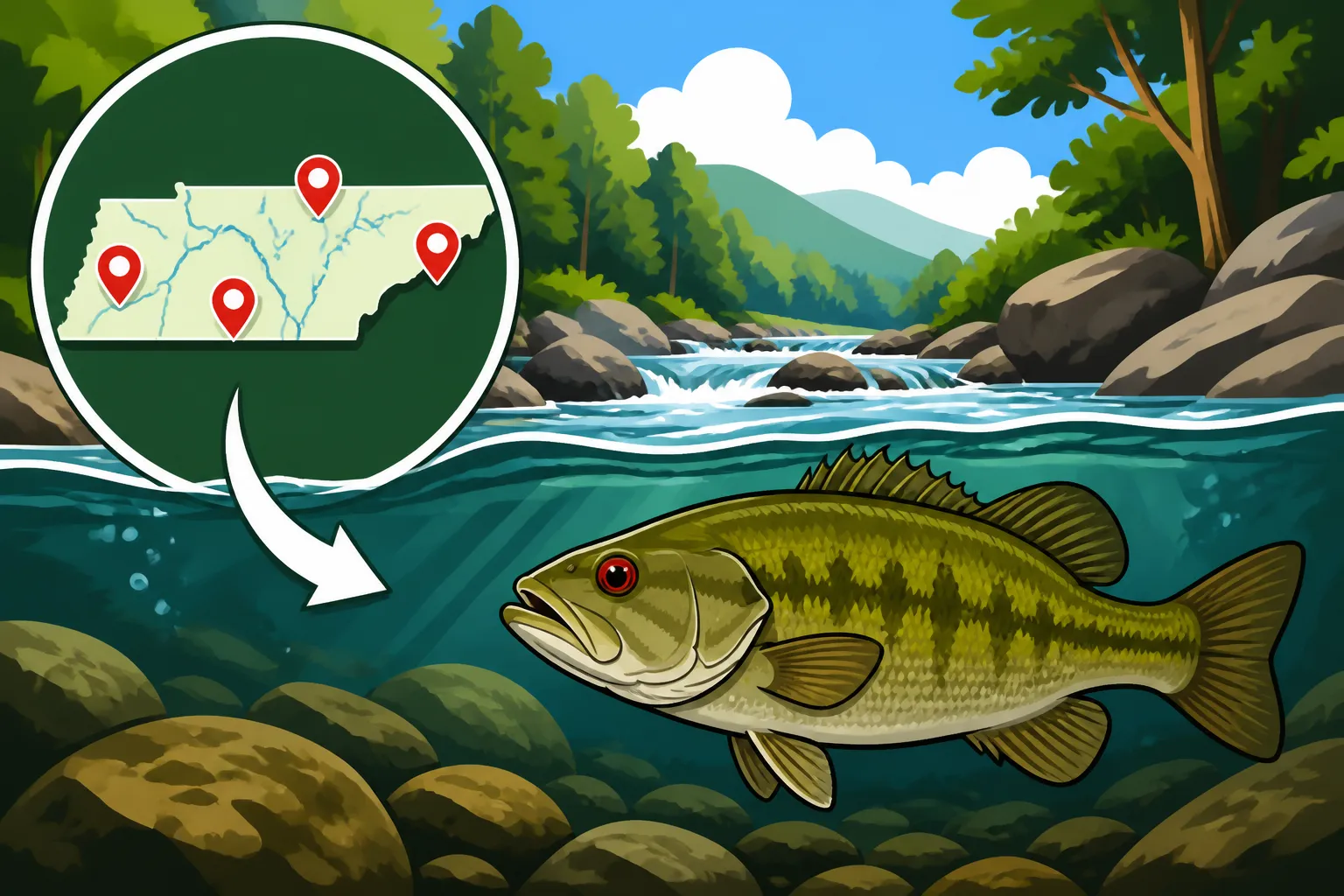
When it comes to Tennessee, the presence of redeye bass is largely restricted to the southeastern part of the state, particularly in streams that are part of the Coosa River drainage system. This is a very specific geological and hydrological region, making your search much more focused. These are not statewide fish, so don't expect to find them in West Tennessee rivers or the large central basin reservoirs.
The key areas to explore would be the tributaries of the Conasauga River, which flows into Georgia and is a part of the Coosa River Basin. You'll find these streams primarily in Polk and Bradley counties. The Hiwassee River system and its various feeder creeks, while more broadly known for other species, can also hold pockets of redeye bass in their upper, wilder sections. It’s critical to remember that Tennessee's 291 Native Fish Species and 52 Sport Fish Explained means each species has its own unique, often limited, range.
Venturing into these specific counties and looking for clear, rocky, flowing creeks and rivers will put you in the right ballpark. However, always double-check local regulations and confirm species identification, as misidentifying a redeye bass for a smallmouth, for instance, could lead to accidentally violating local catch limits. Your best bet is to seek out maps that highlight the Coosa River drainage within Tennessee, then look for accessible stream sections within that area.
Key Tennessee Streams for Redeye Bass
Now that you understand the kind of habitat redeye bass prefer and their general distribution, let's talk about specific areas and types of water within those regions where you can significantly increase your chances of hooking into one of these vibrant fish. It's often not about the biggest, most famous rivers, but rather the smaller, wilder tributaries.
Specific River Systems and Tributaries
As mentioned, the primary target area is the southeastern corner of Tennessee, focusing on streams that feed into the Coosa River system. The Conasauga River itself, though mostly in Georgia, has tributaries that extend into Tennessee, particularly in Polk and Bradley counties. Look for creeks like Conasauga Creek and its smaller feeder branches. These are often smaller, shallower streams than you might typically fish, but they offer that ideal clear, cool, rocky environment.
Another river system to consider, though it requires more diligent searching, is the upper Hiwassee River basin. While the Hiwassee is well-known for Clinch River Trout Fishing in East Tennessee, its headwaters and certain pristine tributaries can sometimes host redeye bass populations. These are typically fast-flowing, scenic waters, often found in more remote, forested areas. Access might be challenging, sometimes requiring a bit of a hike, but the solitude and potential reward are often worth it.
Don't overlook the smaller, unnamed creeks that flow into these larger systems. Often, the best redeye fishing can be found in places that aren't on any prominent map for fishing, as they receive less pressure. These are often places where you’ll want lightweight gear, perhaps even a smaller backpack for your tackle, which you can easily find on Amazon for quick delivery. Researching topographical maps and satellite images can reveal these hidden gems, allowing you to identify potential stretches with the right gradient and substrate.
Finding Prime Redeye Spots
Once you're on a promising stream, knowing where in that stream to cast your line is crucial. Redeye bass are opportunistic ambush predators, and they'll position themselves in specific spots where food is delivered to them by the current, or where they can dart out from cover. Look for a combination of current breaks and structure.
Prime spots include the heads and tails of pools, especially where a riffle or shoals transitions into deeper water. The faster water brings food, and the deeper pool offers a place to rest and wait. Undercut banks, where the current has eroded the soil beneath the bank, creating a hidden ledge, are absolute magnets. Fallen logs, large boulders, and rock outcroppings that break the current flow also create ideal holding lies. Fish will often sit directly behind these obstructions, waiting for an easy meal to drift by.
Another excellent spot is the pocket water found within riffles and rapids. These are small, relatively calm areas of water behind or between rocks in faster currents. Despite their small size, they can hold surprisingly large fish. Pay attention to changes in bottom contour—anywhere the stream bed drops off or offers a sudden change in depth can hold redeye. Even small seams of slower water next to faster currents can be productive. Remember that How to Read Water When Trout Fishing can offer valuable insights applicable to many stream-dwelling fish, including redeye bass.
Techniques and Gear for Redeye Bass
Fishing for redeye bass is a unique experience, often requiring a delicate touch and an understanding of stream dynamics. They're not like casting heavy jigs for largemouth in a reservoir; it's a more nuanced game that rewards stealth and precision. You'll want to tailor your approach to the clear, often shallow, and swift environments they inhabit.
Effective Lures and Baits
When it comes to lures for redeye bass, "small" is the key. These fish have relatively small mouths, and they feed on insects, crustaceans, and small baitfish that are common in stream environments. Ultralight spinning gear or even a fly rod can be incredibly effective.
- Small Crankbaits: Tiny crankbaits, especially those with natural baitfish patterns or crawfish imitations, are excellent. Look for models in the 1-2 inch range that dive only a few feet. Cast them upstream and retrieve them with a slow, steady motion, letting the current work the lure. Brands like Rapala or Rebel often make suitable options.
- Small Jigs: Grubs, tube jigs, or small marabou jigs in 1/32 to 1/8 ounce sizes can be deadly. Tip them with a small piece of live bait like a worm or a small soft plastic trailer for added appeal. Fished on light line, these can be drifted naturally through pools or bounced along the bottom in riffles.
- Spinnerbaits and Inline Spinners: Again, small sizes are crucial. 1/16 to 1/8 ounce inline spinners with gold or silver blades and natural colored dressings (white, brown, black) can be very effective, especially in faster water where the flash and vibration attract attention.
- Live Bait: If you prefer live bait, small worms, crickets, or hellgrammites (if you can find them) are irresistible to redeye bass. A simple setup with a small hook, a split shot weight, and a bobber (or simply free-drifted) can be incredibly productive, especially when fished into deeper pockets or under submerged structure. You can find a good selection of these smaller lures and baits on Amazon for your next trip.
Rods, Reels, and Line
To truly enjoy redeye bass fishing and maximize your success, matching your tackle to the fish and environment is essential. You're not casting great distances or fighting huge fish, so lighter gear is paramount.
- Rods: An ultralight or light action spinning rod, typically 5 to 6 feet in length, is ideal. This rod class allows for accurate casting of small lures and provides excellent sensitivity to feel those subtle bites. A fast or extra-fast action tip will give you the backbone to set the hook quickly and control the fish in current, while the lighter action ensures you don't rip the hook out of their delicate mouths. For those who prefer, a 3 or 4-weight fly rod is also an exceptional tool for targeting redeye bass, offering a truly sporting experience.
- Reels: Pair your ultralight rod with a small spinning reel, in the 1000 or 2000 series size. These reels are lightweight and have smooth drags, which are important when fighting a feisty redeye on light line. A good quality reel with a reliable drag system helps prevent break-offs.
- Line: Stick with light monofilament or fluorocarbon line, generally 4 to 6-pound test. Monofilament offers a bit more stretch, which can be forgiving with aggressive head shakes, while fluorocarbon provides less stretch, excellent abrasion resistance against rocks, and is virtually invisible underwater. Braided line can also be used, especially if you tie on a fluorocarbon leader for stealth. The choice really depends on your personal preference and how clear the water is. This type of light tackle is perfect for navigating tight stream environments and can often be bundled together on Amazon for convenience.
Wading and Approach
How you approach the stream and move through it can make or break your redeye bass fishing trip. These fish live in clear water, and they are incredibly spooky. A heavy footstep on the bank, a visible silhouette against the sky, or even a splashy cast can send them scattering for cover.
- Wade Upstream: Whenever possible, wade upstream. This allows you to approach fish from behind, as they typically face into the current, looking for food. Moving upstream also means any disturbed silt or debris will drift away from your fishing area, not into it. It also makes it easier to present your lure naturally with the current. How to Fish From the Bank for Beginners can give you basic safety tips for streams if wading isn't an option.
- Stealth and Low Profile: Wear natural colors that blend with the surroundings. Move slowly and deliberately. Keep a low profile, especially when approaching a promising pool or undercut bank. Avoid casting shadows over the water where fish might be holding. Think like a hunter, observing before you act.
- Footwear: Good wading boots with felt soles or sticky rubber are a must for navigating slippery, rocky streambeds. Safety should always be your top priority, especially in moving water. Consider a wading staff for added stability.
- Casting Accuracy: Make accurate, gentle casts. Overhand or roll casts with a spinning rod, or delicate fly casts, are preferred over heavy, splashy presentations. The goal is to land your lure softly and precisely in the strike zone without alarming the fish. Remember, you're trying to fool a wary fish in its natural, pristine environment.
Conservation and Best Practices for Redeye Bass
Fishing for redeye bass is a privilege, offering a connection to some of Tennessee's most beautiful and unspoiled waterways. Because these fish are native and often found in delicate ecosystems, practicing responsible angling is not just recommended, it's essential. Our actions today directly impact the health of these populations and their habitats for future generations.
Catch and Release Ethos
While legal limits for redeye bass may exist, many dedicated redeye anglers choose to practice catch and release exclusively. This approach is highly encouraged for several reasons. Redeye bass populations, particularly true Coosa redeye bass, are often localized and can be vulnerable to overfishing. They also don't grow to massive sizes, so their value as a food fish is often outweighed by their ecological importance and sporting quality.
When practicing catch and release, handle the fish as little as possible. Wet your hands before touching them to protect their protective slime coat. Use de-barbed hooks or hooks with smaller barbs to minimize tissue damage. If the fish is deeply hooked, cut the line as close to the hook as possible rather than trying to rip it out. Support the fish gently in the water until it's ready to swim away on its own. Observing Catch-and-release tournaments still require licensed participants in Tennessee can offer further insights into responsible handling techniques. This ethos ensures that others can enjoy the thrill of catching these vibrant fish for years to come.
Protecting Their Habitat
The future of redeye bass fishing in Tennessee depends entirely on the health of their stream habitats. These clear, cool, flowing waters are susceptible to various pressures, from pollution and siltation to habitat destruction. As anglers, we have a responsibility to be stewards of these precious resources.
Always pack out everything you pack in, and perhaps even a little extra trash you find. Avoid disturbing stream banks or wading unnecessarily through sensitive spawning areas, especially during spring. Support conservation efforts by organizations dedicated to protecting stream health and native fish species. Educate others on the importance of clean water and healthy riparian zones. If you notice signs of pollution or habitat degradation, report it to the appropriate authorities, such as the Tennessee Wildlife Resources Agency (TWRA). Your choice of fishing spots and how you treat them directly contributes to the survival of species like the redeye bass and the overall health of Tennessee's Most Remote Fishing Spots and more accessible ones.
Remember, a Tennessee Fishing License Guide or a specific license like the Tennessee Resident Combination Hunt and Fish License funds these conservation efforts. When you respect the fish and their home, every trip becomes more than just fishing; it becomes an act of appreciation and preservation for Tennessee's natural beauty.
| Feature | Redeye Bass (Coosa) | Smallmouth Bass |
|---|---|---|
| Eye Color | Distinct red or orange | Typically brown or golden |
| Jaw Extension | Usually to, but not beyond, rear edge of eye | Usually to middle of eye, rarely beyond |
| Body Markings | Dark, mottled lateral stripe (often broken) | Vertical bars or mottling, no distinct lateral line |
| Preferred Water | Clear, cool, flowing headwater streams, rocky | Clear, cool rivers & reservoirs, rocky |
| Typical Size | 8-15 inches (smaller) | 10-20 inches (larger) |
| Geographic Range | SE Tennessee (Coosa drainage) | Statewide in suitable rivers & reservoirs |
Disclaimer
This article is for general informational purposes only and does not constitute professional advice. Laws, prices and regulations vary by location and change over time. Consult a qualified professional for guidance on your specific situation.