Tennessee Catfish Fishing Techniques and Seasons
For many anglers, figuring out when and how to target catfish effectively in Tennessee can feel like trying to solve a puzzle with a thousand moving pieces. The sheer diversity of our waters, from mighty rivers to tranquil lakes, coupled with the seasonal shifts and the unique habits of different catfish species, often leaves even experienced fishers scratching their heads. This comprehensive guide is here to untangle that knot, offering a deep dive into the most effective techniques and seasonal strategies to help you land more whiskers across the Volunteer State.
Understanding Tennessee's Catfish Species
Tennessee is truly a catfish angler's paradise, boasting three distinct species that offer unique challenges and rewards. Knowing your quarry is the first step to success, as each species has its own preferred habitats, diets, and behavioral patterns. It’s not just about throwing a line in the water; it’s about understanding the fish you’re after.
Channel Catfish The Widespread Favorite
Ah, the channel cat! This is probably the most commonly recognized and caught catfish in Tennessee, and for good reason. They’re prolific, fight hard, and are absolutely delicious on the dinner table. You’ll find them in just about every significant body of water across the state, from small farm ponds to massive reservoirs and flowing rivers. They're particularly abundant in our larger impoundments like Watts Bar Lake and Kentucky Lake.
Channel catfish are known for their relatively small, fork-shaped tail and often have dark spots on their sides when young, though these tend to fade as they mature. They are opportunistic feeders, meaning they’ll eat almost anything, which is why they’re often the easiest to catch. Their diet primarily consists of insects, crustaceans, small fish, and even decaying organic matter. This broad palette is what makes them so accessible to anglers using a variety of baits.
Their preference for a diverse diet and varied habitats means that you can often find them in a range of water conditions. From shallow flats with vegetation to deeper channels and drop-offs, channel cats are adaptable. This adaptability is precisely why they are such a staple of Tennessee fishing, providing consistent action for anglers of all skill levels. They truly are Tennessee's other official state fish, alongside the smallmouth bass, a testament to their popularity. For more details on these prolific fish, you can check out our guide on Channel Catfish: Tennessee's Other Official State Fish.
Blue Catfish The River Monsters
If you're looking for a true heavyweight fight, then the blue catfish is your target. These magnificent creatures are the largest catfish species in North America, with individuals regularly tipping the scales into the triple digits in Tennessee's waters. They are most commonly found in the major river systems and large reservoirs, especially the Tennessee River and its tributaries, as well as Kentucky Lake and Chickamauga Lake.
Blue catfish are distinguishable by their distinctly forked tail, a somewhat humped back, and a bluish-gray body color, often without spots, unlike their channel cat cousins. They are primarily piscivorous, meaning they prefer to eat other fish. Shad, skipjack, herring, and even smaller catfish are all on the menu for a hungry blue cat. This preference for live or fresh cut bait often dictates the techniques used to catch them.
These fish are powerful swimmers and tend to inhabit deeper, moving water. Look for them in main river channels, deep holes, bends, and around structures that break the current. Their sheer size and strength make them a thrilling challenge for any angler, demanding heavier tackle and a strong will. Understanding the nuances of Blue Catfish vs Channel Catfish Identification can be crucial when you're out on the water, especially if you're aiming for a trophy catch.
Flathead Catfish Ambush Predators
The flathead catfish is a unique beast among Tennessee's whisker brigade. While not reaching the extreme lengths of blue cats, they can still grow to impressive sizes, often exceeding 50 pounds. They are predominantly found in slow-moving sections of large rivers and reservoirs, favoring areas with plenty of submerged timber, logjams, and rock piles, which they use as ambush points.
Flatheads have a distinct appearance: a broad, flattened head (hence the name), a protruding lower jaw, and a square or slightly rounded tail. Unlike channel and blue cats, their diet is almost exclusively live fish. They are true predators, preferring to lie in wait and ambush their prey. This makes them notoriously difficult to catch on traditional cut bait or stink bait, requiring a different approach focusing on live offerings.
These solitary hunters are often found tucked away in thick cover during the day, becoming more active at night. Their territorial nature means that if you find one, there's a good chance it's the only large flathead in that specific piece of cover. Targeting them requires patience, precise bait placement, and a willingness to fish in snaggy areas. For an in-depth look at their preferred hideouts, you might find our article on Flathead Catfish Habitat in Tennessee Rivers quite insightful.
Essential Gear for Tennessee Catfishing
Alright, let's talk tackle! You wouldn't bring a butter knife to a sword fight, and the same principle applies to catfishing in Tennessee. Depending on whether you're chasing feisty channel cats in a farm pond or battling a giant blue cat in the Tennessee River, your gear needs to be up to the task. Having the right tools won't just increase your chances of success; it'll also make the experience a lot more enjoyable and less frustrating when that big one finally bites.
Rods, Reels, and Line for Different Catfish
Choosing the right rod and reel combo is paramount. For general channel cat fishing, a medium to medium-heavy action spinning or baitcasting rod, about 7 to 8 feet long, will serve you well. Pair this with a reel capable of holding 15-25 lb monofilament or braided line. This setup offers enough backbone to handle decent-sized channels while still being sensitive enough to detect subtle bites. Brands like Ugly Stik or Berkley Big Game rods are popular choices among Tennessee anglers for their durability and value, and you can easily find a wide selection of these versatile rods on Amazon.
When you start chasing bigger blue or flathead catfish, you'll need to step up your game significantly. Heavy to extra-heavy action rods, 8 to 10 feet long, are often preferred, especially when fishing from a boat or bank casting long distances. These rods need serious power to handle heavy weights, strong currents, and the immense pulling power of a trophy cat. Match these with large baitcasting reels (like Ambassadeur 7000 or Penn Squall) or heavy-duty spinning reels (Shimano Baitrunner or Daiwa BG), spooled with 30-80 lb braided line, often with a 50-100 lb monofilament or fluorocarbon leader. The heavy braid is crucial for its strength and abrasion resistance, especially in snag-filled river environments.
Your choice of fishing line is just as critical as your rod and reel. Monofilament offers good stretch, which can be forgiving, and is generally more affordable. Braided line, on the other hand, has virtually no stretch, providing incredible sensitivity and strength in a smaller diameter, making it ideal for detecting light bites at long distances and muscling big fish out of heavy cover. A good rule of thumb is to use heavier line than you think you need, especially when targeting those massive blues and flatheads that call our rivers home.
Hooks, Sinkers, and Terminal Tackle
Terminal tackle is where the magic happens, connecting your line to the fish. For channel catfish, a variety of hooks work well, including circle hooks (sizes 2/0 to 5/0) and Kahle hooks (sizes 1/0 to 4/0). Circle hooks are fantastic for their self-setting nature and high rate of lip-hooking, which is great for the fish if you plan to release it. For blue and flathead catfish, you'll need much larger, heavy-duty circle hooks, ranging from 7/0 all the way up to 12/0 or even larger for monster fish. Brands like Gamakatsu and Owner are trusted for their strength and sharpness.
Sinkers are necessary to get your bait down to where the catfish are, especially in current. A common choice is the egg sinker, which allows the line to run freely through it, giving the fish less resistance when it bites. Sizes can range from 1/2 oz for lighter applications up to several ounces (3-8 oz) for heavy current or deep water fishing for blues and flatheads. Bank sinkers and pyramid sinkers are also popular, especially when you need to keep your bait from rolling in strong currents.
Swivels are essential components, preventing line twist, especially when using cut bait that might spin in the current. Heavy-duty barrel swivels or ball-bearing swivels (rated for 50-100 lbs) are necessary for the bigger cats. Leaders, made from monofilament or fluorocarbon, typically 1-3 feet long and slightly lighter than your main line (or heavier if you're in toothy, abrasive environments), complete your setup. Fluorocarbon is less visible underwater and more abrasion-resistant, which can be a huge advantage when fishing near submerged logs or rocks.
Essential Accessories for the Catfish Angler
Beyond the core rod, reel, and tackle, a few accessories can make a world of difference. A sturdy rod holder is almost a necessity, whether you're bank fishing or on a boat, especially when fishing with multiple rods. They keep your rods secure and pointed in the right direction, ready for that powerful strike. For boat anglers, drift socks or sea anchors can be incredibly useful for slowing your drift over productive areas, allowing your baits to stay in the strike zone longer.
A good landing net is also non-negotiable, particularly when targeting larger blue and flathead catfish. Look for a large, deep net with a durable, rubberized mesh that won't harm the fish or tangle hooks. Gloved hands are another wise investment; catfish have rough skin and sharp spines that can cause painful injuries. Additionally, a pair of long-nosed pliers or a hook remover tool can be invaluable for safely unhooking fish, especially those that have swallowed the bait deeply. Many anglers also carry a sturdy cooler filled with ice for keeping their catch fresh, or a large livewell for keeping live bait active and healthy. You can find quality versions of all these essential accessories easily on Amazon.
Finally, don't forget the basics: a sharp knife for cutting bait, a comfortable chair for those long waits, insect repellent, and plenty of water or other refreshments. Catfishing often involves patience, and being comfortable and prepared will significantly enhance your experience on the water.
Catfish Fishing Techniques by Species
Now that we've covered the species and the gear, let's dive into the "how-to." Different catfish species, with their unique behaviors and feeding preferences, respond best to specific techniques. What works wonders for a channel cat might barely get a sniff from a flathead, so tailoring your approach is key to consistent success.
Bottom Fishing Basics for Channel and Blue Catfish
Bottom fishing is, without a doubt, the most popular and effective technique for catching channel and blue catfish in Tennessee. These species are scavengers and opportunistic feeders, spending much of their time near the bottom, where their keen sense of smell can detect bait. The core concept is simple: get your bait to the bottom and wait for a bite.
A common setup for bottom fishing is a slip-sinker rig, also known as a Carolina Rig. This involves threading an egg sinker onto your main line, followed by a bead (to protect the knot), and then tying on a swivel. To the other end of the swivel, you attach a leader (typically 1-3 feet long) and then your hook. The beauty of this rig is that the line slips freely through the sinker, allowing the fish to pick up the bait and move off without feeling the weight of the sinker, often resulting in a more confident bite.
When fishing for channel cats, you can cast your rig out and let it settle in areas like creek channels, humps, ledges, or simply along the bottom of a lake. For blue cats in rivers, you’ll want to target deeper holes, current breaks, and the edges of main river channels. Heavy sinkers (2-6 oz) might be necessary to hold your bait in place against the strong current. Patience is vital; often, you’ll need to let your bait sit for 15-30 minutes before checking or recasting. When a fish bites, the rod tip will bend, or the line will start moving. Let the fish take the bait for a few seconds before setting the hook firmly.
Advanced Techniques Jug Lines and Trotlines
For those who want to maximize their chances and cover more water, especially for blue and channel catfish, jug lines and trotlines are traditional and highly effective methods. These techniques are particularly popular on large reservoirs like Kentucky Lake and Watts Bar Lake, where anglers can deploy multiple baited lines. However, it's absolutely crucial to familiarize yourself with Tennessee's specific regulations regarding the use of these devices, as there are strict rules on marking, number of hooks, and attendance. Our Tennessee Fishing Regulations Explained guide can help clarify these rules.
Jug fishing involves individual lines, each tied to a floating device (a "jug" or noodle), with a baited hook suspended below. The jug acts as a visual indicator when a fish takes the bait, often seen bobbing or moving across the water. Anglers typically deploy multiple jugs, allowing them to drift with the current or wind over productive areas. This method is incredibly exciting when you're chasing after a runaway jug that's signaling a big fish has taken the bait. The flexibility of jug fishing means you can target different depths by adjusting line length and weight, making it versatile for both shallow and deep-water catfishing.
Trotlining involves a main line stretched across a body of water or suspended along a bank, with multiple baited hooks attached at intervals using shorter "stagings." This technique allows an angler to present many baits in one area simultaneously, greatly increasing the chances of a catch. Trotlines are often set overnight or for several hours, then checked periodically. They are especially effective in rivers or large coves where catfish travel established routes. For a step-by-step guide on how to safely and effectively use this method, be sure to read our post on How to Set Up a Trotline for Catfish. Both jug lines and trotlines require significant preparation and adherence to regulations, but they can yield impressive catches, particularly of large blue catfish.
Targeting Flatheads with Live Bait
Flathead catfish, being primarily piscivorous and ambush predators, require a very different approach than their channel and blue cat cousins. Forget the stink bait; flatheads want live, struggling prey. This fundamental difference means your strategy must shift dramatically, focusing on presenting live bait in specific ambush locations.
The most effective technique for flatheads is to use live bait, such as bluegill, sunfish, shad, or even small carp, legally caught and of appropriate size (usually 4-8 inches). The key is to keep the bait alive and active on your hook. A standard slip-sinker rig can be used, but some anglers prefer a three-way swivel rig, which allows the live bait to swim more freely. The three-way swivel has one eye for the main line, one for a short leader to a heavy sinker, and one for a longer leader (1-3 feet) to your hook with the live bait. This keeps the bait off the bottom but still in the strike zone.
Placement is critical. Flatheads are solitary and territorial, often holding in specific ambush points like submerged logjams, deep brush piles, rock formations, or undercut banks. You need to present your live bait as close to these structures as possible without getting snagged immediately. This often means carefully lowering your bait from a boat or using a cast-and-retrieve approach with precise targeting. Many successful flathead anglers will spend hours exploring a river with their sonar, looking for these prime pieces of cover, knowing that a single spot might hold a trophy fish. Patience, once again, is a virtue, but the reward of hooking into a powerful flathead is unmatched.
Seasonal Catfish Patterns in Tennessee
Understanding how catfish behave throughout the year is perhaps one of the most important pieces of the puzzle for consistent success in Tennessee. Just like us, fish react to changes in water temperature, light, and food availability. Ignoring these seasonal patterns is like trying to catch a train that’s already left the station; you're just going to miss out. Let's break down the year.
Spring Pre-Spawn and Spawn Aggression
Spring in Tennessee signals a major shift for catfish. As water temperatures begin to rise from the chilly winter lows, typically reaching the 50s and low 60s Fahrenheit, catfish start to shake off their lethargy. This is the pre-spawn period, a time of intense feeding as they bulk up for the upcoming spawning season. Fish will move from their deep wintering holes into shallower areas, especially those with warmer water, such as sun-drenched flats, creek mouths, and feeder streams. This can be one of the best times to catch large numbers of active channel and blue catfish.
As water temperatures climb further, usually into the mid-70s, the catfish spawn begins. Channel and blue catfish typically spawn in late spring to early summer, seeking out dark, secluded areas like hollow logs, undercut banks, rock crevices, and old tires. During this period, their focus shifts from feeding to reproduction, and they can become less interested in bait. However, male catfish become very aggressive in protecting their nests, and they might strike at baits out of territorial instinct. Fishing near these spawning grounds, especially at the edges of cover, can still yield results, though the bite might be more sporadic.
Flathead catfish spawn a bit later, usually when water temperatures are consistently in the mid-70s. Like other catfish, they also seek out secluded, dark spots for nesting. During the spawn, flatheads can be even more challenging to catch as their predatory focus is heavily on reproduction. However, the pre-spawn bite can be exceptional, as these big predators are actively chasing down live bait to fuel their upcoming efforts. Knowing these phases and where to find them is critical for a productive spring catfishing trip.
Summer Deep Water and Night Feeding
When the scorching Tennessee summer hits and water temperatures soar into the 80s, catfish behavior changes significantly. Many species, especially the larger blues and flatheads, will retreat to deeper, cooler water during the day. Look for them in main river channels, deep holes, thermoclines (layers where water temperature changes rapidly), and around submerged structures that offer shade and cooler temperatures. This often means moving your fishing efforts to deeper sections of Kentucky Lake, Watts Bar Lake, or the mighty Cumberland River.
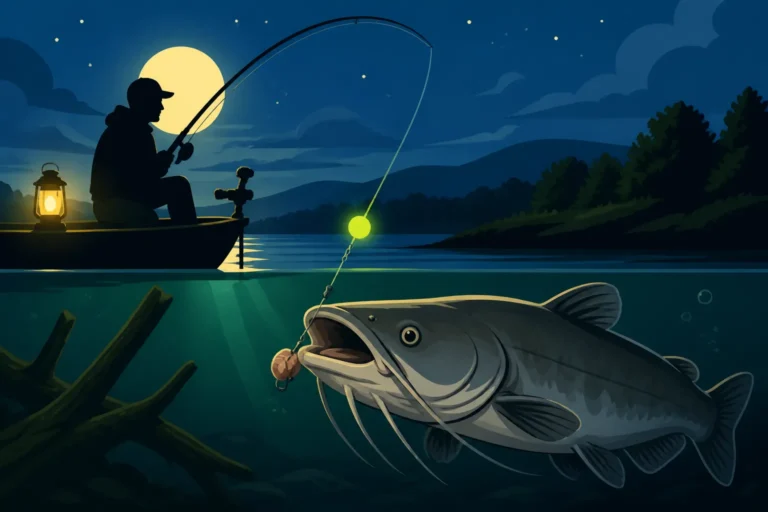
While daytime fishing can still be productive, especially if you can locate those deep-water hangouts, summer is undeniably prime time for night fishing. As the sun sets and temperatures drop, catfish move into shallower areas to feed under the cover of darkness. This is when channel cats will cruise flats and coves, and blue and flathead catfish will emerge from their deep-water sanctuaries to hunt along ledges, points, and even shorelines. For insights into where to cast your line after dark, our guide on Night Fishing Spots on Kentucky Lake, Tennessee might be a useful resource.
The reduced boat traffic and cooler temperatures also make night fishing a more pleasant experience for anglers. Using glow-in-the-dark baits or light-up bobbers can aid visibility. It’s a completely different atmosphere, and often, the biggest fish of the year are caught under the stars during these warm summer nights. Just remember to bring extra bug spray and a reliable headlamp!
Fall Feeding Frenzy Before Winter
As summer fades and autumn leaves begin to change, Tennessee's waters undergo another transformation, and with it, catfish behavior shifts once more. Fall is often considered one of the best times of year to target all three major catfish species, as they enter a "feeding frenzy" mode. Water temperatures start to cool, triggering an instinct to gorge themselves and build up fat reserves for the lean winter months ahead.
During early fall, you'll still find catfish in many of the same areas they occupied in late summer – deeper holes, river channels, and around structure. However, as the water continues to cool into the 60s, they become incredibly active and will often be found shallower than in the peak of summer, aggressively chasing baitfish. This is a fantastic time for both numbers of fish and trophy potential, as they are actively seeking out food. For example, the blues on Chickamauga Lake will be actively chasing shad schools.
Later in the fall, as temperatures drop further, catfish will start to transition back towards their deeper wintering grounds. However, they will still be actively feeding as long as the water isn't too cold. This transition period means you might find them moving back and forth between shallower feeding flats and deeper channels. Pay close attention to baitfish movements; where you find schools of shad, you'll often find hungry catfish right behind them, ready to take advantage of the easy meal.
Winter Slow and Deep Strategies
Winter catfishing in Tennessee can be challenging, but it's certainly not impossible, especially for channel and blue catfish. As water temperatures plummet, fish metabolism slows down significantly, and they become far less active. They typically congregate in large schools in the deepest, most stable water they can find, seeking thermal refuge from the cold. Look for them in the deepest parts of river channels, dam tailraces, power plant discharges (where water is warmer), and significant offshore holes in large reservoirs.
The key to winter success is a slow, methodical approach. Catfish aren't going to chase a fast-moving bait in cold water. Your presentation needs to be subtle, and your bait should stay in the strike zone for extended periods. Downsized baits and lighter tackle might even be effective for detecting the often very light bites. Fresh cut bait, especially shad, remains a top choice for blue cats, while stink baits can still tempt sluggish channel cats.
Patience becomes an even greater virtue in winter. You might go for long stretches without a bite, but when you do connect, it often means you've found a honey hole where a large school of fish is grouped up. Focus on detecting those faint taps and subtle line movements that indicate a curious catfish. While the bite might be slower, the rewards can be great, with anglers often finding large concentrations of fish in these deep winter sanctuaries.
Best Baits and Rigs for Tennessee Catfish
Choosing the right bait and rig for catfishing in Tennessee is less about a "secret weapon" and more about matching the hatch and understanding the specific preferences of the species you're targeting. What a channel catfish might find irresistible, a flathead might completely ignore. Let's break down the most effective options.
Natural Baits for Channel and Blue Catfish
When it comes to channel and blue catfish, your sense of smell is often as important as your visual presentation. These species rely heavily on their olfactory senses to locate food, making pungent, natural baits incredibly effective.
For channel catfish, a wide array of baits work wonders. Prepared stink baits, dough baits, chicken livers, and even hot dogs are classic choices. Catfish Charlie and Sonny's Super Sticky are popular brands of prepared baits you can find in most tackle shops. Chicken livers are particularly potent due to their strong scent and bloody nature, though they can be messy and prone to falling off the hook. Small pieces of cut bait, like shad or skipjack, are also excellent, especially in rivers. When using these baits, a simple treble hook (size 4-8) or a Kahle hook (size 1/0-3/0) with a slip-sinker rig works perfectly.
For blue catfish, fresh cut bait is king, especially in larger rivers and reservoirs like the Tennessee River or Kentucky Lake. Shad, skipjack herring, carp, and even smaller pieces of bluegill are all highly effective. The fresher the bait, the better. Many serious blue cat anglers will spend time catching baitfish with cast nets before setting out to fish for cats. The scent trail that fresh cut bait creates in the current is irresistible to blues. You'll want to use larger hooks (7/0-10/0 circle hooks) with a sturdy leader and a heavy slip-sinker rig to get your bait down and keep it there in the current. Using a glow bead above your hook can sometimes add an extra attractant, especially in murky or deep water.
Live Baits for Flathead Catfish
As we've discussed, flathead catfish are a different breed entirely. They are ambush predators and almost exclusively prefer live bait. Forget the stink bait; if it's not swimming and struggling, they're likely not interested.
The best live baits for flathead catfish in Tennessee include bluegill, sunfish, small drum, shad, and even bullheads, provided they are legal to use as bait in your area and within size regulations. Typically, baitfish ranging from 4 to 8 inches are ideal, as they are large enough to attract a trophy flathead but small enough to be easily swallowed. It's crucial to keep your baitfish alive and frisky. Use a livewell on your boat, or a bait bucket with an aerator if fishing from the bank, to ensure your bait stays active and appealing.
Rigging live bait for flatheads requires a stout hook (6/0-10/0 circle hook) inserted carefully through the back (above the lateral line, avoiding the spine) or through the lips of the baitfish. This allows the bait to swim naturally and stay alive longer. A heavy slip-sinker rig is common, but some anglers prefer a free-lining approach in slower currents or with suspended bait, letting the live fish swim around a bit more naturally. The key is to present the live bait in or very close to the flathead's preferred ambush points, such as submerged timber, logjams, or rock piles. Your goal is to make it look like an easy meal swimming right into their lair.
Popular Rig Setups
Beyond the choice of bait, the way you present it with your rig can make a significant difference. While the slip-sinker rig (Carolina Rig) is a workhorse for channel and blue cats, there are other variations and setups to consider.
Carolina Rig / Slip Sinker Rig: This is your bread and butter for most bottom fishing. As described earlier, the free-sliding sinker allows fish to take the bait without feeling immediate resistance, leading to more solid hook-sets. This rig is versatile for both still and flowing water and can be adapted with different sinker weights and leader lengths.
Three-Way Swivel Rig (Controlled Drift Rig): This rig is excellent for fishing in moderate currents or for presenting live bait for flatheads. It involves a three-way swivel, with your main line tied to one eye, a short dropper line (6-12 inches) with a sinker tied to another, and a longer leader (1-3 feet) with your hook and bait tied to the third. This setup keeps your bait slightly off the bottom and allows it to drift more naturally while keeping the sinker in contact with the bottom. It's especially useful for drifting downriver for blues.
Santee Cooper Rig: A variation of the Carolina Rig, the Santee Cooper rig incorporates a small float (often a peg float or cigar float) on the leader, just above the hook. This float lifts the bait slightly off the bottom, presenting it above snags and making it more visible to cruising catfish. It's particularly effective in areas with soft, muddy bottoms where your bait might otherwise sink into the muck, or over areas with low-lying cover. This rig is great for channel and blue catfish and is often used with cut bait.
Float Fishing Rig: While less common for the biggest cats, a traditional float (bobber) rig can be very effective for channel catfish in shallower ponds or slower-moving waters. It allows you to suspend your bait at a specific depth, which can be useful when fish are holding off the bottom or around submerged vegetation. This is often a great technique for beginners or when fishing with kids.
Mastering these rigs and understanding when to deploy each one, combined with the right bait for the target species, will dramatically improve your catfishing success across Tennessee.
Top Tennessee Catfish Hotspots and Environments
Tennessee is blessed with an abundance of diverse waterways, each offering unique opportunities for catfish anglers. Knowing where to go and what kind of environment to look for can drastically cut down on your searching time and put you on the fish faster. From the winding depths of our major rivers to the vast expanse of our reservoirs, there’s a catfish haven waiting for you. For a deeper dive into many prime locations, check out our guide on the Best Catfish Lakes in Tennessee.
Rivers and Tributaries Blue and Flathead Territory
Tennessee's major river systems, especially the Tennessee River, Cumberland River, and Mississippi River, are absolute goldmines for trophy blue and flathead catfish. These powerful waterways offer the deep channels, strong currents, and abundant cover that these larger species crave.
When fishing rivers, focus on key structural elements. Deep holes, especially those on the outside bends of the river, are prime real estate for big blues and flatheads seeking refuge from the current and waiting to ambush prey. Current breaks, such as behind islands, submerged rock piles, bridge pilings, or logjams, also act as magnet for catfish, providing a spot where they can rest out of the main current while still being close to the food highway. Tributary mouths, where smaller rivers or creeks flow into the main river, often bring in new food sources and create current seams that attract catfish. For more specific information on these riverine giants, refer to our Catfish Species Found in Tennessee Waters overview.
Bank anglers can find success in rivers by targeting accessible deep holes, eddies, and slack water areas near public access points. Boat anglers have the advantage of being able to explore main river channels, navigate around snags, and anchor in precise locations. Always remember the power of river currents; use heavy enough weights to hold your bait in place, and be mindful of boating safety.
Reservoirs and Lakes Channel and Blue Abundance
Tennessee is famous for its massive reservoirs, formed by damming rivers, which offer incredible catfishing opportunities, especially for channel and blue catfish. Lakes like Kentucky Lake, Chickamauga Lake, Watts Bar Lake, and Percy Priest Lake are renowned for their abundant catfish populations.
In these large impoundments, look for channel catfish on shallower flats, humps, and points, especially during the warmer months and pre-spawn periods. They will also congregate in old creek channels and around submerged timber. Blue catfish in reservoirs, while still favoring deeper water, will often relate to the main lake channel, ledges, and deep points. They frequently follow schools of baitfish, such as shad, so using your fish finder to locate bait can lead you directly to the blues. Our dedicated guide on Watts Bar Lake, Tennessee's Largest Lake for Fishing provides insights into one such productive reservoir.
Drifting baits across expansive flats or along deep ledges is a highly effective technique on these reservoirs, allowing you to cover a lot of water. Trolling with cut bait or live bait can also be productive for covering ground and finding active fish. Don't overlook the tailraces below the dams; the turbulent, oxygen-rich waters and abundant baitfish are often a magnet for large blue catfish.
Smaller Ponds and Creeks for Everyday Catfishing
While the big rivers and reservoirs get most of the glory, don't underestimate the excellent catfishing opportunities found in Tennessee's countless smaller farm ponds, community lakes, and medium-sized creeks. These waters are often teeming with channel catfish, providing fantastic action for anglers of all ages and skill levels, especially for family outings or a quick trip after work.
These smaller bodies of water are typically easier to access and navigate, making them perfect for bank fishing. Channel catfish in ponds and creeks will often relate to any available structure: submerged brush, weed lines, drop-offs, or even deeper holes where the creek bends. In these environments, simple tactics often work best. A basic bottom rig with chicken livers, stink bait, or worms can be incredibly effective.
Many of Tennessee's state parks and TWRA-managed lakes also offer excellent bank fishing for channel catfish, with some even having designated fishing piers. These spots are often stocked and are perfect for introducing kids to the joy of fishing. Remember, while you might not catch a 100-pound blue cat in a farm pond, the consistent action and the thrill of a good-sized channel cat pulling on your line are rewards enough. It's a testament to the widespread availability of catfish in Tennessee that you don't always need a giant boat and heavy tackle to have a successful day.
Night Fishing for Catfish in Tennessee
Night fishing for catfish isn't just a preference for many Tennessee anglers; it's often a highly strategic choice that yields some of the biggest and most memorable catches of the year. When the sun dips below the horizon, a different world awakens in our waterways, and catfish, especially the larger blues and flatheads, become incredibly active.
Why Night Fishing Excels for Catfish
There are several compelling reasons why night fishing is so effective for catfish. First and foremost, catfish are largely nocturnal feeders. Their highly developed senses of smell and touch (through their prominent whiskers, which are chemoreceptors) are perfectly adapted for hunting in low-light conditions. While other predatory fish like bass might retreat, catfish are just getting started. This inherent biological advantage makes them much more aggressive and willing to bite after dark.
Secondly, the cooler water temperatures at night, particularly during the hot Tennessee summer months, are far more comfortable for catfish. They move out of their deep-water daytime refuges into shallower feeding areas, making them more accessible to anglers. This means fish that might be sluggish and hard to find during the day suddenly become active and can be found closer to shorelines, points, and flats.
Finally, night fishing offers a quieter, less crowded experience on the water. The reduction in boat traffic and human activity often makes the fish less wary, leading to more confident bites. There’s a peaceful solitude that comes with fishing under the stars, broken only by the splash of a surfacing fish or the exhilarating tug of a big catfish on your line. It’s an experience that truly connects you with the natural rhythm of the water.
Setting Up for a Successful Night Trip
A successful night fishing trip requires a bit more preparation than a daytime outing. Lighting is crucial. A good headlamp with both white and red light settings is indispensable – white for rigging and unhooking, and red for preserving your night vision. Lanterns can illuminate your general fishing area, but be mindful not to spook the fish with excessive light directed onto the water.
Safety should always be your top priority. If fishing from a boat, ensure all navigation lights are working and that you have all required safety gear aboard, including life jackets for everyone. Inform someone of your plans and expected return time. On the bank, be aware of your surroundings, especially uneven terrain or potential hazards like snakes.
Your tackle setup should be organized and easily accessible in the dark. Pre-tie extra rigs, have your bait ready, and keep frequently used tools within reach. Rod holders are even more important at night, allowing you to set multiple lines and relax while waiting for a bite. Consider using glow-in-the-dark sinkers, beads, or even lighted bobbers to help you see your lines and detect bites. For blue and flathead catfish, you'll want to employ the same heavy-duty gear and baits you'd use during the day, focusing on fresh cut bait for blues and live bait for flatheads.
Safety Considerations After Dark
Beyond the basics, there are specific safety protocols to observe when fishing at night, especially on Tennessee's larger waterways. Visibility is severely reduced, which means navigating a boat can be much more challenging. Be extra vigilant for other boaters, floating debris, and submerged hazards. Always adhere to speed limits and operate your vessel cautiously.
Insect repellent is a must, as mosquitoes and other biting insects can be relentless after dark, especially near water. Dress in layers, as even summer nights can get cool, and prolonged exposure to damp conditions can make you uncomfortable. A small first-aid kit stocked with essentials for minor cuts, scrapes, and insect bites is also a wise addition to your gear.
If you’re fishing alone, ensure your phone is charged and accessible, and consider carrying a whistle or other signaling device. The beauty and tranquility of night fishing are undeniable, but respecting the darkness and prioritizing your safety will ensure your trips are not only productive but also enjoyable and free from incident. It's truly a unique way to experience Tennessee fishing, but one that demands a little extra mindfulness.
Regulations and Conservation for Tennessee Catfishing
Understanding Tennessee's fishing regulations isn't just about avoiding a fine; it's about being a responsible angler and contributing to the conservation of our incredible fishery resources. The Tennessee Wildlife Resources Agency (TWRA) sets these rules to ensure healthy fish populations for future generations to enjoy. Ignorance of the law is never an excuse, so let's make sure you're well-informed before your next catfishing adventure.
License Requirements and General Regulations
First and foremost, almost every angler needs a valid Tennessee fishing license. If you're 13 years of age or older, you'll need one to legally fish in public waters. There are various types of licenses available, from annual resident and nonresident licenses to specific short-term options. For example, a nonresident might opt for a Nonresident 3-Day and 10-Day License Options for Tennessee if they're just visiting, or a Tennessee resident might choose the general Tennessee Resident Combination Hunt and Fish License.
The licenses cover most freshwater fishing, but sometimes special permits are required for certain activities or specific species (though not typically for general catfishing). It’s always best to carry proof of your license while fishing, whether it's a physical copy or a digital one on your phone. Game wardens can and will check licenses on the water or at access points. Penalties for fishing without a license in Tennessee can include significant fines and even confiscation of gear, which is a headache nobody wants. For a comprehensive overview, our Tennessee Fishing License Guide is an invaluable resource.
Beyond licensing, there are general regulations that apply to all fishing activities. These include rules on the number of rods you can use (typically three rods per angler, but check current regulations), how you can mark trotlines or jug lines, and rules against littering. Always practice good stewardship of our natural resources. Pack out what you pack in, and dispose of any trash responsibly.
Species-Specific Limits and Rules
While catfish are generally managed with relatively generous limits, it's still crucial to be aware of any species-specific regulations that might apply. For instance, while channel catfish often have no statewide length limits and a daily creel limit of 10, blue catfish and flathead catfish might have different rules depending on the specific body of water you're fishing.
For example, on many of our major reservoirs and rivers, blue catfish might have a daily limit of 10 fish, but only one of those fish can be over a certain length (e.g., 34 inches). This is a conservation measure designed to protect the trophy-sized breeding stock of these impressive fish. Flathead catfish often have a lower daily limit, sometimes as low as 5 fish, with similar size restrictions in certain areas. These lake-specific rules often override the statewide defaults, so always check the latest TWRA fishing guide for the particular body of water you plan to fish.
These regulations can change, so it's always wise to consult the most current TWRA Fishing Guide, which is updated annually. You can find it online on the TWRA website or pick up a physical copy at most license vendors and sporting goods stores. These rules are in place for a reason: to ensure that the thrill of catching a giant blue cat or a feisty channel cat remains a possibility for generations to come.
Boating Safety and Courtesy
For those fishing from a boat, adhering to Tennessee's boating safety regulations is as important as following fishing rules. This ensures not only your safety but also the safety of others on the water. All boats are required to carry certain safety equipment, including US Coast Guard-approved life jackets for every person on board, and throwable flotation devices for boats 16 feet or longer. Children under the age of 12 are required to wear a life jacket whenever a boat is underway.
Operating a boat under the influence of alcohol or drugs is strictly prohibited and carries severe penalties. Boating education is also mandatory for anyone born after January 1, 1989, to operate a boat with an engine of 10 horsepower or more. Earning your Tennessee Boating Safety Education Certificate Guide is a smart move for any new boater.
Practicing courtesy on the water is also paramount. Give other anglers and boaters plenty of space, especially when approaching someone who is fishing. Avoid excessive noise or creating large wakes near smaller boats or areas where people are swimming or bank fishing. Our waterways are shared resources, and a little common courtesy goes a long way in ensuring everyone can enjoy their time responsibly and safely.
Disclaimer
Please remember that fishing regulations and conditions can change. Always consult the latest Tennessee Wildlife Resources Agency (TWRA) regulations guide before heading out on the water. The information provided in this article is for general guidance and informational purposes only and does not constitute legal advice.