Freshwater Fish Identification Guide for Anglers
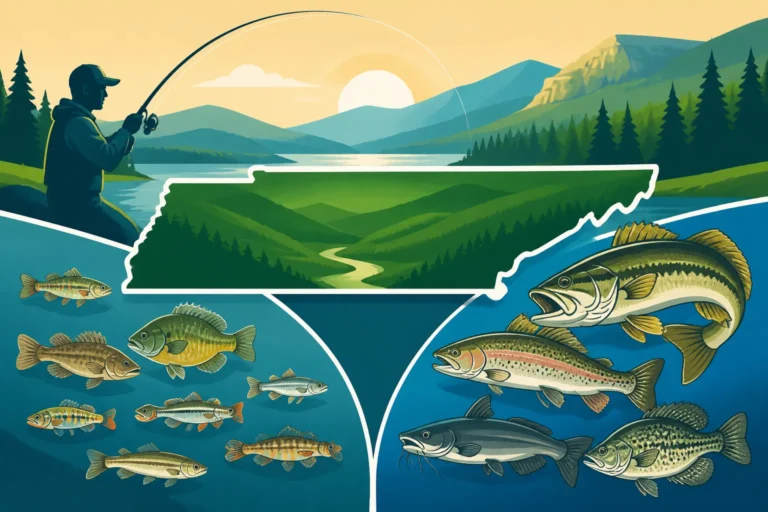
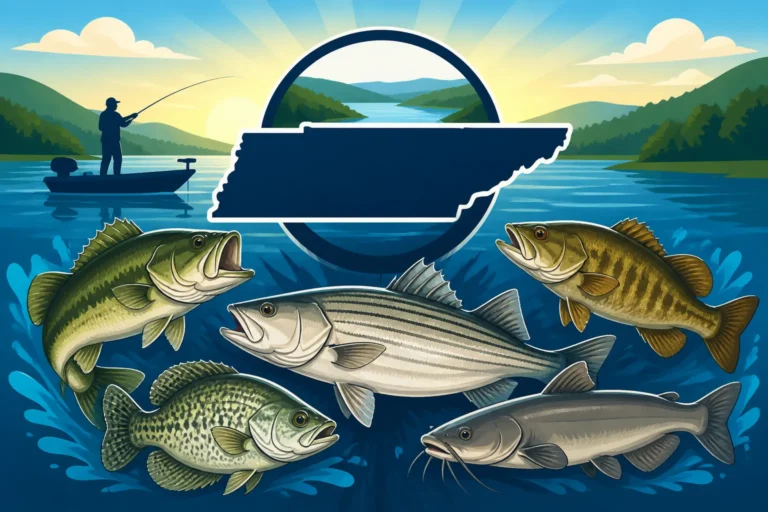
It can be incredibly frustrating to reel in a beautiful fish on a Tennessee lake or river, only to stare at it, scratching your head, wondering "What is this, exactly?" With the sheer diversity of fish swimming in our beautiful Volunteer State waters, it's easy to get confused. This comprehensive guide is designed to help you confidently identify the most common freshwater fish species you'll encounter as an angler in Tennessee, so you know exactly what you've caught.
The Mighty Bass Family: Kings of Tennessee Waters
When you think of fishing in Tennessee, chances are bass are one of the first fish that come to mind. These powerful, aggressive game fish are incredibly popular, but distinguishing between the different species can be a bit tricky, especially for newer anglers. They often share similar habitats and fighting styles, yet their markings and physical characteristics offer clear clues once you know what to look for.
Largemouth Bass: The Classic Green Monster
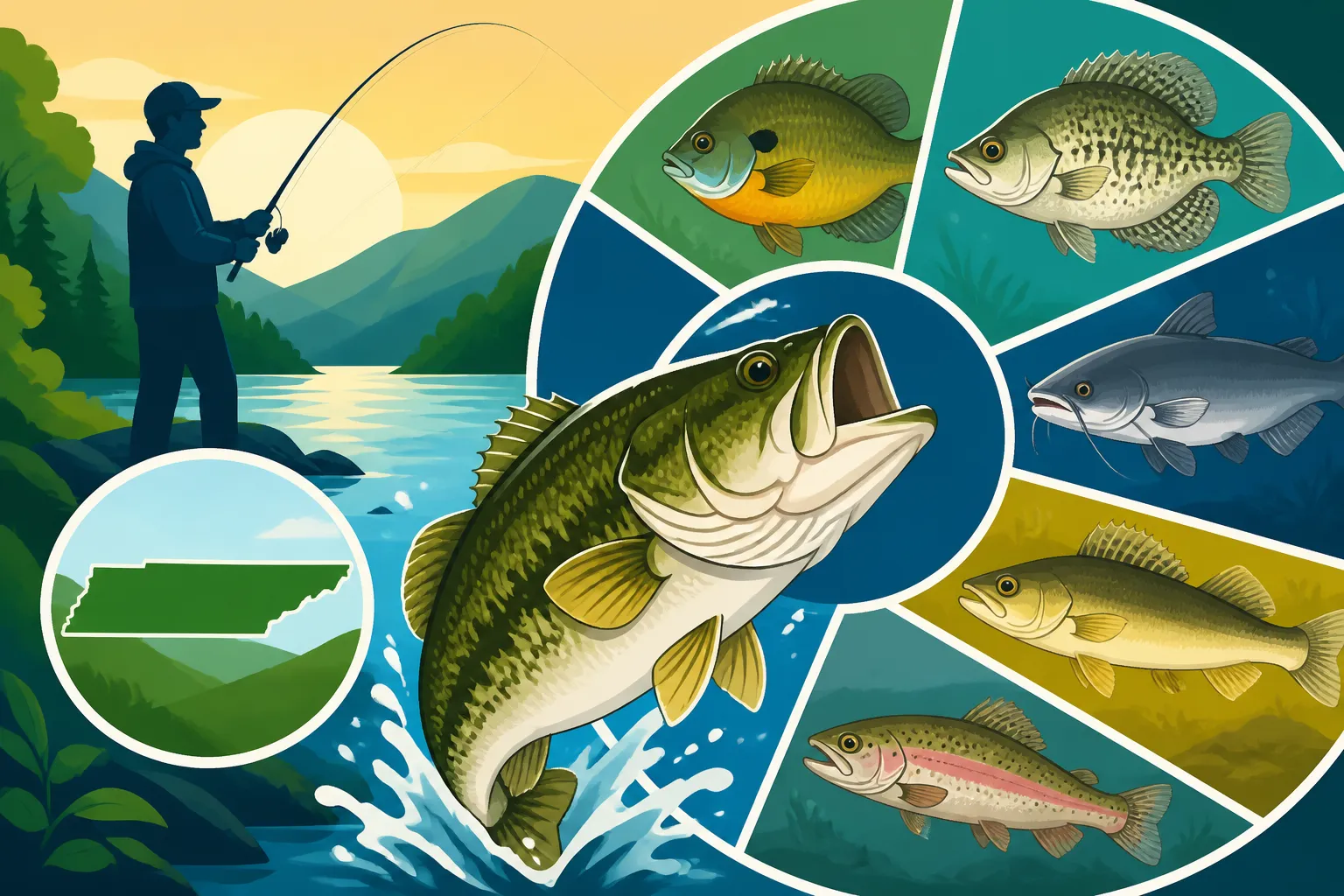
The largemouth bass is arguably the most iconic freshwater sport fish in North America, and it thrives in Tennessee's warmer, often nutrient-rich waters. You'll find them in abundance in lakes like Chickamauga, Kentucky Lake, and Percy Priest. Identifying a largemouth usually comes down to its mouth: when closed, the hinge of its jaw extends well past the back of its eye. This is the most distinct telltale sign.
Beyond the mouth, largemouth bass typically have a dark, jagged lateral line running horizontally along their greenish-gold bodies. This line can sometimes look like a series of blotches rather than a solid stripe, especially in clearer waters where their camouflage needs to be more intricate. Their overall body shape tends to be more robust and football-like compared to some of their slimmer cousins. Keep an eye out for that distinct dark lateral line and that ridiculously large mouth; if you can fit your thumb in there comfortably, you've likely got a largemouth.
Their preferred habitat also provides clues. Largemouth bass love structure – submerged timber, weed beds, lily pads, docks, and brush piles are all prime real estate for them. They're ambush predators, so they prefer areas where they can hide and dart out to strike unsuspecting prey. Understanding Tennessee Bass Fishing Seasons and Patterns can help you predict where these green monsters will be throughout the year.
Smallmouth Bass: The Brown Bomber of Rivers
Often called "brown bass" or "bronzebacks," smallmouth bass are Tennessee's official state fish for a reason. They're incredible fighters, pound-for-pound, and are typically found in cooler, clearer waters, especially in rocky rivers and reservoirs with deep, expansive main lake points. Dale Hollow Lake is legendary for its smallmouth population. Their distinguishing feature, as their name suggests, is their mouth: when closed, the jaw hinge typically does not extend past the back of the eye.
Smallmouth bass also have a different coloration and pattern. They usually range from a golden-brown to a dark bronze, often with vertical bars or blotches along their sides, rather than a distinct horizontal lateral line like the largemouth. Their eyes can often appear reddish. Their body is usually more streamlined and torpedo-shaped, built for navigating current and rock structures.
These feisty fish prefer rocky bottoms, current breaks, and bluff walls in rivers, and deep, clear reservoir main lake points and humps. They're less likely to be found buried deep in dense weeds or lily pads. If you're fishing a clear, rocky river like the Cumberland or Clinch, or a deep reservoir like Norris Lake, you're much more likely to encounter a smallmouth. Always be ready for a powerful fight when you hook into one of these bronze beauties, as they're known for their acrobatic jumps and strong runs.
Spotted Bass: The Often-Confused Cousin
The spotted bass is the "middle child" of the Tennessee bass family, often mistaken for either a largemouth or a smallmouth. They share characteristics with both, which can make identification a real head-scratcher. However, there are a few key features that set them apart. Their mouth size is intermediate: the jaw hinge typically extends to or slightly past the eye, but usually not as far back as a largemouth.
The most reliable identifying mark for a spotted bass is the patch of small, rough scales on its tongue. If you can get a finger in its mouth (carefully!), you'll feel a distinct "sandpaper" patch. Additionally, they often have rows of dark spots below their lateral line, which is usually more defined than a largemouth's, but not as mottled as a smallmouth's. Their body shape is generally slimmer than a largemouth but a bit more robust than a smallmouth.
Spotted bass are found in many of the same waters as largemouth, especially in reservoirs, but they tend to prefer deeper, clearer sections and rockier areas than a typical largemouth. They are more adaptable to current than largemouth bass, making them common in areas influenced by river flow within reservoirs. Understanding Spotted Bass vs Largemouth Bass in Tennessee Lakes is crucial for correct identification and adherence to local regulations.
Redeye Bass: A Lesser-Known Gem
While not as widespread or well-known as their larger cousins, the redeye bass (also sometimes called Coosa bass in other regions) is a true Tennessee native, particularly found in cooler, clear, flowing streams in the eastern parts of the state. They're smaller than largemouth or smallmouth, rarely exceeding a few pounds, but what they lack in size, they make up for in beauty and fight.
Their most distinctive feature is, you guessed it, their bright red eye. This striking characteristic immediately sets them apart. They also have a dark, pronounced lateral stripe along their sides, usually with some vertical bars or blotches, and often have blue-green mottling on their lower jaw. Their body shape is stout and robust, built for stream life. Unlike spotted bass, they do not have a patch of teeth on their tongue.
Redeye bass thrive in swift-moving, clear, cool streams with rocky bottoms and plenty of submerged wood or undercut banks for cover. They are a true stream specialist, rarely found in large reservoirs. Catching a redeye is often a special treat for stream anglers, as they offer a spirited fight on light tackle. If you're exploring the more pristine, flowing waters of East Tennessee, keep an eye out for that fiery red eye! You can learn more about Redeye Bass Identification and Habitat if you plan to target them.
Crappie and Panfish: The Delicious Darlings
Tennessee's waters are teeming with panfish, offering fantastic opportunities for anglers of all ages and skill levels. These smaller, schooling fish are renowned for their delicious table fare and are often a gateway for new anglers. Identifying them correctly can help you understand their patterns and improve your catch rate.
Black Crappie: The Speckled Beauty
Black crappie are a beloved panfish across Tennessee, known for their distinctive speckled appearance and propensity to school up, making for exciting fishing. Their most reliable identification feature is the number of dorsal spines: black crappie will have 7 or 8 distinct spines in their dorsal fin. They also tend to have a more scattered, pepper-like speckling all over their silvery-green or olive bodies, with no distinct vertical bands.
Their bodies are typically deeper and more compressed laterally than many other panfish, giving them a "plate-like" appearance. The mouth is relatively large for a panfish, extending to or slightly beyond the front of the eye. Black crappie are often found in clearer, cooler water than white crappie, preferring areas with abundant aquatic vegetation, submerged timber, and brush piles, especially around creek channels and main lake points in reservoirs like Chickamauga Lake or Norris Lake.
They are fantastic targets for jigging and often respond well to small jigs and minnows. When you find a school, you can often catch them one after another, which makes for a memorable outing. Black Crappie Stocking by TWRA in Tennessee efforts help maintain healthy populations throughout the state.
White Crappie: The Striped Relative
White crappie are the other half of the crappie duo in Tennessee and are often found alongside their black crappie cousins, though they tend to tolerate slightly murkier water and slower current. The key to identifying a white crappie lies in its dorsal spines and body pattern: they typically have 5 or 6 dorsal spines, fewer than the black crappie. More distinctly, white crappie usually have several dark, vertical bars or stripes along their silvery-white to yellowish bodies, rather than the scattered speckles of the black crappie.
Their bodies are usually a bit more elongated than a black crappie, but still deeply compressed. The mouth is similar in size to the black crappie. You'll often find white crappie in warmer, shallower areas of reservoirs and large rivers, congregating around submerged brush, stump fields, and dock pilings. They're particularly prevalent in riverine sections of large reservoirs like Kentucky Lake and Watts Bar.
Like black crappie, they are highly sought after for their delicious meat and provide excellent angling opportunities. Small jigs, minnows, and tiny crankbaits are all effective. Knowing the differences helps not only with identification but also understanding subtle differences in their preferred habitats. Fishing for them during the Spring Crappie Spawn Timing in Tennessee can be incredibly productive.
Bluegill: The Backyard Pond Favorite
Ah, the humble bluegill! This vibrant little panfish is a staple for beginner anglers and seasoned pros alike, known for its tenacious fight on ultralight tackle and its delicious fillets. Bluegill are easily recognized by the prominent black spot on the posterior edge of their gill cover, which gives them their name. They also typically have a small, dark spot at the base of their dorsal fin.
Their coloration can vary wildly depending on water clarity and habitat, ranging from olive-green to dark blue, often with vertical bars on their sides. The males, especially during spawning, can develop brilliant orange-red bellies and brighter blue highlights around their operculum. Their body is round and compressed, almost like a dinner plate. The mouth is quite small, reflecting their diet of insects and small invertebrates.
Bluegill are found virtually everywhere in Tennessee: ponds, lakes, rivers, and streams. They prefer areas with some vegetation, rocky bottoms, or submerged structures, often in shallower water. They're incredibly aggressive feeders and will readily strike small worms, crickets, corn, or tiny artificial lures. They are a fantastic fish to introduce kids to fishing, offering constant action. You can find Bluegill Fishing Tips for Kids in Tennessee that will make your family outings even more successful.
Redear Sunfish (Shellcracker): The Snail Crusher
Often confused with bluegill, the redear sunfish has a similar body shape but a few distinct features that set it apart. The most obvious, and the source of their common name "redear," is the prominent red or orange spot on the opercular (gill) flap, which is usually edged in black. Unlike bluegill, they lack the distinct black spot on the dorsal fin base and don't typically have the blue "ear" flap.
Their coloration is generally olive-green to yellowish-brown on the sides, often with faint vertical bars, and a lighter belly. Their mouth is small, and their most unique feature is the set of specialized molars (pharyngeal teeth) in their throat, which they use to crush the shells of snails, their primary food source. This gives them their "shellcracker" nickname.
Redear sunfish prefer clear, calm waters with abundant aquatic vegetation and soft bottoms where snails are prevalent. You'll often find them cruising the bottom in shallow bays or along weed lines in reservoirs and ponds. They're not as eager to strike a moving lure as bluegill and are typically caught with bait fished directly on the bottom, such as worms or small pieces of shrimp. Targeting these specialized eaters can be a fun challenge.
Catfish: Whiskered Wonders of the Depths
Tennessee is a haven for catfish anglers, offering some of the best opportunities to land whiskered giants. These powerful bottom dwellers are not only excellent table fare but also provide thrilling battles. Identifying the different species is key to understanding their behavior and where to find them.
Channel Catfish: Tennessee's Official State Fish
The channel catfish shares the honor of being one of Tennessee's official state fish, a testament to its popularity and widespread distribution. They are arguably the most commonly caught catfish species in the state. Key identifiers include a deeply forked tail, a relatively small head compared to its body, and a smooth, scaleless body that is typically olive, brown, or blue-gray on top, fading to white on the belly. Younger channel cats often have distinct dark spots along their sides, which tend to fade as they age. They possess barbels (whiskers) around their mouth.
Channel catfish are incredibly adaptable and can be found in a wide variety of habitats, from large rivers and reservoirs to smaller streams and ponds. They prefer slower-moving water, deeper holes, and areas with submerged cover, but will also cruise shallower flats in search of food. They're opportunistic feeders, readily taking a wide array of baits from cut bait, stink bait, worms, and even some artificial lures.
These prolific fish are a fantastic target for anglers seeking both action and a tasty meal. Their abundance and willingness to bite make them a favorite for family fishing trips. Learning How to Identify Channel Catfish, Tennessee's Other State Fish can help you distinguish them from other whiskered species.
Blue Catfish: The River Giants
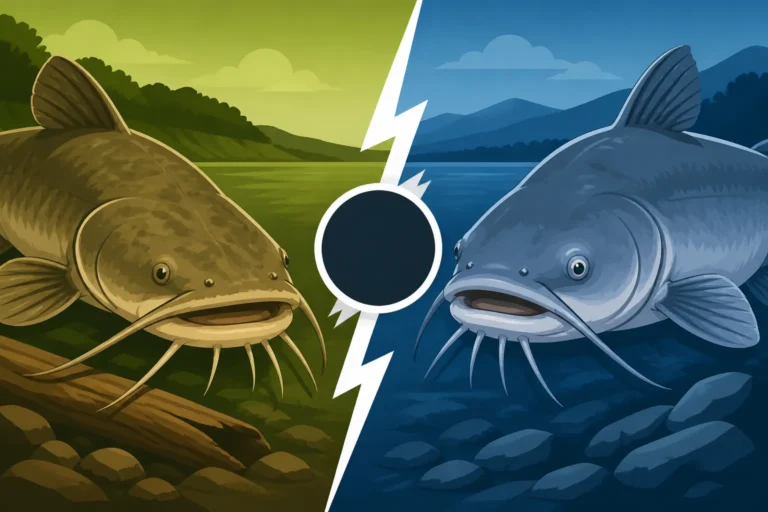
If you're looking to wrestle a true leviathan, the blue catfish is your target. These are the largest catfish species in Tennessee, known for reaching immense sizes and putting up incredible fights. Their most distinct features are their un-forked (or only slightly forked) tail, a slate blue to gray body color with no spots (even when young), and a humped back when mature. Their head is also proportionally smaller than a flathead catfish.
Blue cats thrive in large river systems and major reservoirs with strong current and deep channels, such as the Tennessee River system, including Kentucky Lake, Chickamauga, and Watts Bar. They are often found in deep holes, along ledges, and near current breaks. They are primarily piscivorous, meaning they eat other fish, so fresh cut bait (shad, skipjack herring) is often the most effective.
Landing a trophy blue catfish is a monumental achievement for any angler. Their sheer power and size demand stout tackle and patience. Many anglers use heavy-duty catfish rods and reels, some of which you can find on platforms like Amazon, specifically designed for these giants. Knowing Where to Catch Trophy Blue Catfish in Tennessee is half the battle.
Flathead Catfish: The Ambush Predator
The flathead catfish is a unique and formidable predator, often identified by its distinctively flat, broad head (hence the name) and prominent lower jaw that protrudes beyond the upper jaw. Unlike channel and blue cats, the flathead has a rounded, non-forked tail. Their body coloration is usually mottled yellow-brown to olive, with darker blotches, providing excellent camouflage against logs and rocky bottoms. They have relatively small, beady eyes.
Flathead catfish are solitary, ambush predators that prefer live bait. They typically inhabit slow-moving rivers, large creek channels, and reservoirs, often associating with heavy cover like submerged logs, rock piles, or undercut banks. They're less prone to schooling than blue or channel cats and often hold tight to structure, waiting for prey to come by.
Catching a flathead often requires live bait such as bluegill, sunfish, or large shiners, fished directly into their lairs. The patience and specific techniques required to target flatheads make them a challenge that many experienced catfish anglers relish. If you're looking for a truly unique catfishing experience, understanding Flathead Catfish Habitat in Tennessee Rivers is essential.
Trout Species: Cold-Water Jewels
Tennessee's cold-water streams and tailwaters offer fantastic trout fishing, particularly in the eastern part of the state. While often grouped, there are distinct differences between the rainbow, brown, and brook trout that inhabit these pristine waters.
Rainbow Trout: The Colorful Stocker
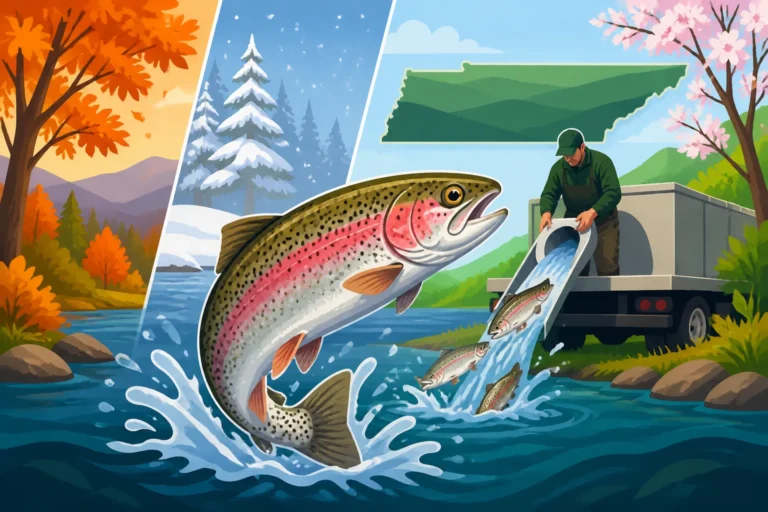
Rainbow trout are perhaps the most widely recognized trout species in Tennessee, largely due to extensive stocking programs by the Tennessee Wildlife Resources Agency (TWRA) in suitable streams and tailwaters. Their most defining feature is the prominent, iridescent pink or red stripe running horizontally along their sides, often accompanied by numerous small black spots on their body, dorsal fin, and tail. Their backs are typically olive-green, fading to silvery sides and a white belly.
These beautiful fish are known for their acrobatic jumps when hooked and their willingness to strike a variety of baits and lures. You'll find them in abundance in tailwaters below dams, such as the Caney Fork River, and in many mountain streams, particularly after stockings. They thrive in oxygen-rich, cool water.
Rainbow trout are a fantastic target for fly anglers, spin fishermen, and bait fishermen alike. Their vibrant colors and strong fight make them a joy to catch. Learn more about Rainbow Trout Stocking Schedule Across Tennessee to know where and when to find them.
Brown Trout: The Wary European Import
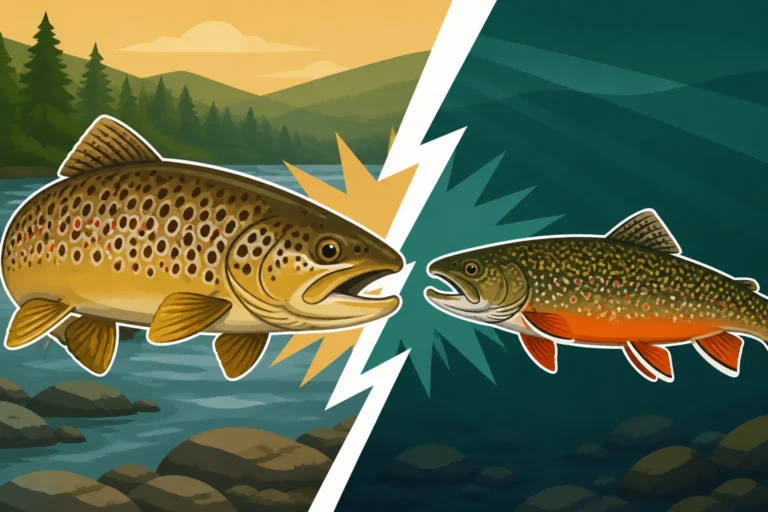
Brown trout are another popular species in Tennessee's trout waters, known for their wariness and often impressive size. They are identifiable by their brownish-gold or olive-brown bodies, which are covered in distinct dark spots with pale halos (like a target) and often some red or orange spots, particularly along their sides. Unlike rainbows, brown trout typically have few or no spots on their tail fin, which can sometimes appear square or slightly forked.
These trout are much more elusive than rainbows and are highly regarded for their challenging nature. They can grow very large in Tennessee's tailwaters, becoming powerful predators. They are less tolerant of warmer water than rainbows and prefer deep, cool pools and undercut banks.
Brown trout often require more subtle approaches, especially from fly anglers, but can also be caught on lures and bait. Landing a large brown trout is considered a significant achievement among Tennessee's trout enthusiasts. Knowing Brown Trout vs Rainbow Trout: Key Differences helps with proper identification.
Brook Trout: Tennessee's Native Treasure
The brook trout holds a special place in the hearts of Tennessee anglers, as it is the only trout species native to the state. These vibrant, smaller trout are typically found in the highest, coldest, and most pristine mountain streams, often in remote, difficult-to-access areas.
Brook trout are stunningly beautiful, identifiable by their dark, worm-like markings (vermiculations) on an olive-green to dark brown back, and distinctive red and blue spots (often with light halos) along their sides. Their lower fins are usually orange or red, tipped with a white leading edge, often called "parr marks" or "leading edges." Their belly can be white or a striking orange-red, especially in spawning males. Their tail is square.
These fish are an indicator of exceptionally clean, cold water and healthy ecosystems. Because of their sensitivity and limited habitat, they are often protected by special regulations, including catch-and-release only or strict catch limits. Catching a native brook trout in its wild mountain stream habitat is a truly unique Tennessee experience. Anglers often use ultralight gear or fly fish with small dry flies or nymphs. Learn more about Brook Trout in Tennessee's Cold-Water Streams for conservation efforts.
Striped Bass and Hybrids: The Powerful Fighters
Tennessee's large reservoirs are home to some incredibly powerful and exciting game fish: striped bass and their hybrid cousins. These fish are known for their incredible fighting ability and schooling behavior, making them a popular target for many anglers.
Striped Bass: The Ocean Migrant
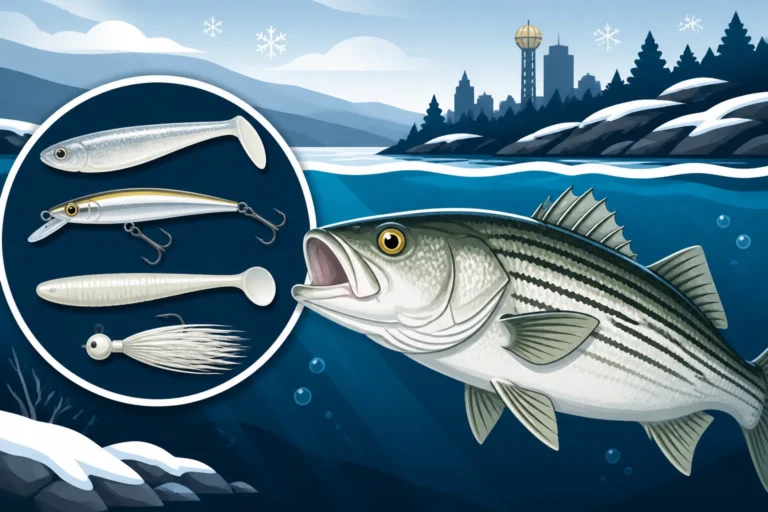
Naturally, striped bass are saltwater fish, but they thrive in many of Tennessee's landlocked reservoirs, where they are maintained through stocking programs. They are easily identified by their sleek, silver bodies with distinct, dark, unbroken horizontal stripes running from head to tail. These stripes are typically very clean and evenly spaced. Their body is generally longer and more cylindrical than the hybrid striped bass.
Stripers are powerful, open-water predators that school extensively and chase baitfish, primarily shad. You'll find them in large reservoirs with abundant bait, such as Norris Lake, Watts Bar, and Percy Priest. They prefer deeper, cooler water in the summer and can be found near the surface in cooler months, especially during early morning and late evening.
Catching a true striped bass often requires heavy tackle and specialized techniques like trolling large plugs, live baiting with shad, or casting big spoons and swimbaits into schooling fish. Their explosive runs are legendary. Discover Striped Bass Fishing in Tennessee Reservoirs for optimal techniques.
Hybrid Striped Bass: The Pound-for-Pound Fighter
Hybrid striped bass, often called "wipers," are a cross between a striped bass and a white bass. They are stocked in many Tennessee reservoirs to provide a fast-growing, hard-fighting sport fish. Identifying them can be tricky because they look very similar to true striped bass, but there are key differences. The stripes on a hybrid are typically broken or interrupted, especially below the lateral line, and they often appear blotchy or less uniform compared to the clean, unbroken lines of a pure striper.
Hybrids generally have a deeper, more football-shaped body than a pure striper, and their overall size is usually smaller than the maximum size of a true striped bass, though they still grow quite large. They share the aggressive, schooling nature of their parents, relentlessly chasing baitfish.
You'll find hybrid striped bass in many of the same waters as pure stripers, and they respond well to similar techniques, including trolling, casting spoons, and live bait. They are considered by many to be one of the strongest fighting fish pound-for-pound in Tennessee. When in doubt, check the stripes – broken means hybrid!
Understanding Key Identification Features
Beyond the obvious color patterns and mouth shapes, there are some universal anatomical features that can help you precisely identify a fish and solidify your understanding. Paying attention to these subtle cues can make all the difference, especially when regulations depend on species.
Fins and Spines: Counting for Clarity
One of the most scientific ways to identify fish, especially closely related species, is by counting their fin rays and spines. While this might sound daunting, it's often simpler than it seems and provides definitive answers. For example, we noted earlier that black crappie typically have 7 or 8 dorsal spines, while white crappie have 5 or 6. This is a consistent and reliable differentiator. Similarly, the number of anal fin rays can distinguish between species that look otherwise similar.
Take a moment to gently examine the fish's fins. The dorsal fin (on the back), pectoral fins (behind the gills), pelvic fins (on the belly, usually below or behind pectorals), and anal fin (on the belly, behind the anus) all offer clues. Are they soft and flexible (rays) or stiff and sharp (spines)? Do they have a distinct shape or color? For trout, the adipose fin (a small, fleshy fin without rays between the dorsal and tail) is a key characteristic. Having a good fish identification guide, perhaps one you can reference quickly on your phone or a laminated version from Amazon in your tackle box, is always a smart move.
Sometimes, the shape of the caudal (tail) fin is also a big clue. Is it deeply forked like a channel catfish, slightly forked like a rainbow trout, or rounded like a flathead catfish or brook trout? These small anatomical details are often the most accurate way to confirm an identification, especially when visual patterns are ambiguous due to water conditions or individual variation.
Lateral Line and Scales: Nature's Fingerprints
The lateral line is a sensory organ visible as a faint or distinct line running horizontally along the side of most fish, from the gill plate to the tail. It helps fish detect vibrations and pressure changes in the water. For identification, its prominence and pattern can be very useful. For instance, the largely unbroken, distinct dark lateral line on a largemouth bass is a key feature, contrasting with the more blotchy or vertically barred patterns of smallmouth bass.
Scale patterns and types can also be indicators, though they are usually harder for the casual angler to discern quickly. Are the scales large or small? Are they cycloid (smooth-edged) or ctenoid (toothed-edged)? Some fish, like catfish, are entirely scaleless, which is a major identification point in itself! While you might not be counting scales on every fish, observing the texture and pattern of the scales, or lack thereof, can contribute to your overall identification.
Also, pay attention to the overall body texture and slime coat. Some fish, like trout, have a very fine, smooth scale pattern and a distinct slime coat. Catfish, being scaleless, have a very slick, smooth skin. These tactile clues, combined with visual observations, create a more complete picture for accurate identification.
Mouth and Jaw Structure: What They Eat Tells a Story
A fish's mouth is a window into its diet and feeding habits, and thus, a critical identification feature. We've already touched on the obvious difference between a largemouth and a smallmouth bass. But there's more to it. Does the upper jaw protrude, or does the lower jaw? This is known as being "superior" (lower jaw protrudes, good for feeding on the surface) or "inferior" (upper jaw protrudes, good for feeding on the bottom). A flathead catfish, with its protruding lower jaw, is clearly designed for engulfing prey from above.
Consider the teeth as well. Are they sharp and conical, like a striped bass, indicating a piscivorous (fish-eating) predator? Are they small and numerous, like a crappie, perfect for gulping down small insects and minnows? Or are they specialized, like the crushing molars of a redear sunfish? While you won't be performing a full dental exam, a quick glance inside the mouth, especially for species like the spotted bass with its tongue patch, can provide immediate confirmation.
Even the overall shape of the head and how the mouth is positioned plays a role. A trout's terminal (front-facing) mouth is versatile for catching food in current, while a bluegill's small, upturned mouth is perfect for nibbling insects off vegetation. These characteristics, when combined with other features, help paint a clear picture of the fish in hand.
Why Accurate Identification Matters
Beyond satisfying your curiosity, knowing precisely what fish you've caught in Tennessee is incredibly important for several practical and ethical reasons. It ensures you're fishing responsibly, adhering to regulations, and contributing to the conservation of our precious aquatic resources.
Adhering to Size and Creel Limits
Perhaps the most immediate and critical reason for accurate identification is compliance with Tennessee's fishing regulations. Almost every species has specific size limits (minimum or maximum length) and creel limits (the number of fish you can keep per day). These limits are designed to protect fish populations, ensure sustainable fishing, and provide quality angling experiences for everyone.
Imagine you've caught several bass, but you're not sure if they're largemouth or spotted bass. If the limits differ, you could inadvertently be over your daily creel limit for one species while being under for another. Or you might keep a fish that's undersized for its species. Game wardens are out there to enforce these rules, and "I didn't know what it was" isn't a valid excuse. Taking the time to properly identify your catch ensures you're fishing legally and responsibly. Having a physical copy of the Tennessee Fishing Rules Every Angler Should Know or the TWRA app readily available on your phone is highly recommended.
It's not just about avoiding penalties; it's about being a good steward of the resource. These regulations are based on scientific data to maintain healthy fish populations. By correctly identifying and abiding by the rules, you're directly contributing to the future of fishing in Tennessee.
Understanding Habitat and Behavior
Accurate fish identification deepens your understanding of the aquatic world. Once you know what a fish is, you can start to learn about its preferred habitat, what it eats, when it spawns, and how it behaves. This knowledge isn't just academic; it makes you a much better angler!
For example, if you consistently catch smallmouth bass in a particular clear, rocky section of a river, you'll start to recognize similar spots elsewhere as prime smallmouth territory. Conversely, if you're targeting largemouth and only finding smallmouth, your identification skills tell you that you might need to move to an area with more weed beds or submerged timber. Understanding Tennessee's Best Trout Streams often comes down to knowing which species thrive in colder, higher elevation waters versus tailwaters.
Knowing the species also informs your bait and lure selection. If you've identified a school of bluegill, you know small worms or crickets will likely be effective. For trophy blue catfish, you'll reach for that fresh cut bait. This link between identification and practical fishing knowledge is invaluable for improving your success and making your time on the water more productive and enjoyable.
Contributing to Conservation Efforts
Finally, accurate fish identification plays a vital role in broader conservation efforts. Wildlife agencies like TWRA rely on angler participation and reporting to monitor fish populations and manage our fisheries effectively. Sometimes, you might catch a rare or unusual species, or a fish that's part of a special research program. Correctly identifying and, if required, reporting these catches contributes valuable data to scientists.
Beyond formal reporting, simply having an educated angling community fosters a culture of stewardship. When anglers understand the various species, their needs, and their vulnerabilities, they are more likely to support conservation initiatives, practice catch and release for certain species, and advocate for healthy aquatic environments. Every time you correctly identify a fish and adhere to its specific regulations, you're doing your part to ensure that Tennessee's diverse and vibrant fisheries remain healthy for generations to come. It’s all part of the larger picture of appreciating Tennessee's 291 Native Fish Species and 52 Sport Fish Explained.
Disclaimer
This article is for general informational purposes only and does not constitute professional advice. Laws, prices and regulations vary by location and change over time. Consult a qualified professional for guidance on your specific situation.